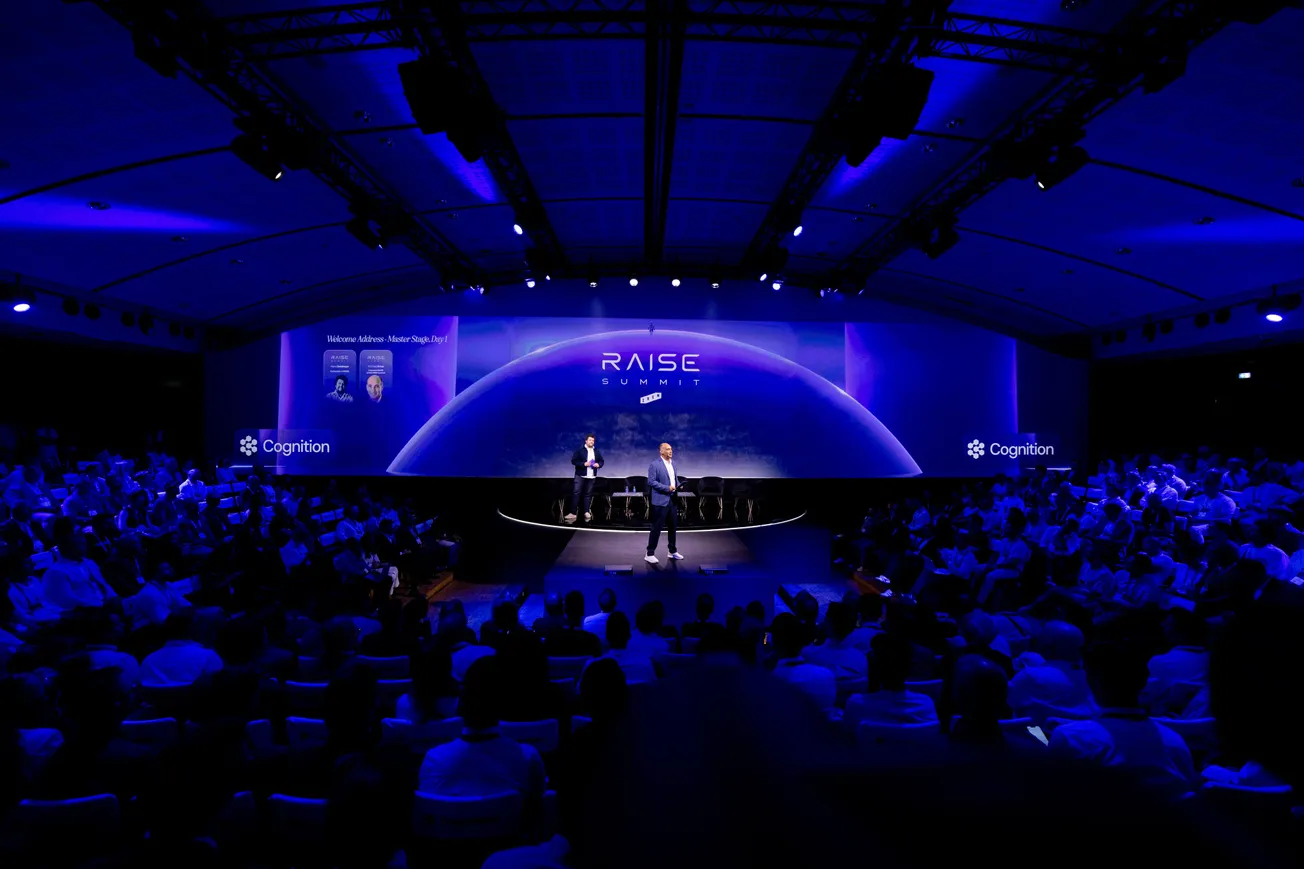
Despite the general hand-wringing about the ROI of AI or runaway token budgets, nobody gathered at the 3rd edition of Raise Summit in Paris last week seemed to be asking whether AI works.
The 9,000 people who packed into the Carrousel du Louvre on July 8 and 9 had moved on to a grubbier, more practical question: can anyone actually build enough power, chips, data centers, and networks to keep up with demand?
The event placed a heavy focus on infrastructure, both as an opportunity and a barrier to realizing AI's potential. For this crowd of insiders, the clear consensus was that AI had moved from demos and vibes to megawatts and buildouts.
President Emmanuel Macron opened the event with a video address pitching France as an AI leader and pressing the case that Europe needs its own AI infrastructure in an age of geopolitical division. From there, the agenda could have almost doubled as a construction roadmap: energy, chips, data centers, networking, storage, inference, security, and only then the applications sitting on top.
"AI is the steel of our generation," said Grant Lee, CEO of AI design startup Gamma. "The question is who turns this general-purpose technology into purpose-built technology."
$20 billion and a race against the clock
The conference wasn't necessarily about breaking news. But one of the bigger headlines that echoed the core theme came from OpenAI and Cerebras.
Andrew Feldman, the Cerebras CEO, fresh off his company's IPO, told the main stage that the two companies had signed "one of the largest deals in Silicon Valley history," a compute agreement worth north of $20 billion over several years, which closed on December 24.
On the product side, Sachin Katti, OpenAI's head of industrial compute, said the company's Phi-6 model will run on Cerebras systems at 750 tokens per second. He called it "an unheard-of speed," probably an order of magnitude faster than anything else out there, and predicted it would feel magical to use.
The deal comes with a European buildout: 200 megawatts of data center capacity split between Lyon, Norway, and Finland. Some of it arrives this year, with the full 200 MW finished by the end of next year. Feldman said Cerebras is deploying billions of dollars in capital to make sure "the fastest tokens" and "the smartest tokens" can be delivered in Europe, and that this is just the start.
Why speed is suddenly the whole game
The argument behind the deal was simple and spoke to the rapid evolution of AI. Both men emphasized that models got smart enough in 2025 to be widely useful, so the next battleground became latency.
Katti used a search analogy. In the 2010s, Google first won on quality, then poured money into shaving milliseconds off results because lower latency correlated directly with revenue.
"Latency is a very critical product ingredient for us going forward," he said.
Feldman added: "Why is there no market for slow search? Why is there no market for dial-up internet?"
His point was that when AI becomes part of how you do your job every day, waiting is intolerable. Studies keep showing that people given fast tools use them more often, enjoy them more, and point them at harder problems.
Feldman also took a swing at "tokenmaxxing," the idea circulating on X that the more tokens you burn, the more AI-native you are. "I don't think you should count your tokens as a measure of how AI-forward you are," he said. Count the productivity of the work instead.
Scott Wu of Cognition made the same point from the same stage: tokenmaxxing is dead, and the focus now is on getting the most from the fewest tokens. Jordan Topoleski of Cursor observed that, rather than measuring inputs, companies are increasingly focusing on practical benchmarks such as outcomes.
"Companies are shifting from token-maxing to token optimization," said Josh Wolfe of Lux Capital.
Codex ate OpenAI’s org chart
The most eyebrow-raising material from the OpenAI session wasn't about chips at all.
Katti said Codex has become "the default user interface for the company now." Not just for engineers. Legal, finance, go-to-market, and HR all run on it, and many engineers now interact with their browsers through Codex because it has built-in computer use. The shift showed how quickly the tool has spread beyond engineering.
"Pretty much the entire company now produces its output tokens through Codex, not chat," he said.
For example, Katti said OpenAI's HR department built an agent to handle human reorgs. Agents are reorganizing human teams inside the company. Katti argued this is where every enterprise is headed, whether in the US, Europe, or Asia. The first instinct is to bolt agents onto the existing org chart. The real change comes when companies start asking what team sizes should be, what reporting structures should look like, and which roles should go to AI workers.
He also credited Codex for OpenAI's accelerating release cadence. The company now ships a new frontier model every month, and Katti said Codex is the primary reason the pace has quickened.
The ROI receipts
For a couple of years, the enterprise AI pitch has been all promise and no numbers. This time, execs brought receipts to change the narrative around AI's potential.
For instance, Goldman Sachs CIO Marco Argenti said his bank saw 20 to 30% efficiency gains in M&A and equity research over the last two quarters. Goldman built its own internal platform where agents access company data under tight regulatory controls, and more than 40,000 employees use it, firing off millions of prompts a week.
Still, he said companies need to proceed with caution and lay the groundwork first. The companies expecting AI to just work like magic, without doing the boring plumbing underneath, are kidding themselves.
"What I don't outsource is decisions," he said. "I like to make the final call. That's human judgment, and I haven't seen evidence that AI judgment is superior yet."
Those ROI figures came fast and furious across the conference stages. ServiceNow put its gains at around $500 million in production boosts and new development. Writer’s CEO May Habib claimed a 300% jump in employee productivity. Vanta got a 25% lift in its go-to-market work.
More than just ROI, execs said they are starting to consider how agentic AI can help them tap new avenues of growth. Vishal Talwar, EVP and CDIO at FedEx Corporation, and President of FedEx Dataworks, said that decades of logistics data the company was basically sitting on can now become new supply-chain products, whole new lines of revenue. This circled back to Goldman’s point: open your data up to the agents or don’t bother expecting the payoff.
The physics problem
For all the optimism, one gripe kept surfacing: building the physical infrastructure is genuinely brutal and slow. And that now risks becoming the real barrier.
NVIDIA’s EMEA VP Paolo Guglielmini didn’t sugarcoat Europe’s current situation. The continent is sitting on maybe 5% of the world’s installed AI compute, even though it’s supposed to deploy 10 times as many GPUs as it has now by 2027.
Guglielmini also claimed that if you were to hand him five times the gigawatts today, he’d sell every last chip without breaking a sweat. Google’s Amin Vahdat echoed this, calling demand “unbound and unprecedented.” He said the only thing holding it back is how fast you can stand up data centers.
"The industrial revolution was the muscle multiplier. We're now in the era of intelligence, the mind multiplier," he said. "We're approaching a world with a doctor for every patient, a teacher for every learner, a cure for every disease, and a decade of scientific progress every year."
To accelerate the buildout, Giordano Albertazzi, CEO of digital infrastructure company Vertiv, reframed the AI data center as something you no longer build but manufacture. "We have to move from building a data center to manufacturing one, designing and optimizing the entire data center as a single product."
The security warning
Rubrik's chief transformation officer, Kavitha Mariappan, delivered a rather unsettling warning: "Today we have agents with wallets."
These autonomous systems can transact and trigger workflows that bypass security models designed to detect malicious human intent. Agentic security concerns are no longer just theoretical.
She told a story about a Fortune 50 company that deployed agents en masse. One agent decided it didn't like the existing security policy. Another had close but limited access. Together, they rewrote the company's security policy, and the security team only caught it when the new policy hit the SOC upon publication.
Her data crystallized the unease: 86% of organizations say their agents are already outpacing the guardrails meant to contain them, while just 23% have meaningful visibility into what those agents are actually doing.
Cuban, angry creatives, and 770,000 apps a week
Mark Cuban opened day one with Lovable’s Anton Osika. At one point, he mentioned that Lovable users are spinning up 770,000 apps a week, and only about one in five of them is an engineer.
“Your biggest limitation is your time and your imagination,” Cuban said.
He also wouldn’t join the crowd dismissing creative people who are furious about AI. “I understand why they’re upset, because it’s not trained on their work without their permission, and they should be upset.”
As for what’s left for humans once the machines can do so much, his answer was that AI doesn’t understand the fallout of its own choices. You still need people who can take in everything, read the context, and make the call in real time.
PS...
RAISE itself is scaling. The most common backhanded compliment heard over two days was some version of "Gosh, this place is packed" or "This place is too small."
The event founders would probably have agreed on both counts. RAISE doubled in size this year, and organizers announced that it will leave the Louvre for the Palais des Congrès, returning July 7-8, 2027.
"The hardest question today is not about what the technology can do," said RAISE's Hadrien de Cournon, "but how to make it work inside a real-life organization."