Since its launch in 2016, VivaTech has positioned itself as the place where startups and large corporations come together to turn innovation into business. That ambition has produced tangible results.
Through initiatives such as Je Choisis la French Tech, more than €2 billion in contracts have now been signed between startups and public and private organizations, while nearly two-thirds of French startups count large companies among their customers.
Yet beneath those encouraging numbers, the reality remains uneven. Some corporates have made startups a core part of their innovation strategy, with dedicated budgets and teams. Others are still stuck in an endless cycle of proofs of concept and procurement processes that rarely lead to deployment.
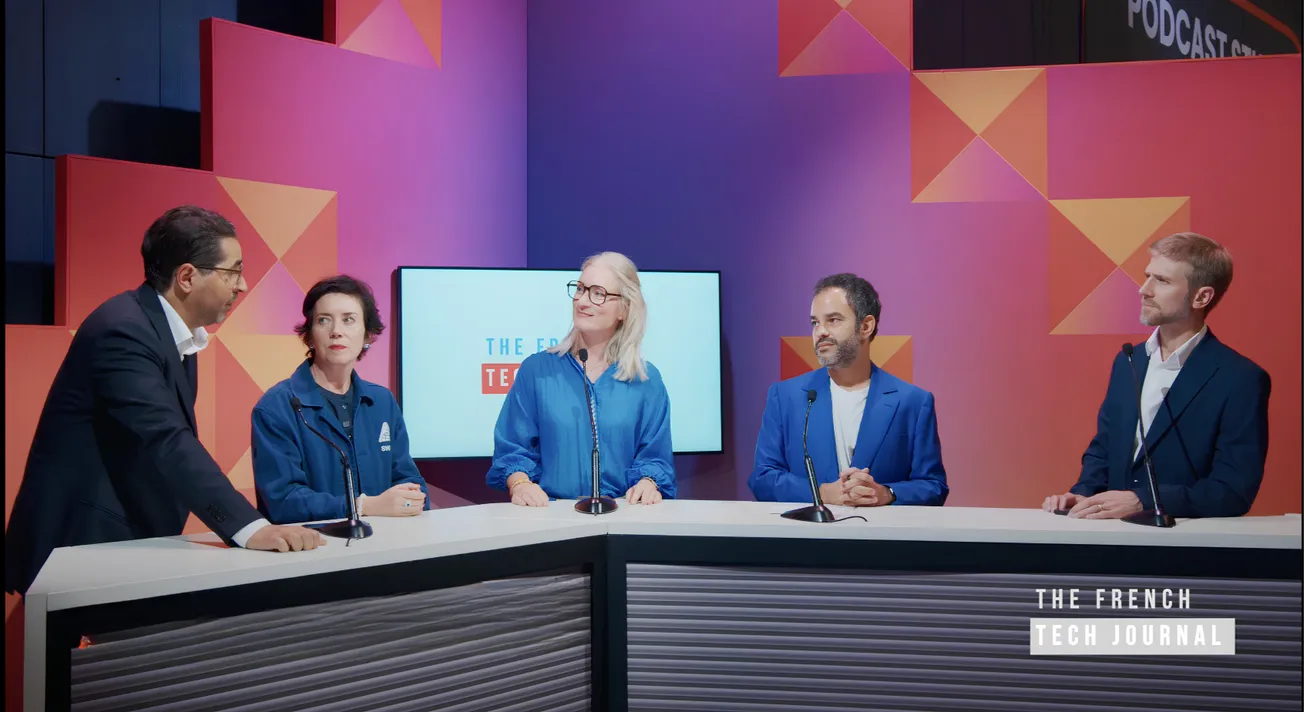
To explore why, the French Tech Journal brought together two startup founders - Thor Olof Philogène, CEO and co-founder of Stravito, and Rachel Delacour, CEO and co-founder of Sweep - and two corporate leaders, David Sabban, Partner at IBM Consulting, and Philip Marais, Global Startup Program Director at OVHcloud.
While the discussion centered on AI, the panel quickly converged on a broader conclusion: French corporates can no longer afford to treat startups as experiments. As innovation cycles accelerate, the greatest risk may no longer be partnering with the wrong startup - but waiting too long to partner at all.
AI is forcing corporates to look outside
Large companies have always partnered with startups to access innovation. But AI is changing the balance.
According to Philip Marais, who leads OVHcloud’s global startup program, the pace of AI development has leveled the playing field. Startups can now build and deploy products so quickly that large organizations increasingly need external innovation simply to keep pace.
That urgency is also changing how companies fund experimentation, with innovation and R&D budgets increasingly replacing traditional procurement processes for AI projects.
For corporates, he argued, this creates a rare opportunity to engage startups earlier and more strategically.
Startups don’t need perfect customers. They need faster ones.
If the founders on stage shared one frustration, it was the pace at which many large companies still operate.
Rachel Delacour, CEO of sustainability software company Sweep, described spending months navigating proof-of-concept discussions that often go nowhere.
Her message to corporates is both simple and surprising: learn to fail faster.
She recalled one startup spending an entire year working through a proof of concept before ultimately shutting down.
A quick decision - even a negative one- is often far less damaging than a twelve-month evaluation process that consumes engineering resources, management attention, and cash.
The biggest risk is doing nothing
For Thor Olof Philogène, CEO and co-founder of enterprise insights platform Stravito, AI has changed how executives think about risk.
“There is more risk in not doing anything than there used to be,” he pointed out.
Companies still need to evaluate security, compliance, and governance, but refusing to experiment has become a strategic risk in itself. The most innovative organizations, he argued, are those willing to take calculated risks rather than waiting for perfect certainty.
Speed beats perfection
That philosophy extends beyond startups.
David Sabban, Partner at IBM Consulting, argued that AI requires organizations themselves to become more comfortable with experimentation.
Rather than pursuing perfect solutions, companies should prioritize rapid iteration and productivity gains.
IBM has already deployed thousands of internal AI agents across its consulting organization, he said, reflecting a broader shift towards testing, learning and improving at speed.
The challenge is no longer whether AI will transform businesses, but whether businesses can transform quickly enough to benefit from it.
Trust remains the real currency
Speed alone, however, is not enough.
For startups, winning enterprise customers still depends on building trust.
Philogen argued that businesses making strategic decisions care less about how quickly AI produces an answer than about whether they understand where that answer came from.
At Stravito, that has meant developing what he calls “glass box AI”, allowing customers to trace AI-generated responses back to the underlying data rather than relying on opaque outputs.
Transparency, he suggested, may ultimately prove a bigger competitive advantage than raw AI capability.
Partnership over ownership
Asked whether tomorrow’s leading companies would build everything in-house or increasingly rely on partnerships with startups, the panel offered remarkably little disagreement.
The consensus was that neither approach works in isolation. Corporates provide scale, customers, and operational expertise. Startups contribute speed, specialization, and the willingness to experiment.
As AI accelerates the pace of technological change, that combination is becoming less a competitive advantage and more a necessity.
But the panel also pointed to a more fundamental shift. For years, the burden of adaptation fell almost entirely on startups, which were expected to navigate corporate procurement processes, governance, and decision-making. That balance is beginning to change.
The message emerging from this year’s VivaTech is that the opposite is now becoming true. In the AI era, it is increasingly large organizations that will need to adapt to startup speed - not only to remain competitive, but to seize the next wave of innovation.
Watch the panel here: