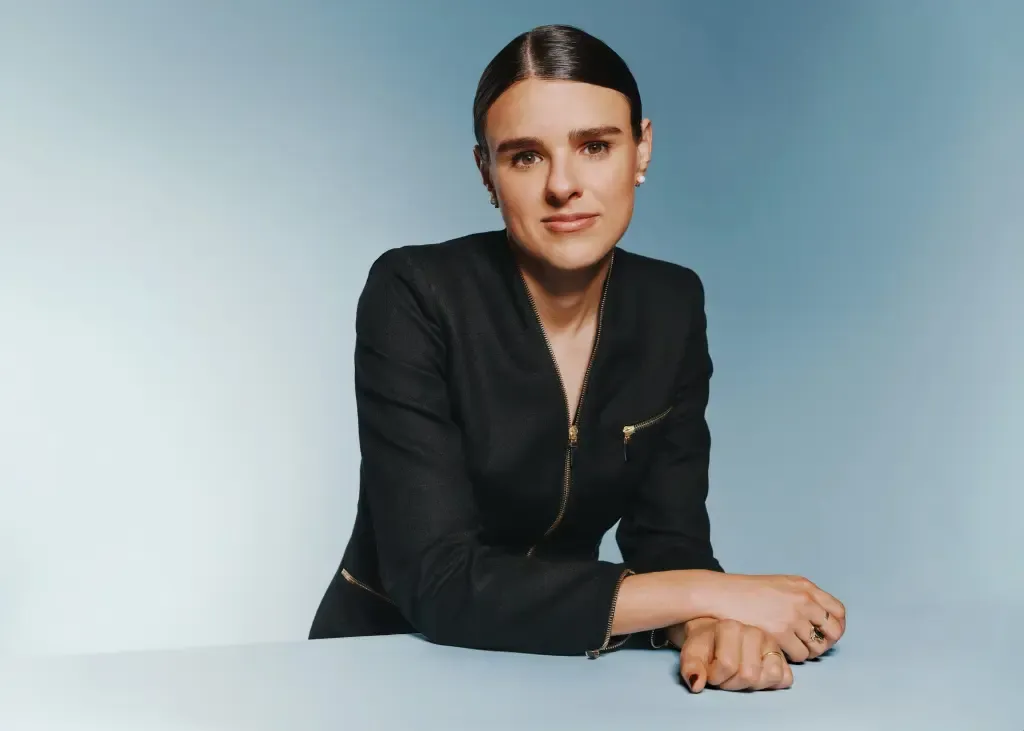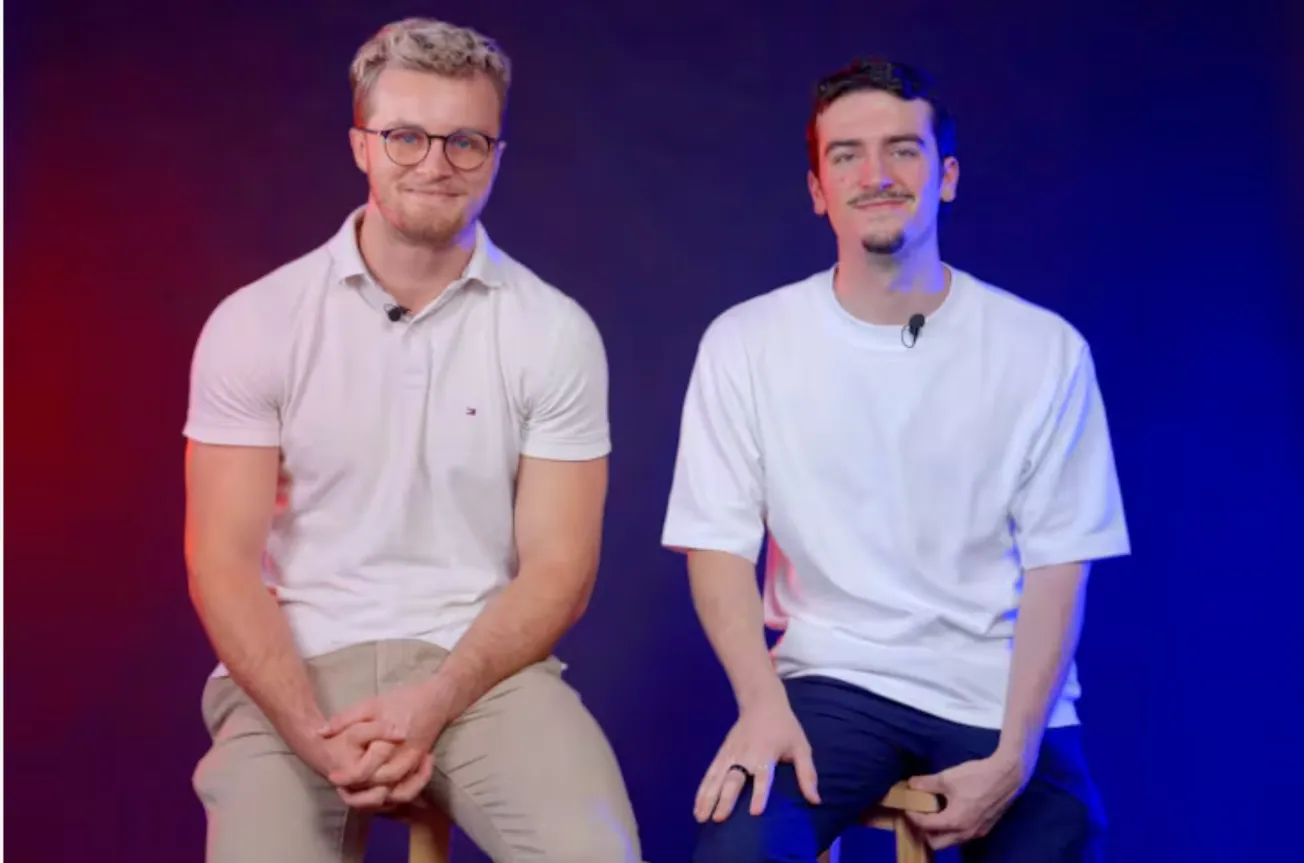
The day before UMA CEO and Co-Founder Rémi Cadène took the stage at the Machina Summit at Station F, he gathered a small group of journalists at the company's Paris office to show them what nine months of work looks like.
"It's been nine months since we created UMA, so I think it will be a moment of pride for the whole team," the CEO said.
Those results include the first images of UMA's humanoid robot, a working prototype designed and assembled in Paris, demo videos of its AI performing industrial tasks for hours at a stretch, and a new name for the learning technique underpinning it all: Real-Time Learning.
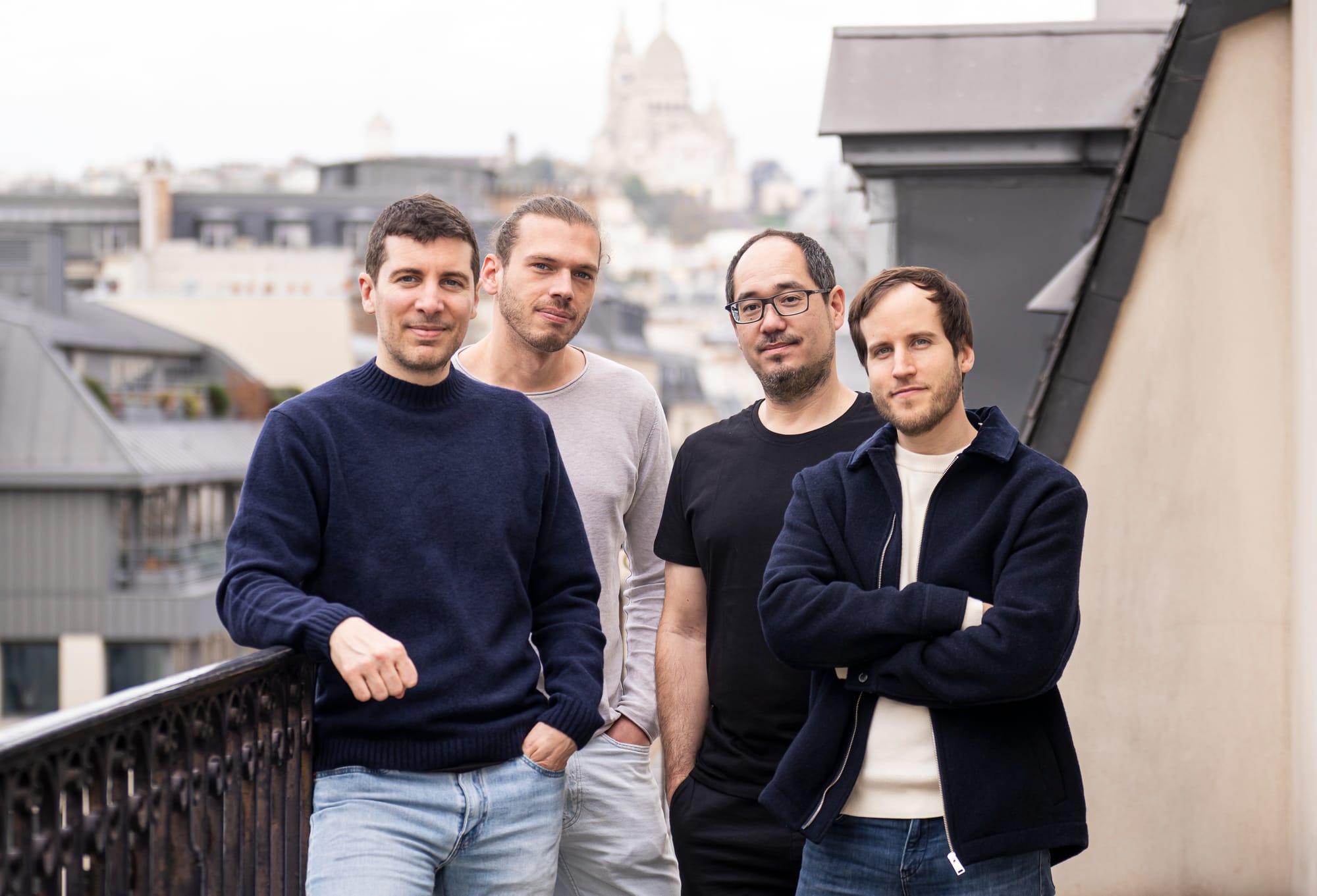
When UMA (Universal Mechanical Assistant) came out of stealth last December, the story was mostly about pedigree. Cadène spent five years at Tesla working on Autopilot before becoming the first research engineer on the Optimus humanoid program. He then built the LeRobot open-source robotics platform at Hugging Face alongside Simon Alibert, now UMA's CTO. The other two co-founders are Pierre Sermanet, who spent a decade doing AI research at Google DeepMind, and Rob Knight, the founder of The Robot Studio and a lifelong specialist in robotic hands.
Now the company has something to show.
 Chris O’Brien
Nothing Is Scripted
Cadène opened with a video of UMA's AI controlling a standard robotic arm with a gripper, picking and sorting objects into the compartments of a box. The footage runs at accelerated speed to show the behavior holding up over time, and the team deliberately messes with the robot mid-task to prove the point.
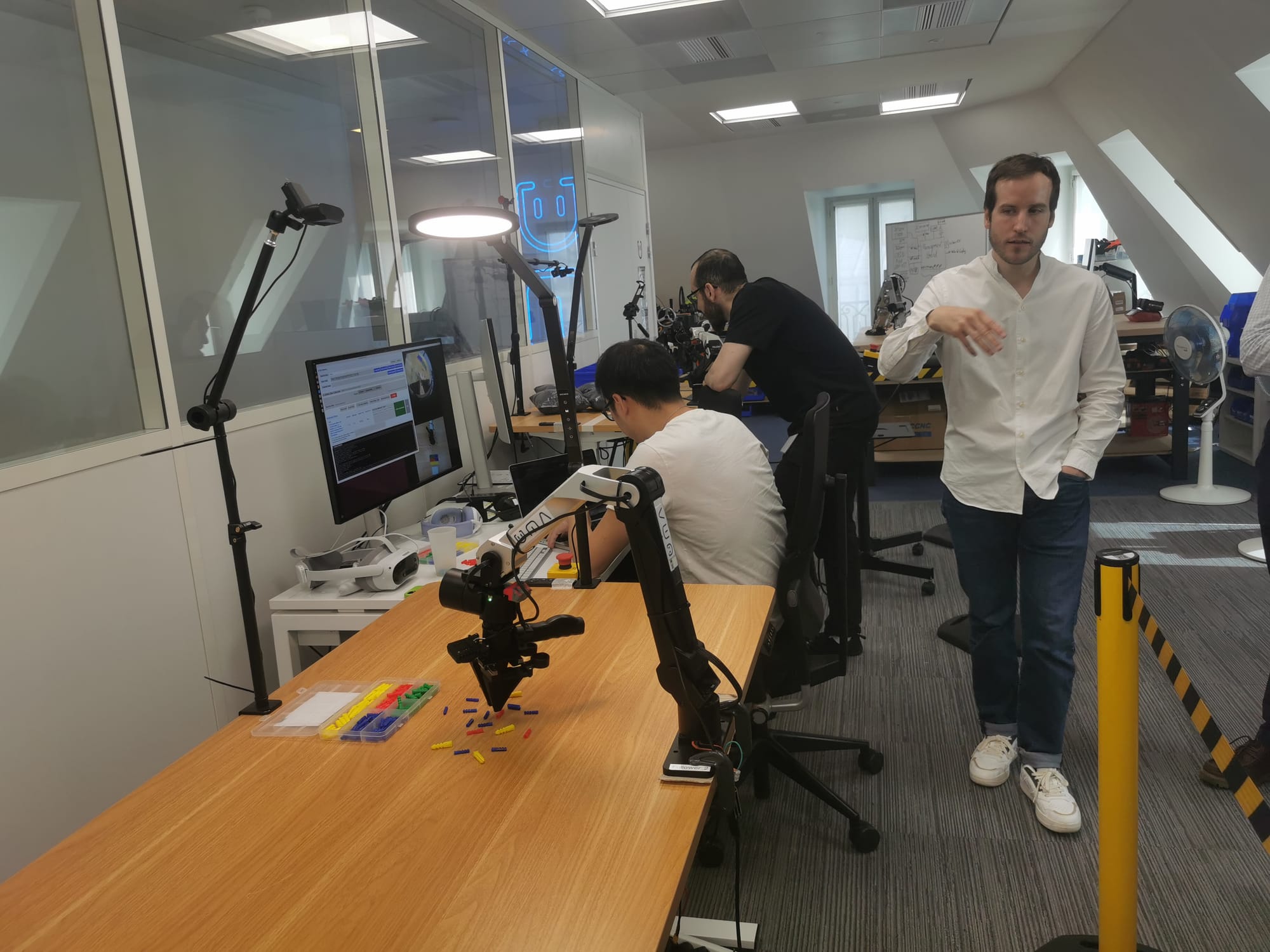
"Nothing is scripted," Cadène said. "There's no hardcoded instruction telling the robot to go to a position or grab an object of a certain color. It's end-to-end, with a neural network connected directly to the cameras that decides what to grab, where to move, and that drives the motors directly."
For someone who has spent his career on this problem, the moment carries weight. "My whole career, I've worked on AI, trying to teach machines to perceive and act," he said. "This is a really significant shift we're reaching."
A second video showed two robot arms grabbing objects, scanning them, and placing them in bins. The items were chosen because today's robots struggle with them: deformable cables, slippery shampoo bottles, a mousepad thin enough to frustrate any gripper, and fragile boxes. Again, the team plays tormentor, blocking the robot and moving things around. The robot adapts.
The claim Cadène kept returning to is durability. Impressive demos of a few minutes are now common across the industry. UMA says its AI runs these tasks reliably for hours, and that this robustness, more than any single flashy manipulation, is what will get robots deployed in real facilities.
Learning Like a Human Ties Its Shoes
The technical bet behind those videos is what UMA calls Real-Time Learning. Rather than racing to scale data and compute, Cadène said, the team went back to fundamentals and focused on making learning radically more efficient.
His explanation is disarmingly domestic. "Do you remember the first time you learned to tie your shoes?" he asked. "Your parent showed you, then you struggled a bit, but you tried again and again, and at some point it became a reflex. That's the capability we're trying to develop."
He wouldn't go into the method in depth, calling it too new and too specific to UMA. But he sketched the outline: "We have demonstrations of the task. We're guided by clearly identified rewards and goals, and the robot can learn very quickly in real time by practicing the task, always under the supervision of an operator."
The payoff, in his telling, is edge cases. "The main reason an enormous number of tasks aren't automated today is that there's an edge case that classic software can't handle," he said. A robot that keeps learning on the job can absorb those exceptions instead of breaking on them.
There's a second learning mode, too, and it doubles as a safety system. UMA is building its own world model that constantly predicts what happens next. "We can be completely still, watching the world, always predicting the future state of the world, predicting the outcomes of the behaviors of the people around us," Cadène said. "That's what lets us learn enormously."
A Machine in Work Clothes
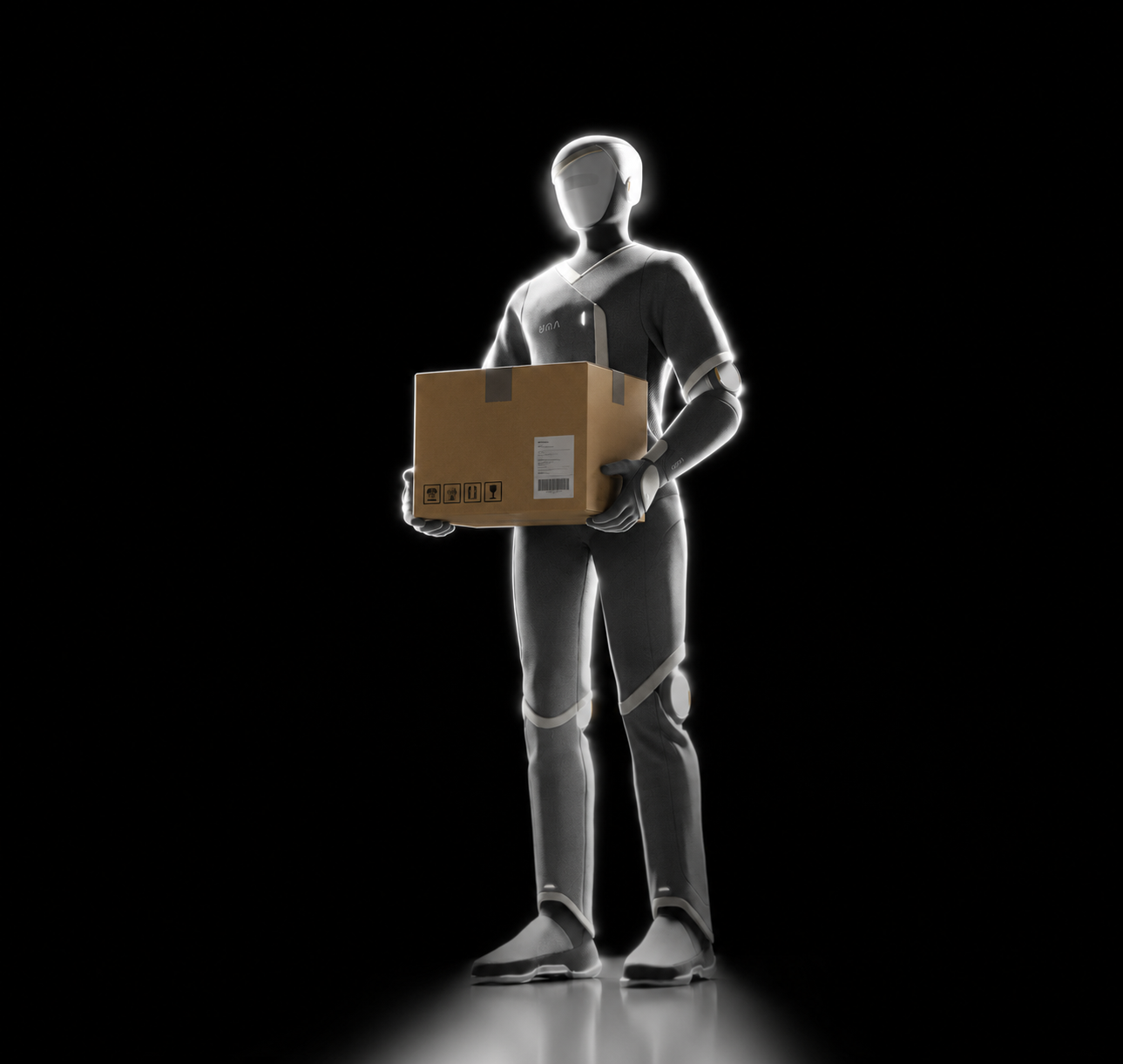
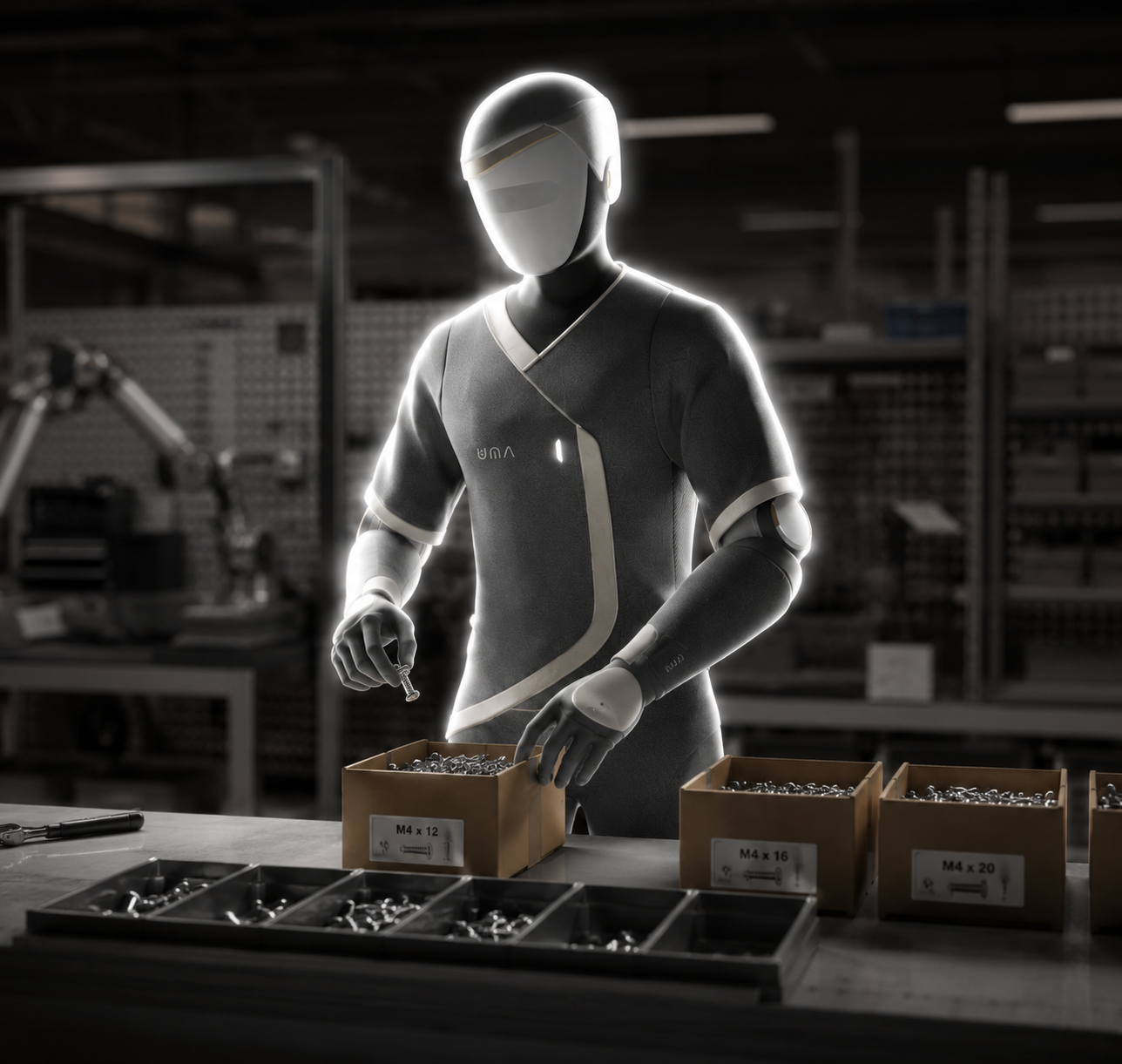
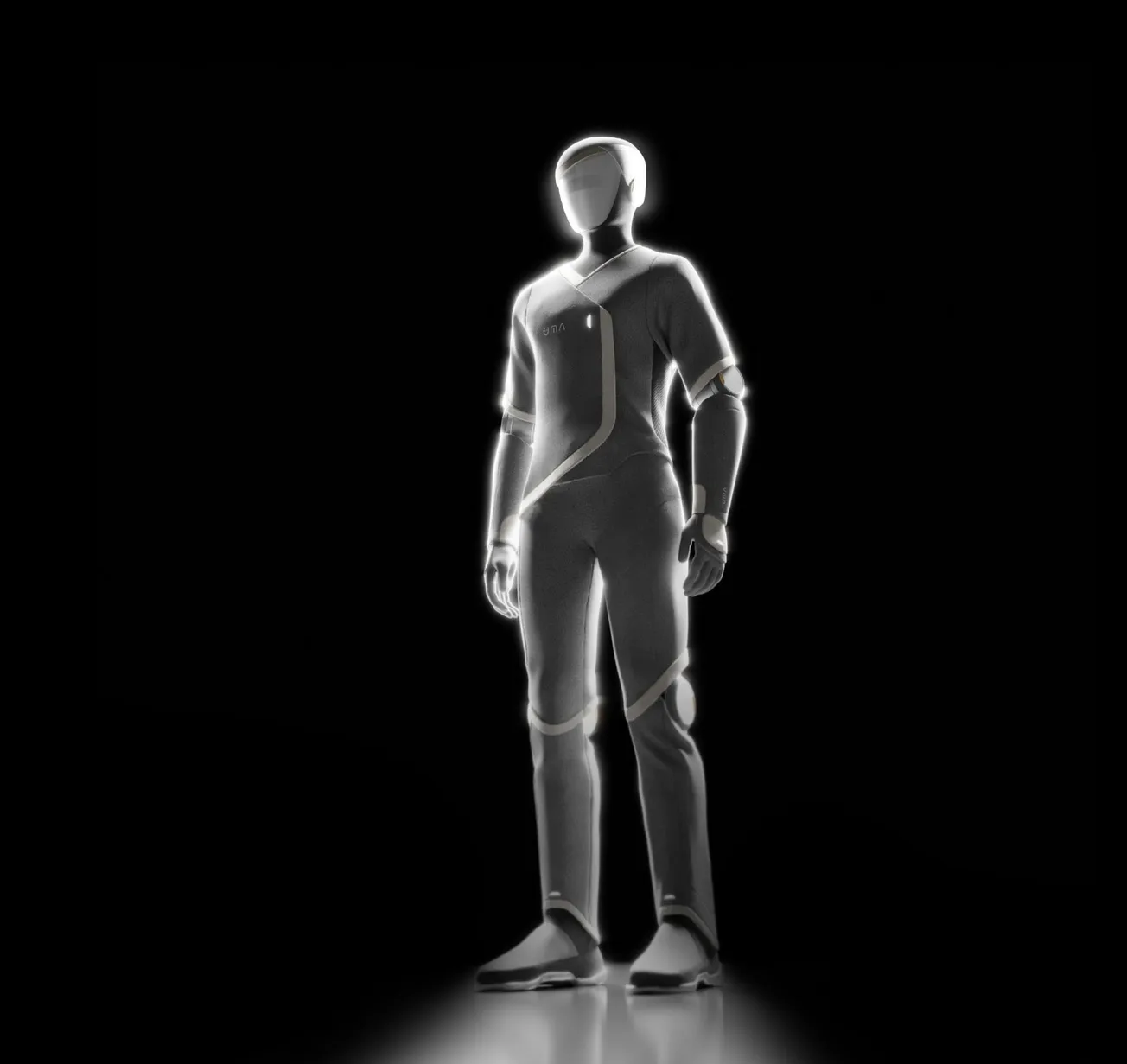
Then came the reveal: UMA's humanoid design, dressed in what Cadène describes as high-tech technical fabric. The silhouette is human-scale. The face is a blank visor, no eyes, no mouth.
"We designed it to have an appearance that's comfortable to look at, that gives an impression of calm, serenity, and competence," he said. The blankness is deliberate. "The idea is that you can clearly identify it as a robot, even from far away. That's why the head can light up."
The outfit is more than styling. It carries sensors, and it can be swapped. "It's a technical garment," Cadène said, comparing it to workwear that could change color or configuration depending on the task. He's under no illusion that the first version is final: "Cell phones took years to evolve in terms of design. I think it will be the same for these robots."
Safety, he insists, is the foundation, and UMA has organized it around three pillars. First, a lightweight build: less mass means less kinetic energy in any collision, and the goal is a robot "much lighter than a human." Second, redundant and independent compute and software systems, an idea borrowed from aerospace. Third, that world model, which "predicts the consequence of every action we ask of the robot before the robot moves."
The prototype shown to journalists, assembled in Paris, exists to validate those fundamentals. "We developed this in under nine months with a small team," Cadène said. "We're showing that we have the ability to do the whole robotics stack and integrate vertically." The company now runs about 70% AI work to 30% hardware, with a lab in Paris, a hardware team in Geneva working on the hand, and a go-to-market team in London. Headcount is around 30 and growing, and the presentation itself was partly a recruiting pitch.
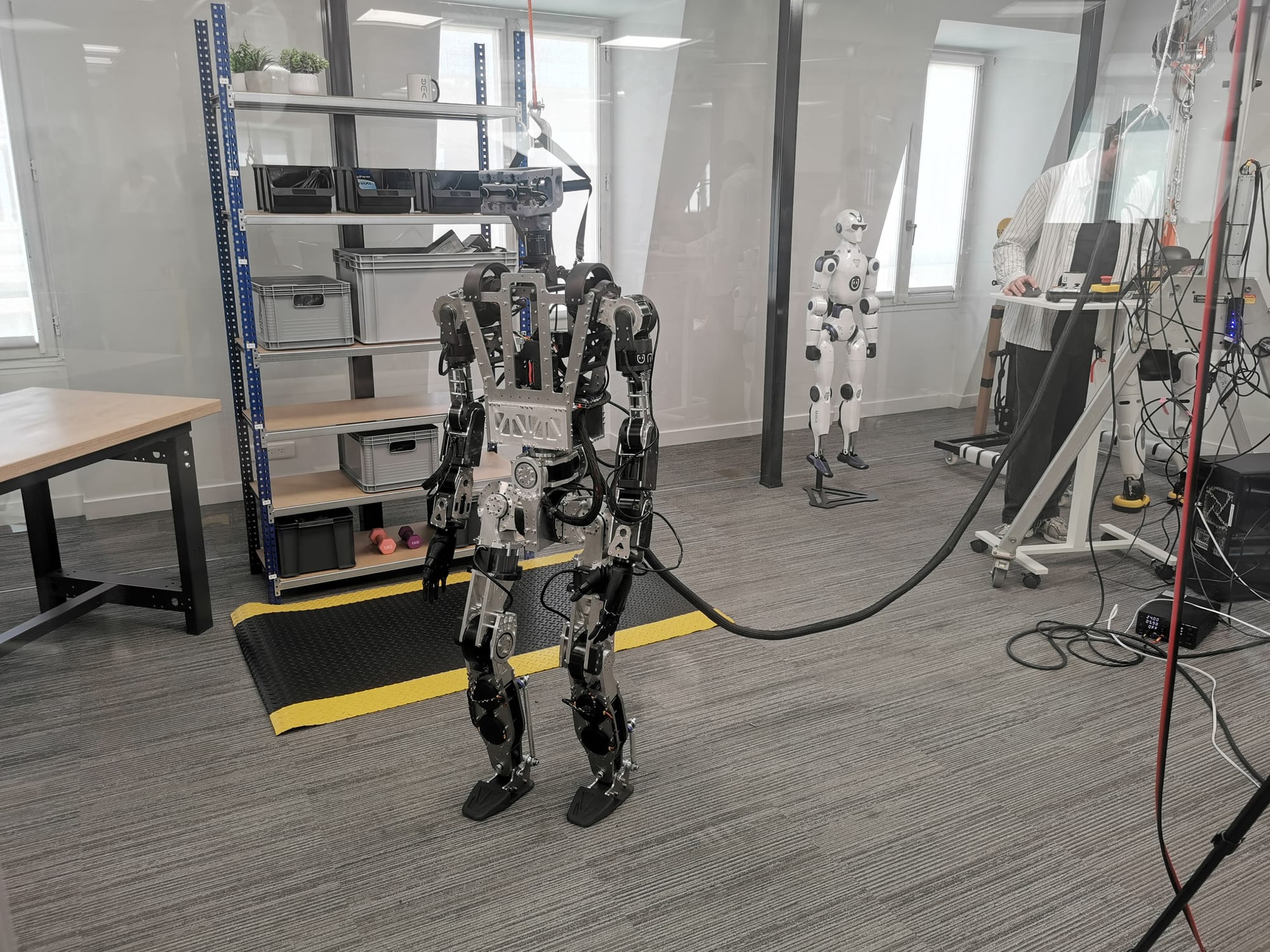
While that is the North Star, UMA has also developed "Version Zero," a tele-operated robot that illustrates how far the company has come and the distance remains to fulfill that greater vision.
Three Crises, One Bottleneck
Why build any of this? Cadène's macro thesis centers on three crises converging at a single bottleneck: labor.
The demographic crisis he illustrated with a profitable German factory that closed because it couldn't find machinists, technicians, and welders, even after raising salaries and paying relocation costs. The environmental crisis, in his framing, is partly a labor problem too: decarbonized infrastructure isn't getting built fast enough because construction labor is scarce and expensive. And the supply chain crisis showed its face during Covid, when wealthy nations couldn't produce masks, and again when a single ship blocked the Suez Canal for two weeks.
The numbers behind the thesis come from Korn Ferry, which projects a global shortfall of 85 million skilled workers by 2030, worth as much as $8.5 trillion in unrealized economic value.
This is also the core of his case for Europe. "We started in Europe because that's where the opportunity is. For us, it's the best market in the world," he said. "The needs are critical, the cost of skilled labor is very high, and with the demographics, demand is already enormous." Pressed on whether Europe can match China's manufacturing speed, he pointed to the continent's industrial base: "There's a manufacturing history that's very present in Europe, far more present than in the US."
Warehouses First, Homes Later
The commercial plan starts with logistics and warehouses, where floors are flat, environments are constrained, and a single site can absorb hundreds of robots. Manufacturing comes next, with its heavier demands on dexterity and task sequencing. Homes come last.
The business model is robot-as-a-service. "You pay per month to get access to a fleet of robots that automates a task," Cadène said. "You don't buy the robot."
And in a notable detail, the humanoid isn't the first product. Cadène described the biped as UMA's iPhone-equivalent long-term goal. What ships first is something more pragmatic. "The first version of this robot in industry will be a robot on wheels, with dexterity and learning capabilities," he said, with a first concept prototype targeted for the end of the year.
He was blunt about where the competition stands. Unitree's affordable humanoids, he argued, serve the research market: "It's not deployed in factories. It doesn't have the dexterity that's needed. It can't operate for hours and hours." As for his former project at Tesla: "We're still at the proof-of-concept stage. We're not yet at the level of the first iPhone. Optimus hasn't fully done that yet either."
On funding, Cadène stayed coy, declining to confirm a figure. "We haven't announced it," he said. "We're not limited by our financing, and we're not in a rush either. But like every startup in robotics, we need significant capital." The company says it's talking with around 50 identified potential customers and has already conducted site visits.
The long game rests on a comparison Cadène clearly relishes. It took 12 years to go from the first iPhone to as many smartphones as there are people on Earth. Robots, he believes, can move faster, for one strange and compelling reason: "A smartphone doesn't build another smartphone. For the first time in history, we have a product that can assemble other products, that can be part of its own supply chain."