Skip to content
AI

Plume Believes AI Can Solve Europe’s Biggest Renewable Energy Bottleneck

As renewable energy scales, site selection remains a critical barrier. Backed by a recent €3.3M funding round, Plume is building an AI platform to help developers navigate complex geospatial and regulatory data, accelerating decision-making and improving project success rates.

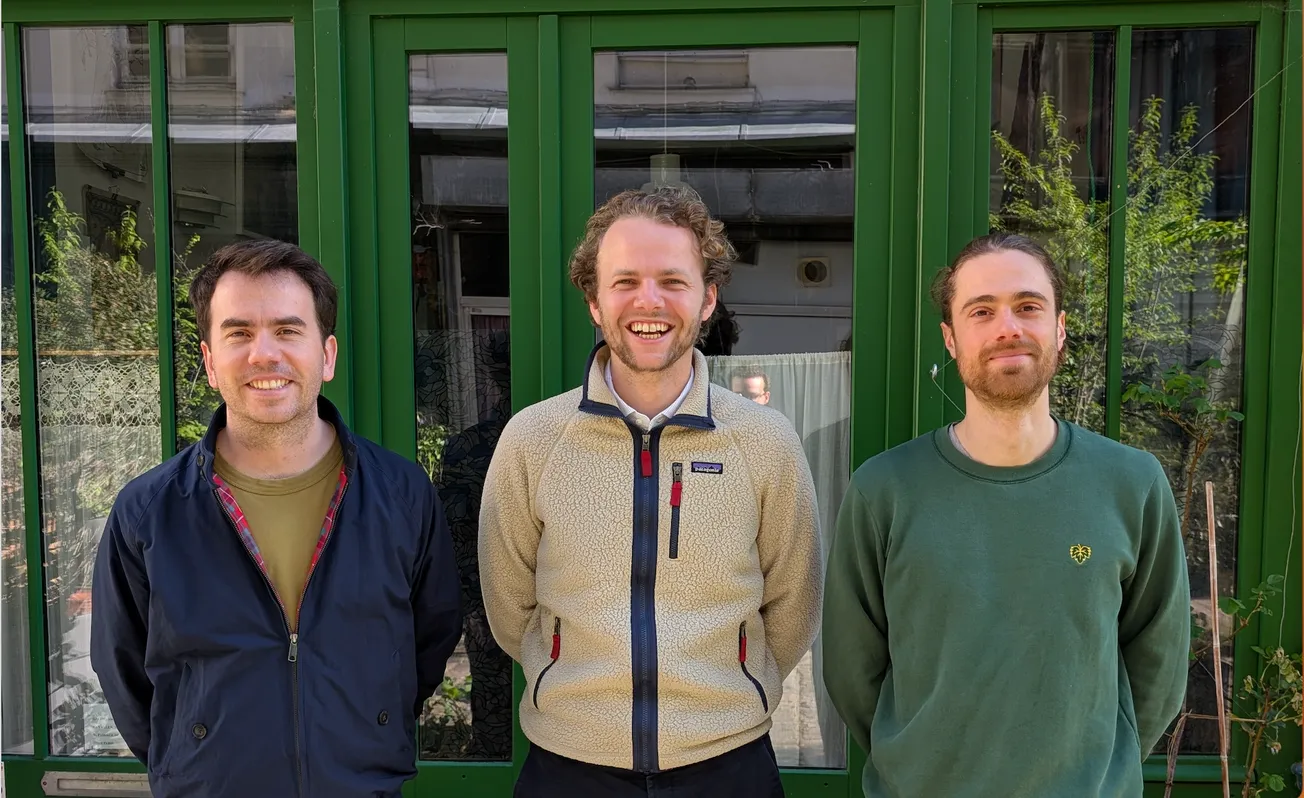
Co-founders (from left) Pierre Amelot (Founding engineer), Edouard Labarthe (CEO), and Alexandre Cornet (Founding Engineer)

Behind the urgency of Europe’s energy transition lies a quieter, more complex problem: not building renewable infrastructure, but figuring out where to build it.

Paris-based startup Plume believes the problem is fundamentally a data problem and can be solved with AI.

This week, the Franco-American company announced a €3.3 million funding round led by AENU, with participation from Y Combinator, Kima Ventures, Raise Sherpa, and Collab Fund. The funding will support its expansion across Europe and into the US, as well as continued product development.

Beyond the funding, Plume is positioning itself as something more ambitious: an intelligence layer for renewable energy development.

A problem hidden in maps, documents, and time

Developing renewable energy projects is often framed as an engineering or financing challenge. In reality, much of the friction happens much earlier.

Site selection requires navigating a dense web of constraints: zoning laws, grid capacity, protected land, permitting histories, environmental risks, and local politics. In markets like France, this can mean analyzing nearly a hundred layers of geospatial data, alongside unstructured documents such as municipal deliberations or regulatory filings. The result is a process that remains largely manual, slow, and uncertain.

“Renewable energy development is a reasoning problem hidden in maps and documents,” said co-founder and CEO Edouard Labarthe. “You need to understand a territory very quickly, but also very deeply.”

That complexity has real consequences. Projects can take years to validate, and many are abandoned late in the process after significant investment.

From methane detection to renewable infrastructure

Plume did not initially set out to solve this problem.

Labarthe, who previously worked at Palantir on energy-related projects, teamed up with Marc Watine, a researcher specializing in geospatial AI at Harvard. The pair are close friends and have known each other for a decade.

“As students, we were kind of the weird kids,” Labarthe recalled. “We’d been thinking about these problems and how to solve them for a long time.”

Their first idea was cooked up during a vacation from which Labarthe never returned to Palantir. It focused on detecting methane emissions using satellite data, a technically complex but promising area, particularly as regulators began introducing heavy fines for industrial emissions. They pitched it to Y Combinator, which accepted them into one of its programs.

But that model proved fragile.

“With the change in US regulation, the fines disappeared,” Labarthe explained. “We realized we couldn’t build a company that depended entirely on regulation.”

The pivot came through conversations with renewable energy developers, a sector Labarthe already knew well through his work with Palantir. The feedback was consistent: the same technical capabilities could be applied to a different bottleneck.

“They told us: your skills could help us find where to build,” he added.

Building an AI layer for site selection

Plume’s platform combines geospatial datasets with large volumes of unstructured regulatory information, allowing users to query and analyze potential sites through a simple interface.

At its core, the product aggregates more than 150 data sources, from natural risk zones to grid infrastructure and planning documents. It uses AI agents to synthesize that information into actionable insights.

The goal is not to replace on-the-ground work, but to drastically reduce the time spent before it begins.

“Today, a lot of this work takes weeks or months,” Labarthe explained. “We allow teams to do that in seconds, so they can spend their time where it actually matters, on the ground.”

In practice, this means helping developers identify viable sites earlier, avoid hidden risks and prioritise projects with a higher likelihood of success.

Plume has also developed a “territorial intelligence” layer, surfacing less obvious signals such as local opposition groups or influential stakeholders - factors that can significantly impact project timelines.

“These weak signals are often what kill projects later,” Labarthe noted. “If you can see them early, you save both time and huge amounts of capital.”

Early traction in a competitive market

Since pivoting to renewables in early 2025, Plume has grown from two to around a dozen clients in a matter of months. Its platform is now used by energy project developers operating across France, Spain, Romania, and the Czech Republic.

According to the company, it has already supported projects representing more than 1 gigawatt of capacity.

The product follows a relatively standard SaaS model, with users integrating it into their daily workflows. Several hundred users are already active on the platform, often spending significant time on it.

“It becomes a real working tool for them,” said Labarthe. Growth so far has been largely organic.

“A lot of it is word of mouth,” he added. “Our users talk about it - which is always a good sign.”

The market itself is becoming increasingly competitive, particularly in countries like Spain and France, where renewable development is accelerating.

“The advantage is speed,” Labarthe said. “If you can identify opportunities faster than others, that’s where you win.”

Scaling across geographies and use cases

A key design choice for Plume has been to build a product that works across multiple geographies from the outset, rather than focusing on a single national market.

“We didn’t want to build a niche product for one country,” Labarthe explained. “We wanted something that could scale.”

That approach is now reflected in its expansion plans. The company is targeting Italy next, alongside a move into the US market, where it will face established competitors such as the startup Paces.

At the same time, Plume is expanding its scope beyond solar and battery projects to adjacent use cases such as data centers. The ambition, however, goes further.

“In the long term, we want to help build infrastructure almost on autopilot,” Labarthe said. “The human side remains essential but everything around it can become much simpler, faster, and cheaper.”

A race against time and complexity

Plume’s proposition sits at the intersection of two accelerating trends: the urgency of the energy transition and the growing role of AI in decision-making processes. Yet its success will depend on more than technology.

Renewable energy development remains shaped by regulation, local dynamics, and market fragmentation, factors that no platform can fully abstract away. What Plume is attempting instead is more pragmatic: reducing friction where it is most acute.

“Uncertainty around risk and timelines is still one of the biggest obstacles,” Labarthe said. “We’re trying to build the intelligence layer that allows teams to move faster and increase the number of projects that actually get built.”

Comments

Latest