If you want to understand France’s place in the global AI race, the latest Stanford HAI Index paints a picture that is neither bleak nor triumphant. Instead, it perhaps offers a decent reality check of France as distinctly “second tier, with pockets of excellence.”
Pulling back from any specific metric, one thing stands out across the 423-page report: France consistently shows up on the charts, more than many countries can say. While it rarely leads, that's hardly unexpected given its relative size and resources. It's worth noting that it still consistently ranks in the Top 5 on many of these measures.
Of course, that may feel like a blow to French pride. That puts it in a crowded middle where it's strong enough to matter, but not quite strong enough to shape the frontier or the policies that count. Still, I'd say it's in the upper end of the mix, and given the stakes and fierce competition, that is nothing to sneeze at.
By The Numbers
Let's run through some of the more revealing data points, starting with the cutting edge: model development.
France produced just one notable AI model in 2025, compared to 50 in the U.S. and 30 in China. And there are just two for Europe.

On the research front, France looks far more substantial. It has roughly 18,800 top AI researchers and inventors, placing it alongside countries like Canada and the UK.

That’s a meaningful base. But France is still behind in spinning some of that IP into commercial ventures. This has been a big focus of the Deep Tech program launched by the government and Bpifrance several years ago, but clearly, there is still work to be done.


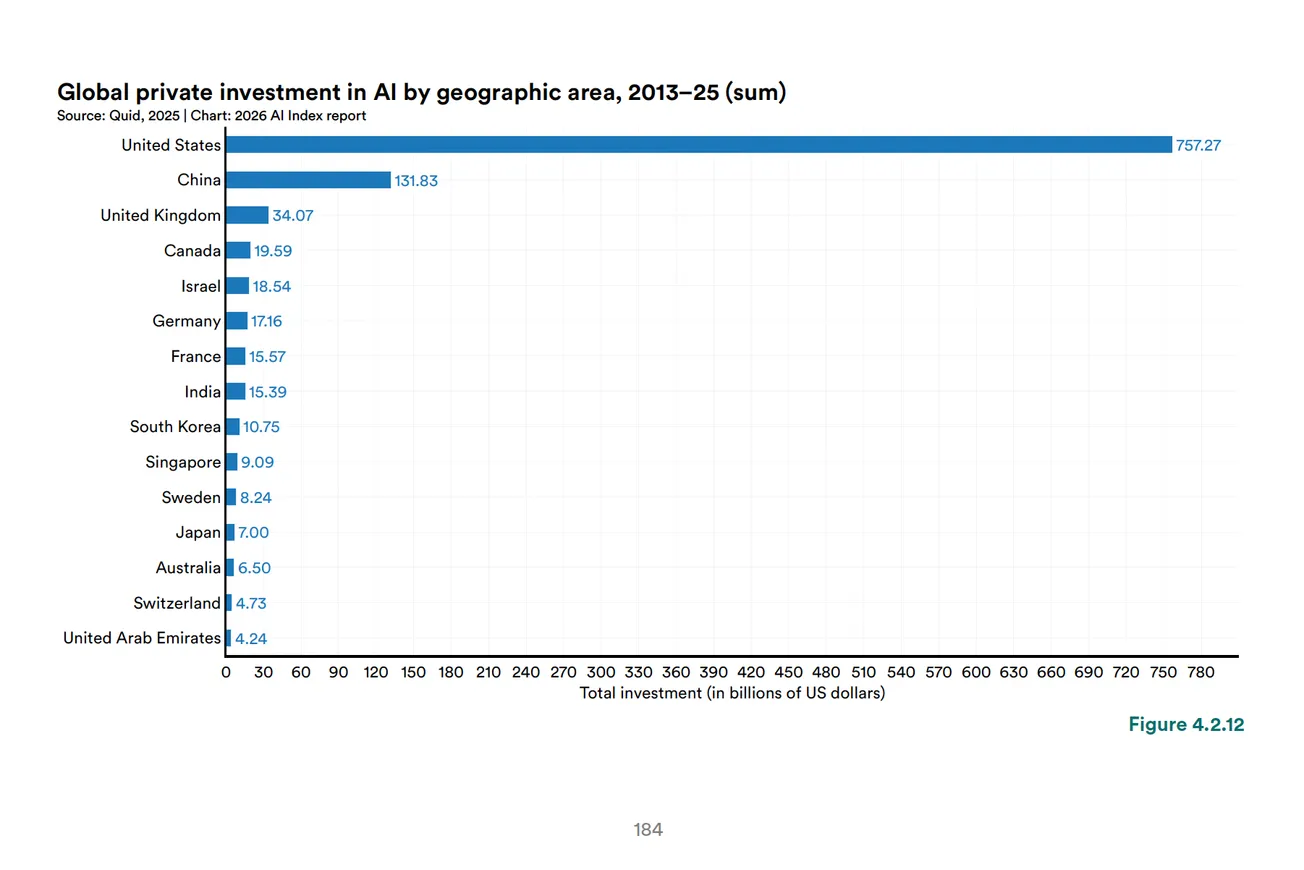
The same “solid but not dominant” story plays out in startups and investment. In 2025, France attracted about $4.36 billion in private AI investment, putting it behind the U.K. and China and far behind the U.S., which pulled in nearly $286 billion.
While the private funding gap is not so shocking, the public funding gap might be.
Between 2013 and 2024, the United States government invested roughly $20 billion in AI through grants, contracts, and other mechanisms. That compares to about $3.7 billion in total public commitments across Europe.

Within Europe, the United Kingdom leads with $1.6 billion, followed by Germany at $505 million and France at $320 million. While France ranks among the top European contributors, its investment remains small relative to the U.S., underscoring how fragmented and comparatively limited Europe’s public funding landscape is.
Just as important as scale is structure. U.S. investment is heavily driven by research grants—particularly through agencies like the NSF and NIH—and complemented by defense spending, creating a pipeline that fuels frontier innovation. Europe, by contrast, relies primarily on public procurement, channeling funding into government use cases in sectors like health and education. The result is a fundamental divergence: the U.S. model is geared toward advancing cutting-edge capabilities, while Europe’s—including France’s—focuses more on deployment and regulation. Both regions are accelerating spending, but from very different baselines, reinforcing a broader dynamic where the U.S. leads in innovation capacity and Europe in institutional adoption.
AI For The People
Where France does stand out, interestingly, is on the demand side. AI adoption in France is relatively high at around 40.9%, placing it among the top adopters globally.
That’s higher than many larger economies, including Germany. It suggests that while France may not lead in building frontier systems, it is comparatively strong at integrating AI into its economy.


The charts on hiring and talent penetration show that AI hiring growth in France has been positive but uneven, with periods of acceleration followed by mild slowdowns, broadly in line with other European economies rather than leading them.

At the same time, AI skill penetration, as measured through the share of the workforce with AI-related capabilities, continues to rise, signaling that France is successfully diffusing AI expertise across its labor market. However, it still trails more concentrated talent hubs like Israel or Singapore in overall density.

On infrastructure, the power demand chart underscores a more structural constraint. France, like much of Europe, faces rising electricity demand driven by AI workloads, particularly from data centers. Yet it lacks the hyperscale expansion seen in the United States.
While France benefits from a relatively robust and low-carbon energy mix (notably nuclear), the charts suggest that future AI growth will increasingly hinge on the country’s ability to scale power capacity and grid infrastructure to meet compute-intensive demand.

If we considered the Index a report card, I'd say that France would get a B+.
It’s consistently strong across most categories, such as talent, adoption, research, and depth. It's obviously above the class average.
But frontier models aside, it still can't quite match that Top Tier scale of investment and ecosystem dominance. In other words, France is a very good student, just not at the top of the class.