Skip to content

From Bottles to Infrastructure: Le Fourgon’s Race to Own Europe’s €Trillion Circular Packaging Shift

With 70% of France’s reuse market, Le Fourgon is expanding into Belgium and Spain as EU bans on single-use packaging and mounting microplastics concerns force brands and retailers to rethink logistics at scale.

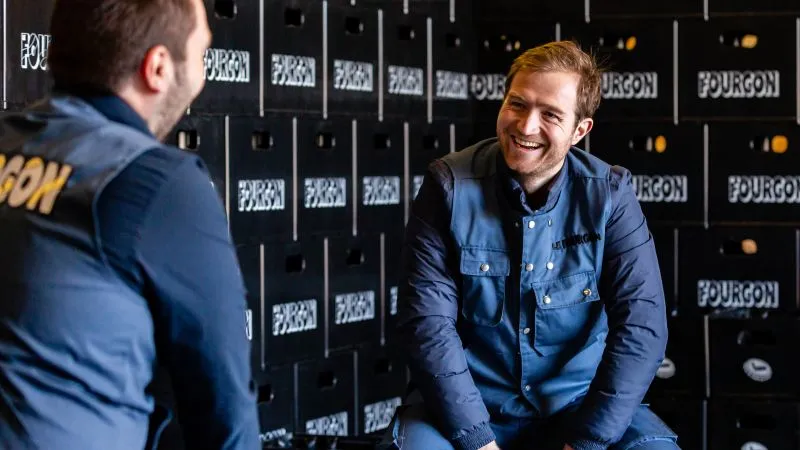
Charles Christory, CEO of Le Fourgon

Fresh from its merger with La Tournée and its expansion into the Paris region, the Lille-based returnable-bottle startup Le Fourgon is now heading beyond France for the first time, launching in Belgium and acquiring a local startup in Spain.

The ambition is no longer simply to deliver groceries in glass bottles. It is to become what co-founder and CEO Charles Christory calls “the European leader in reusable packaging.”

Europe’s plastic backlash is creating an opening

The timing is no coincidence.

Europe has already voted to phase out much of single-use packaging by 2030, while growing concern over microplastics is beginning to reshape consumer behavior and corporate strategy alike.

“Fifty percent of single-use packaging will disappear by 2030. That has already been voted in Europe and in France,” Christory said

For years, reuse was often dismissed as an expensive, niche alternative. But that is beginning to change.

“Microplastics and nanoplastics are proving to be extremely harmful for humans - linked to cancers, fertility problems, and other diseases,” he said. “It feels a bit like tobacco in the 1960s. At first, there was doubt. Today, there isn’t.”

That shift is putting pressure on major food and beverage groups to find alternatives. Brands including Evian are already working with Le Fourgon, while larger industrial players are increasingly asking the company to help them build a Europe-wide reuse platform.

From Lille to 45% of France

Founded in 2021, Le Fourgon now serves more than 100,000 customers across France. Following its merger with La Tournée in late 2025, the company now covers 45% of the French population across more than 3,000 towns and cities.

Since launch, Le Fourgon has enabled the reuse of more than 50 million bottles and jars. The company estimates it now accounts for around 70% of France’s reuse market. The model is straightforward: customers order groceries online, receive them in reusable glass bottles and jars, and then return the empties when their next delivery arrives. Le Fourgon collects, sorts, washes, and redistributes the containers, which can be reused up to 40 times.

The company says this reduces energy consumption by 75%, CO₂ emissions by 79%, and water use by a third compared with single-use packaging. But the real challenge lies not in selling products but in building the infrastructure behind them. “We are not just selling groceries,” pointed out Christory. “We organize the entire loop: the delivery, the collection, the washing, and the redistribution. That is what makes the model hard to replicate.”

Belgium first, Spain next

Le Fourgon’s first international launch has taken place in Liège, where the company has begun delivering within a 50-kilometer radius of its local warehouse. The Belgian offer has been adapted to local tastes, with products sourced within 150 kilometers wherever possible: Belgian beers, milk from Inex, juices from Looza, and regional wines from Namur.

At the same time, the startup has acquired Barcelona-based Re-pot Market, a local reuse startup founded in 2020. The Spanish company already has 2,000 customers and claims to have prevented more than 400,000 plastic bottles from being thrown away.

Le Fourgon plans to use Barcelona as a springboard to expand into other Spanish cities, including Madrid and Valencia, from 2027 onwards.

“Spain is actually more advanced than France on environmental issues,” said Christory. “There is greater awareness and stronger regulation.”

Barcelona startup Repot's fouders

Supermarkets are starting to call

Perhaps the clearest sign that the market is changing is who is now knocking on Le Fourgon’s door. “Eighteen months ago, we had to convince people,” said Christory. “Now retailers like Carrefour and Auchan are calling us.”

Traditional supermarkets have experimented with small returnable bottle sections, but Christory argues that without a full logistics platform, the model does not work.

“Carrefour tried to do it with a small shelf of reusable products. But we have 2,500 SKUs and the logistics system behind them. That is the difference.”

The company now believes it has proved that reuse can scale, provided the technology and logistics are in place. Its priorities over the next 12 months are clear: make the French business profitable, scale Spain to €2.5 million in annual recurring revenue, and prepare for the next wave of European expansion.

“Five years ago, people thought this was a niche,” said Christory. “Today, we are building the infrastructure for what comes next.”

Comments

Latest