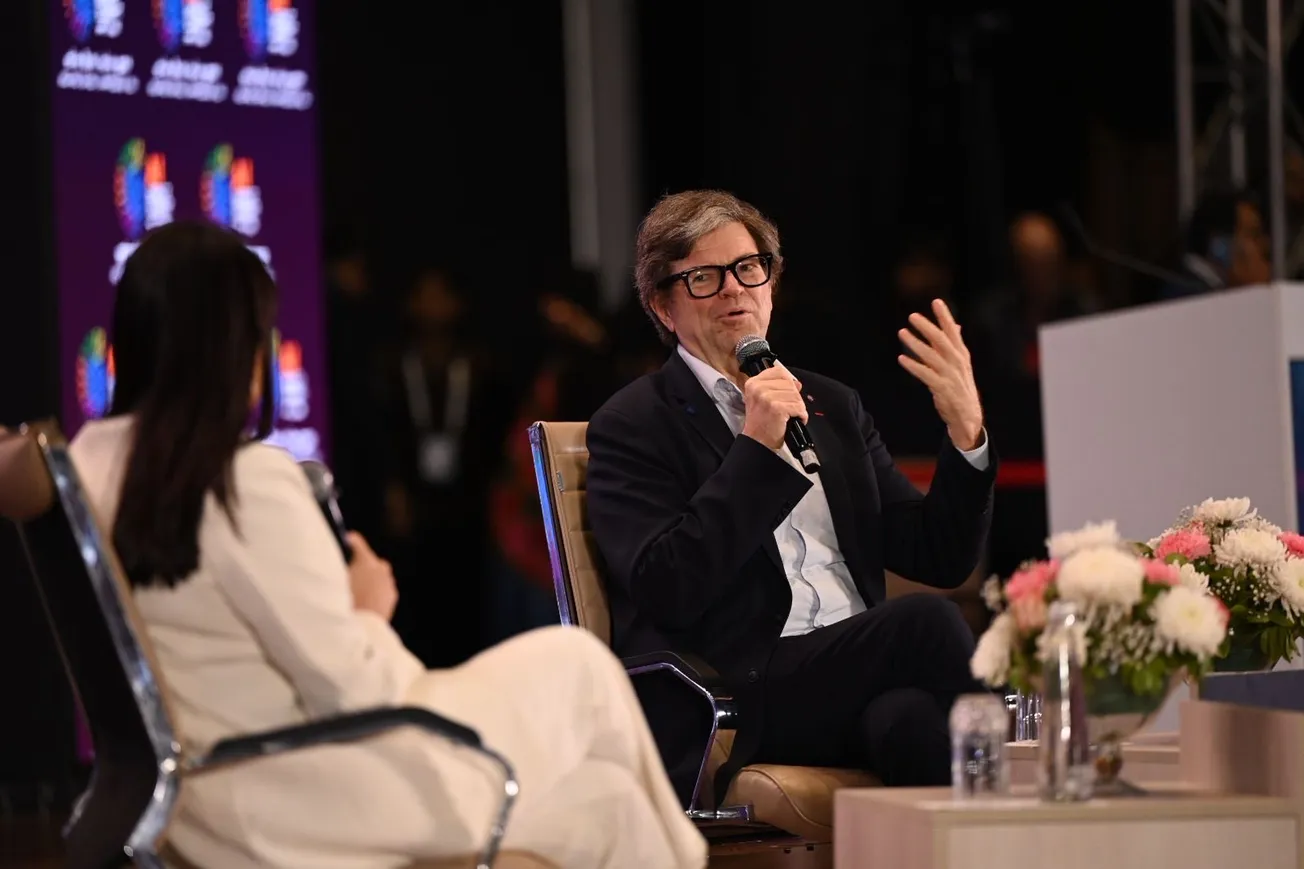
At the India AI Impact Summit 2026 in New Delhi, Ami CEO and AI pioneer Yann LeCun argued that despite the breathless hype, we are still far from building machines that rival human intelligence, and that the real revolution will be slower, messier, and more interesting than the tech industry wants you to believe.
In a wide-ranging fireside chat, LeCun laid out his vision of AI not as a looming superintelligence but as "an amplifier for human intelligence." He acknowledged that machines surpassing humans across the board will happen eventually — "maybe in the lifetime of some people here, possibly not in mine" — but insisted the more exciting near-term prospect is building tools that "amplify human intelligence in ways that will accelerate progress."
That distinction matters to LeCun, who has spent years pushing back on the notion that large language models represent a leap toward true intelligence. He was characteristically blunt on this point. LLMs, he said, "are mostly information retrieval systems." They compress and serve up knowledge previously created by humans. "In a way, it's kind of a natural evolution of the printing press, the libraries, the internet, and search engines. It's just a more efficient way to access information."
The real gap, he argued, is between what AI can do with language and symbols and what it cannot yet do in the physical world. "Why do we have systems that can pass the bar exam and win mathematics Olympiads, but we don't have domestic robots?" he asked. "We don't even have self-driving cars, and we certainly do not have self-driving cars that can teach themselves to drive in 20 hours of practice like any 17-year-old. So we're missing something big still."
That "something big" is what the AI field calls a world model — the mental representation that allows humans and even animals to navigate new situations on the fly. "Animals have a much better understanding of the physical world than any AI systems that we have today, which is why we don't have smart robots," LeCun said. It's also the focus of his current company, Ami, which he described as building "intelligence for the real world."
On the question of whether AI will usher in an era of radical abundance, LeCun was measured. He cited economists who estimate AI could boost productivity by around 0.6% per year — "that seems small, it's actually quite big" — but rejected the idea of a singular inflection point.
"I do not believe there's going to be like a singular, identifiable point where the economy is going to take off, and there's going to be abundance," he said, adding that the distribution of those benefits "is a political question, has nothing to do with technology."
LeCun also took aim at the term AGI itself.
"I don't like the phrase AGI because human intelligence is specialized," he said. Intelligence, he argued, shouldn't be measured as a checklist of tasks but as "an ability to learn new skills extremely quickly and even to accomplish new tasks without being trained to do it."
He reserved some of his sharpest words for the recurring predictions of imminent superintelligence.
"People have been making that claim for the last 15 years, and it's been false. In fact, they've been making it for the last 60 years or 70 years, and it's been false," he said. "Every time in the history of AI that scientists have discovered a new paradigm…people have claimed, within 10 years, the smartest entity on the planet will be a computer. And that just proved to be wrong four or five times in the last 70 years."
Speaking to the summit's host country, LeCun struck an optimistic note about India's potential, tying it to demographics and education.
"The scientists of the future, and in fact many of the present, are from India, and in the future will be mostly from Africa," he said. But he warned against the temptation to let AI replace the hard work of learning. "The idea that somehow we don't need to study anymore because AI is going to do it for us — that's completely false, absolutely, completely false."
He compared AI's societal impact to that of the printing press rather than electricity: a tool for the "dissemination and sharing of knowledge and amplification of human intelligence."
And he closed with a challenge that neatly captured his worldview: the real frontier isn't making machines that manipulate language. It's making machines that can handle "the messiness of the real world, the unpredictability of the real world."
Your house cat can do it. Your computer still can't.