Skip to content

The Infinite Library: One Man's Quest To Let AI Help Anyone Write a Book

An AI founder is betting the future of media isn’t video or podcasts, but books. Using “chained agents,” it turns raw ideas into full manuscripts in hours. But can algorithmic authorship truly replicate voice, craft, and credibility?

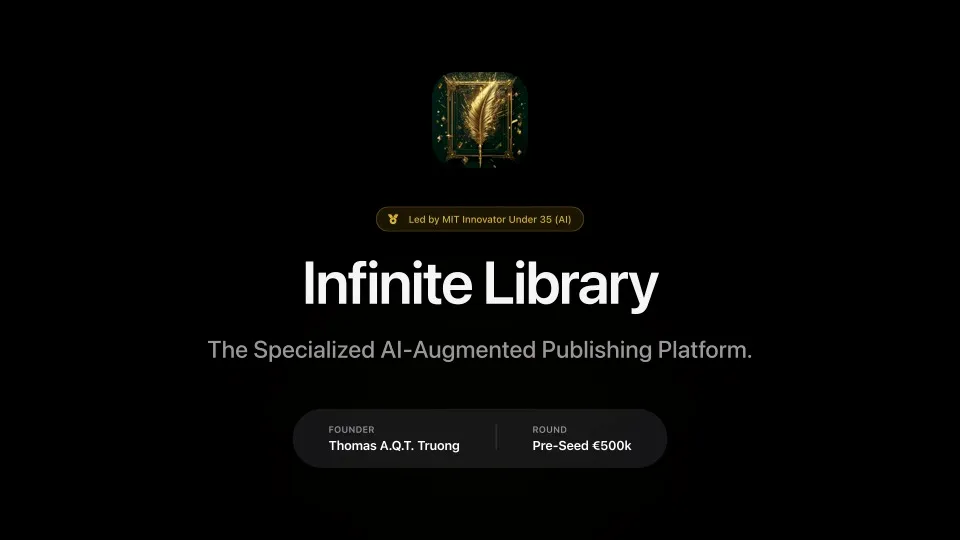
Thomas A.Q.T. Truong has a theory about the next big thing in media. It's not podcasts. It's not short-form video. It's books.

"We have WordPress, then we have YouTube videos, then we have social media posts, images," the Paris-based founder says. "The next evolution, I think, is going to be books. It allows everyone to create a legacy."

That conviction sits at the heart of Infinite Library, Truong's AI-powered publishing platform that promises to take anyone from a raw idea to a 100,000-word manuscript in an afternoon. The startup, now raising a €500,000 pre-seed round, is part ghost writer, part vanity press, part Amazon rival, and one of the more intriguing bets on where the collision of AI and the written word is headed.

Truong's name first came across my radar last year, related to another AI project. So when he reached out to discuss Infinite Library, I was curious for a wide range of reasons.

Even if Infinite Library can do what it promises, a thicket of harder questions surrounds the whole enterprise. Many of these are ones that, as someone who writes, researches, thinks, and creates for a living, I think about a lot: How are these new generation of AI tools re-shaping our world?

This is what compelled me to test the limits of voice AI tools, create an AI band, and publish a synthetic album to Spotify:

🐇 Follow Me Down The Voice AI Rabbit Hole 🎤
Voice AI has crossed the uncanny valley, turning sound, speech, and music into powerful tools. It’s fun, unsettling, and wildly investable. Welcome to the hottest, weirdest market in AI, where France is making some noise.

Writing a whole book? That hits even closer to home.

Publishing has always been, at least nominally, a meritocracy of ideas. The notion that a book reflects genuine thought, experience, and craft. A platform that can generate a 100,000-word manuscript challenges that assumption at its foundation, raising uncomfortable questions about authenticity, authorship, and what it even means to "write" something.

Of course, let's not be naive. The internet is flooded with AI-generated content. And when it comes to books, well, the famous and the rich have been hiring ghostwriters since forever, and that's never stopped them from becoming bestsellers. So, what if the third party is a machine rather than a human? Early surveys suggest significant consumer resistance to AI-generated content, particularly in genres such as memoir, self-help, and narrative nonfiction, where the perceived authenticity of the author's voice is precisely the point.

But as Deezer has found in its audience surveys, 95% of listeners can't tell the difference between AI and non-AI tracks. So in that case, if it's good, whether it's a book or a song, is that the only thing in the end that matters? If your memoir was written by an algorithm, is it still your story?

Beyond that, I was curious about several technical and legal issues and how they were being addressed.

So, on a recent morning, I sat down with Truong at the Petit Palais art museum to hear this pitch and get a demo.

Spoiler alert: This story ends with me testing Infinite Library to write a novel. (Or, at least a chapter)

The Age of Inevitability: A Silicon Valley Tale
Chapter I: The Tribes of the Future Gather

Chapter I

Truong came to France from Vietnam at 18 to study at the Sorbonne, eventually earning two master's degrees: one in artificial intelligence, another in data science from the Institut de Statistique de l'Université de Paris. He built accessibility tools before turning to publishing: VocalSign, which translates sign language into voice and text across 300 languages, and VocalAll, which vocalizes objects for the visually impaired. In 2023, MIT Technology Review named him an Innovator Under 35 in Europe.

But a late-night experiment with ChatGPT set him on the path to Infinite Library. Playing with the technology shortly after it launched, he figured out what he calls an algorithm that forces the AI to write an entire book in a single session. (That has broader technical implications, which I'll come back to in a moment.)

He saw a business. Not just a tool, he says: "a real business."

The pitch is seductive: 90% of aspiring authors never get past the outline stage, overwhelmed by the complexity and cost of writing a book the traditional way. Traditional publishing is gated; self-publishing is lonely. Truong wants Infinite Library to be neither. Users upload their research notes, YouTube video links, or a website URL, answer a series of AI-generated interview questions about their ideas, and then hit go.

The platform does the rest, generating a full draft with cover art, in the writing style of their choice: journalistic, Stephen King, take your pick.

Chapter II

Anyone who has tried to get a large language model to automate or perform extended tasks knows this problem all too well.

The AI starts strong, then loses the plot. Literally. Context windows run out. The AI makes mistakes.

Here's the thing about the current LLMs: They are amazing and revolutionary!

Here's the other thing about the current LLMs: They suck ass and are lying assholes!

Consider a November 2025 study by Carnegie Mellon and Stanford: "How Do AI Agents Do Human Work?: Comparing AI and Human Workflows Across Diverse Occupations." It compared human work with that of AI agents and made two critical findings.

First, GenAI and Agentic AI: "produce work of inferior quality, yet often mask their deficiencies via data fabrication and misuse of advanced tools." So, if you plug this stuff in, and you just let it go, not only do you NOT get productivity gains, but actually LOSE productivity because you will spend MORE time cleaning up their mess. Because when LLMs go off the rails and start making mistakes, they just keep right on going and pretending everything is fine, which is what leads to the hallucinations. Basically, they are Bullshit Machines.

For the moment. But....!

The study also found that for certain "readily programmable" tasks, the agents could "deliver results 88.3% faster and cost 90.4–96.2% less than humans, highlighting the potential for enabling efficient collaboration by delegating easily programmable tasks to agents."

So, this is where we are: If you can find the right, narrow tasks and set the tools to work on those, they are pretty damn good. Those are small now, but getting bigger every day. Because this type of AI has memory and context. It learns and remembers. It's like the newbie you hire on Day 1. You gotta teach it shit.

And then, when it has demonstrated it can handle it, you give it more shit. Etc.

But that brings us back to writing a novel. Infinite Library operates via an API call to ChatGPT. So how does he get it to stay on task without, well, losing the plot?

If characters wander, if a thriller becomes a children's book fifty thousand words in, if the model starts hallucinating, filling gaps with plausible-sounding nonsense rather than admitting it's lost, nobody is going to be happy.

Chapter III

Truong's solution is what he calls the "Chained Agent" architecture. It deploys what he describes as invisible agents working in parallel: one handling plot, another managing character bibles, another doing the actual drafting. The key feature is something he calls Active Recall: later chapters actively reference early ones to maintain coherence. He's also incorporated a "reasoning effort" mode that makes the AI think longer before it writes, reducing repetition and keeping the output on track.

In AI lingo, this is effectively known as developing "orchestration."

To help reinforce that, the system is set up as a constant dialogue between the author and the machine. One can enter a prompt and just ask it to generate a book. However, the system will continually ask refining questions. The author can have it create a page, a chapter, a section, or the whole thing to review and revise.

"The more you answer the questions, the better the book output will be," Truong said. The interview process, he adds, never officially ends. You just decide when you have enough to start generating.

It works better for some genres than others. For memoir and nonfiction, he recommends keeping the word count to around 50,000. Fiction, he says, can go longer. The further it roams from verifiable reality, the less hallucination matters.

Chapter IV

The core business model is straightforward for now: a pay-as-you-go credit system, with 10,000 words free and packages running from €30 to €325. Authors keep 95% of royalties from sales through the platform. Infinite Library takes 5%. Printing and shipping is handled through a partnership with Lulu Press.

The longer play is building out what Truong calls the Infinite Public Library, a marketplace for AI-assisted books, the Netflix of AI writing.

Commercially, this platform faces a structural tension between supply and demand, not to mention some potential legal limitations.

The same technology that makes it trivially easy to create books also risks flooding the market with them. Then there is the question every writer faces: How do you get anyone to discover your book?

Beyond that, the legal landscape is somewhat unsettled. For original works, Infinite Library leans on OpenAI's copyright shield, a provision that covers legal costs and damages for content generated via the ChatGPT API in the event of a copyright infringement lawsuit. Each book gets an ID tied to that coverage. In France, Truong notes, copyright is automatic upon creation: prove you generated the book under your email at a specific date and time, and the rights are yours.

Still, some cases remain murkier. Take fan fiction, for example. Say you want to write a novel about the sexual awakening of your favorite Harry Potter character. You can write it on the Infinite Library, you can share it, but you can't sell it without running into problems with the rights holders.

Publishing on Amazon requires a separate copyright registration process in both France (through the BNF) and the US (through the USPTO). Truong walks users through both. The platform also handles cover art automatically, pulling images from Unsplash and assigning them via AI.

Chapter V

For now, Truong is focused on securing funding to expand his marketing outreach and product development. Truong is a solo founder, which he acknowledges is a complication for fundraising. Most VCs want teams. But he has a counterargument ready.

"100% of the code was written by AI," he says. The website, the iOS app, and everything else were built using the Cursor coding environment. "AI will make a one-person billion-dollar company possible."

Post Script

After we met, Truong gave me some credits to take the Infinite Library for a test drive. And so I thought, "What great AI novel do I want to write?" Naturally, the answer: "A novel about AI and Silicon Valley." You can read a chapter here:

Comments

Latest