👋 Inside this week's edition:
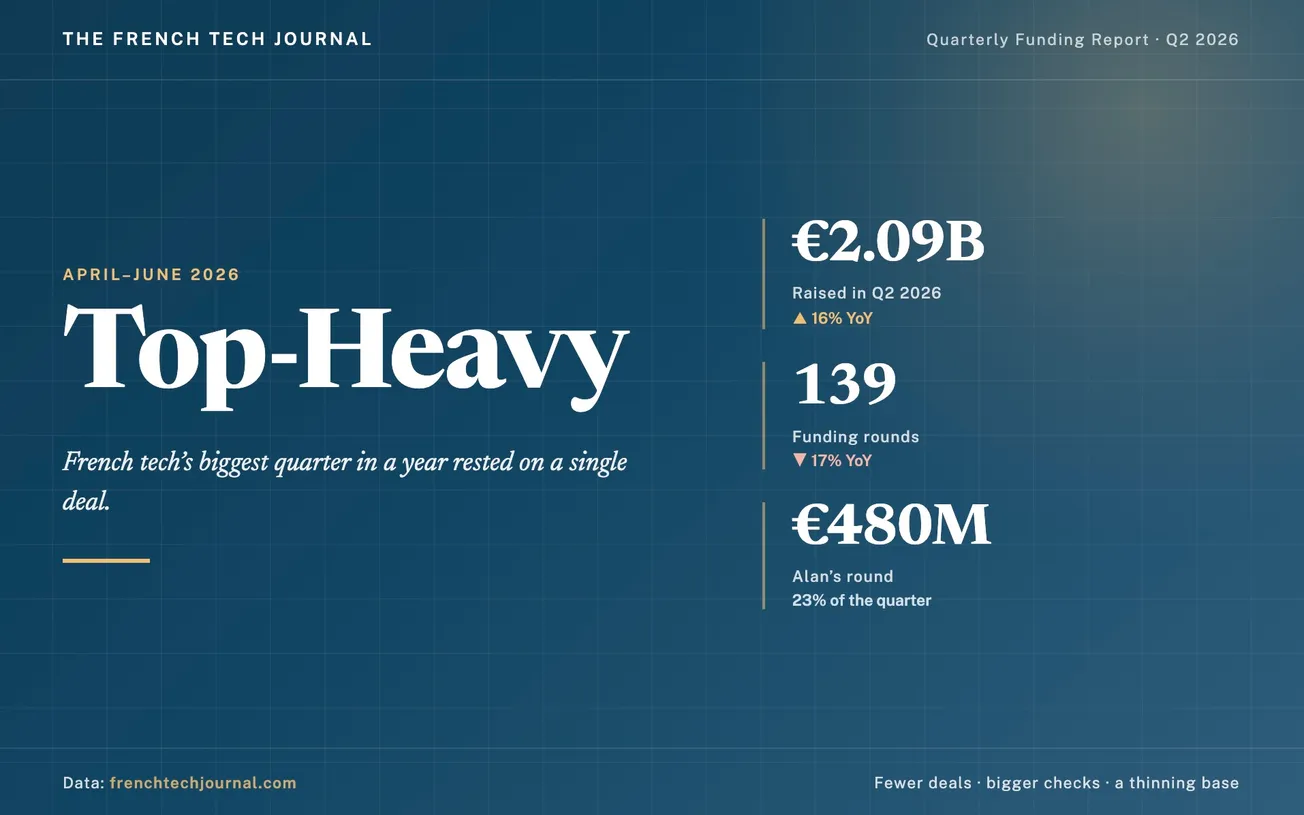
💸 The French Tech Journal Q2 2026 Funding Report is here: French startups raised €2.09 billion in Q2 2026 and are on pace for their strongest year since 2022. But beneath the rebound, deal counts have hit a six-year low, seed funding continues to shrink, and a handful of mega-rounds are reshaping the market. Read the breakdown.
👀 As AI assistants increasingly replace traditional search, a growing share of the world’s knowledge risks remaining invisible because it lives in video. French startup Aive says that it has found a way to make that content understandable and searchable for large language models.
Chris O'Brien + Helen O'Reilly-Durand

RAISE Summit returns to the Carrousel du Louvre on July 8–9, 2026, bringing together 9,000 global leaders at a pivotal moment for the industry alongside the launch of the CxO Summit & MACHINA Summit. With more than 80% of attendees at the C-level, RAISE has become one of the world's most influential forums where AI strategy, investment, policy, and deployment converge.
Tech Talk
🛍️🤑 Datadog (and its French founders) has acquired Paris-founded Adaptive ML, a startup built by former LightOn and Hugging Face researchers, to strengthen its AI research lab and accelerate its push into agentic AI for observability and cybersecurity. Rather than chasing the next blockbuster LLM, Adaptive focused on helping enterprises continuously improve their own AI using reinforcement learning, a sign that the industry's attention is shifting from building bigger models to making existing ones smarter over time. The real prize for Datadog isn't just the team; it's the chance to combine Adaptive's expertise with the vast stream of operational data flowing through its platform to create highly specialized AI agents. It's another reminder that in AI, proprietary data may soon matter more than proprietary models. | FrenchWeb, DataDog, AdaptiveML
🧮 🛒 Qonto is moving beyond business banking and into accounting, acquiring online accounting firm Acasi as it builds an all-in-one financial platform for entrepreneurs. The deal will let Qonto gradually roll out certified accounting services alongside banking, invoicing, and bookkeeping, while leaning on AI to automate the drudgery and leave human accountants to focus on higher-value advice. It's another step in Qonto's ambition to become the operating system for Europe's small businesses, and a reminder that fintechs increasingly want to own the entire financial workflow, not just your bank account. | LinkedIn
🇺🇸 🤝 Uncle Sam may be about to get a seat at OpenAI’s table. According to the FT, OpenAI is discussing selling a 5% stake to the US government as part of a broader plan championed by the Trump administration to give Washington equity stakes in leading AI companies. The proposal would reportedly channel returns through a public investment vehicle inspired by Alaska’s Permanent Fund, sharing some of the financial upside of AI with American citizens. Whether the idea becomes reality remains uncertain, but it signals a dramatic shift in how governments view frontier AI - not simply as a technology to regulate, but as a strategic national asset. If it happens, the debate won’t just be about who governs AI. It’ll be who owns it. | Financial Times, Les Echos
🇪🇺🇺🇸 Could Europe’s data transfer deal with the US be heading for another legal showdown? A recent US Supreme Court ruling gave President Donald Trump greater authority to dismiss commissioners at the Federal Trade Commission (FTC), weakening the agency’s political independence. That matters because the FTC is one of the key watchdogs underpinning the EU-US Data Privacy Framework (DPF), the agreement that allows European companies to transfer personal data to certified US firms. The framework remains in force, but privacy campaigners argue the ruling undermines one of the legal safeguards the European Commission relied on when approving the deal—and they’re already preparing a fresh challenge. For European businesses built on US cloud services, the question isn’t whether data can cross the Atlantic today, but whether the legal bridge will still be standing tomorrow. | L’Usine Digitale
🇫🇷 🇲🇦 French Tech Casablanca is taking French women founders on the road. The second edition of its Elles Tech Tour is bringing entrepreneurs from France and Mayotte to Morocco for a week of meetings with startups, investors, corporates, and innovation hubs, from Casablanca to Tangier. Last year’s program introduced Moroccan founders to the French ecosystem. This time, the journey goes the other way, reflecting French Tech’s growing role in connecting entrepreneurs across the Mediterranean. More than a study tour, it’s another reminder that innovation diplomacy increasingly happens through startup communities - not just governments. | PR - French Tech Morocco
📈 It only took 18 years, but...Withings has finally reached profitability. After weathering its failed Nokia chapter and pouring up to 27% of its revenue back into R&D, the French health tech pioneer says 2025 marks its first profitable year. With 15 million active users and ambitions in predictive healthcare, the company is proving that not every startup story follows the “grow fast, exit faster” playbook. Sometimes, the longest journeys make the strongest businesses. | Maddyness
🎮 From startup to prescribed therapy? French healthtech Poppins has cleared a major hurdle after France’s health authority (HAS) backed the provisional reimbursement of its game-based app for children with dyslexia. If approved by the Health Ministry, it would become one of the few digital therapeutics covered by the French healthcare system. The decision still hinges on additional clinical data, but it signals growing recognition that software can play a role alongside traditional care. For French digital health startups, the next challenge is proving they deserve a place on the prescription pad. | Buzz e-Santé
🏦 ⚛️ Quantum computing is inching closer to the trading floor. Crédit Agricole CIB and French quantum unicorn Pasqal are entering a new phase of their partnership, with plans to bring quantum-powered applications into production from 2028. After years of testing risk modeling and portfolio optimization, the focus now shifts to industrializing the technology for real-world banking operations. Quantum may still be years away from widespread deployment, but France is quietly positioning itself to be among the first to put it to work in finance. | Yahoo
French Tech Funding Reaches €4.83B in H1 2026. Just Two Deals Drove 91% of the Growth
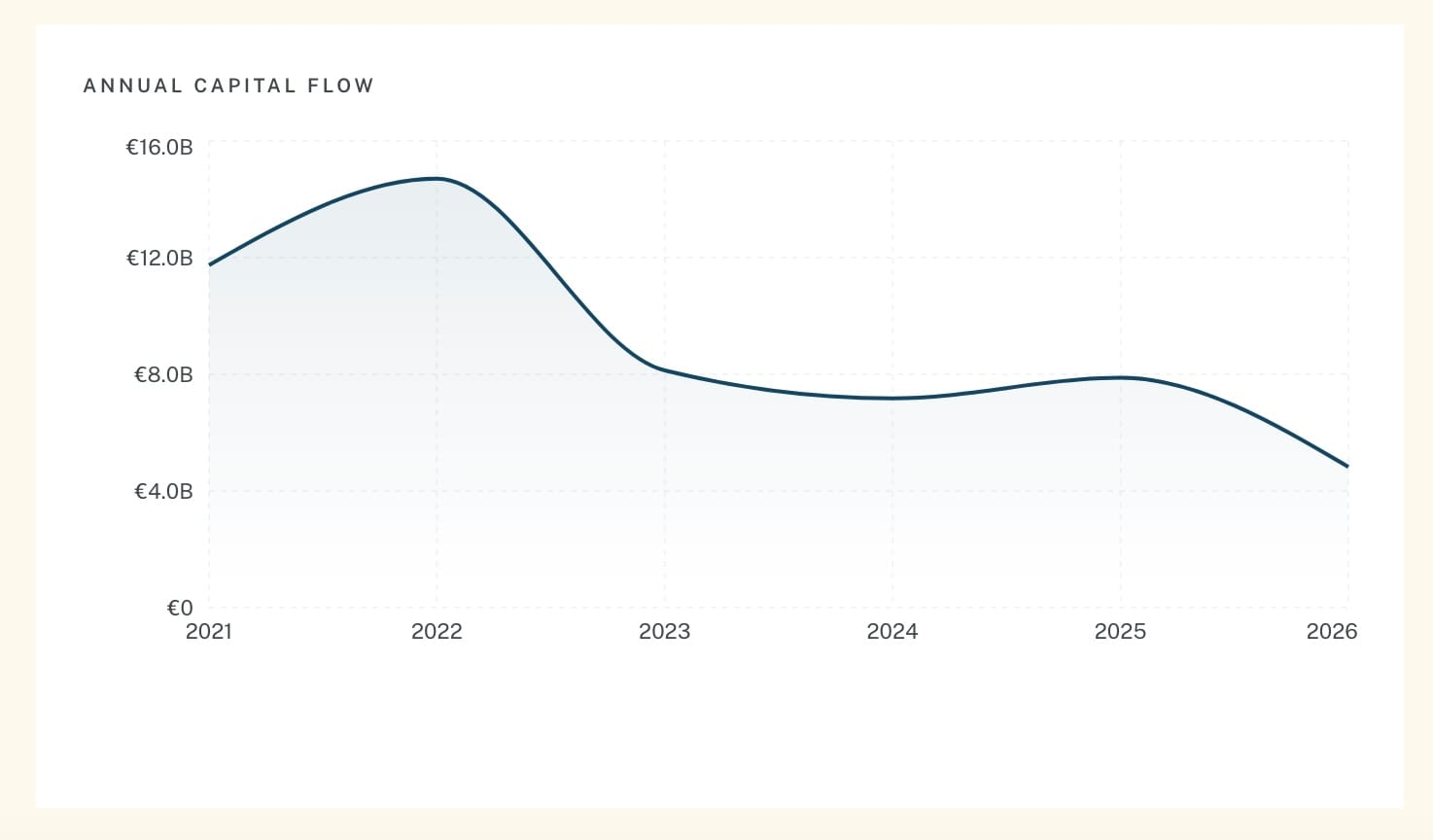
There's a version of the Q2 2026 French tech funding story that offers a comforting narrative.
French tech raised €2.09 billion between April and June, up 16% on last year. Four companies pulled in more than €100 million each. The typical round is bigger than it's been in six years. Overall, funding in the first half of 2026 is on pace to easily surpass 2025 levels, potentially the second consecutive annual increase.
It's tempting to embrace this as confirmation that the funding rebound is real.
Alas, there's a catch, and it's a big one. In June, Alan, the Paris health-insurance unicorn, closed a €480 million growth round led by Index Ventures, with Prosus, Dara Holdings, and Teachers' Venture Growth alongside.
That single deal is 22.9% of everything French startups raised all quarter. Pull it out of the numbers, and the picture inverts completely. The 16% gain becomes an 11% decline.
The Next Frontier For AI isn’t Generating Video. It’s Understanding It.
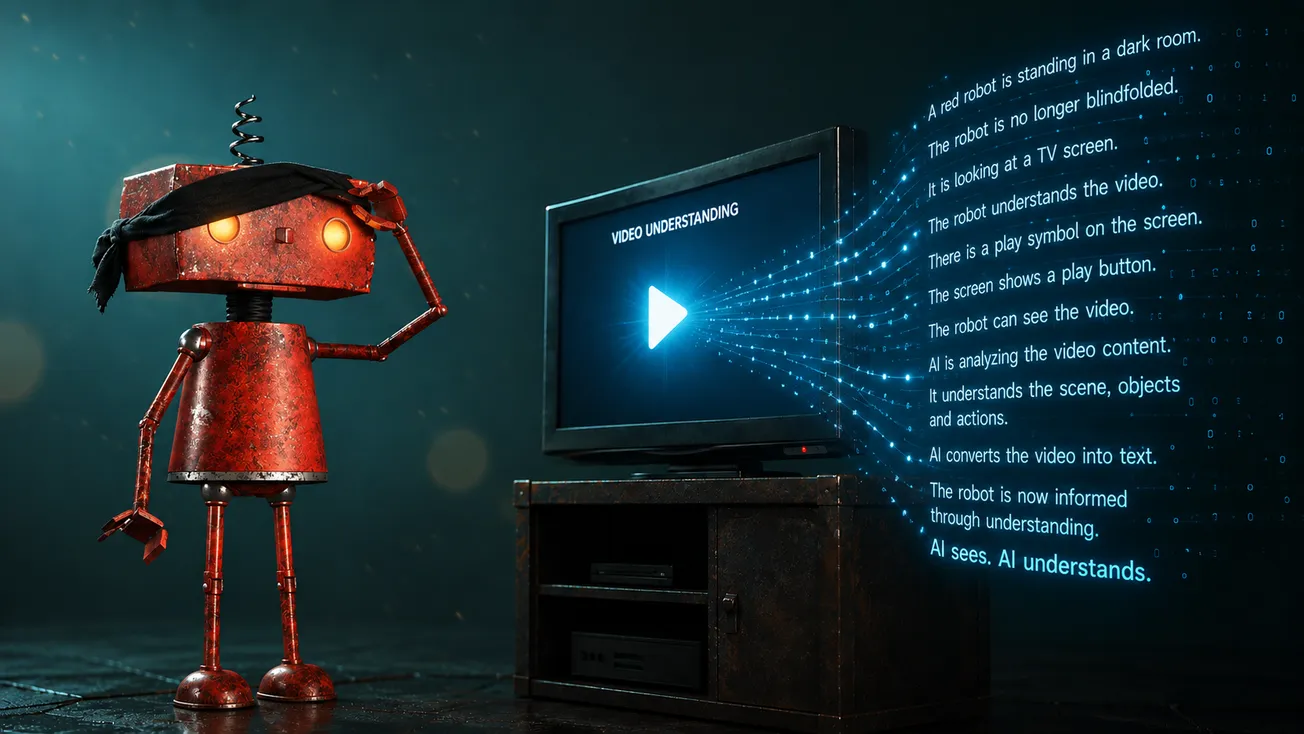
As clever as they are at generating text and images, AI assistants have a blind spot for video. Ask one for the best face cream, and you'll probably get an answer drawn from product reviews, blog posts, and retailer websites. But what if the best explanation of that product lives in a 10-minute demonstration video instead?
Large language models (LLMs) such as ChatGPT, Gemini and Claude remain surprisingly limited in what they can extract from video. They can process transcripts or metadata, but most of the audio and visual context — the products on screen, the demonstrations, the branding, the sequence of events — is lost on them.
French startup Aive believes that it is about to become a much bigger problem as AI assistants become the first stop for finding information online. The company, which recently announced a collaboration with Nvidia around its open-source Nemotron models, says its technology can transform videos into structured knowledge that AI models can understand and cite.
Rather than generating new videos, Aive analyses existing ones using its proprietary Multimodal Generative Technology (MGT), extracting information from the audio and visual content and converting it into machine-readable knowledge.
"If I'm advertising a cosmetics product through a ten-minute video, today's LLMs mostly see the transcript, if it's available to them," CEO and co-founder Olivier Reynaud said. "They don't really understand what's happening visually. Our technology transforms that video into knowledge that AI can use."
💸 Top Funding Deals 💸
📇 Company: Elixir Aircraft
🏷️ Sectors: Aerospace, Aviation, Manufacturing, Mobility
🔍 Description: Elixir Aircraft is a French aircraft manufacturer developing next-generation carbon-fiber training aircraft. Its flagship Elixir aircraft is certified in Europe and the U.S., offering lower operating costs, improved safety, and significantly lower emissions for pilot training.
💻 Website: https://www.elixir-aircraft.com
📍 HQ City: La Rochelle
🧗 Round: Growth Equity
💰 Amount Raised: €45 million
🏦 Investors: Bpifrance SPI Fund (lead), Odyssée Venture, Innovacom (Turenne Groupe), other investors
👨💼👩💼 Founders: Arthur Léopold-Léger, Cyril Champenois, Nicolas Migault
🗞️ News: Elixir Aircraft has raised €45 million to accelerate industrial expansion, international growth and launch Equinox, a new aircraft program that will expand its product range. The company will consolidate production into a larger manufacturing site, expand operations in the U.S., and strengthen its presence in Asia, particularly India. Since its last funding round in 2024, Elixir has nearly tripled production, now employs almost 250 people, and has more than 60 aircraft in service across Europe. The funding will also support commercialization following FAA certification and the rollout of the enhanced Elixir+ aircraft. Elixir says it now has an order backlog exceeding 300 aircraft and aims to scale production to five aircraft per month.
👋🏻 If you’re enjoying The French Tech Journal, support the project by forwarding it to friends and sharing it on your social networks. You can also comment on this post. And if you have ideas for stories, tips, or just want to harass us, shoot us an email: chris@frenchtechjournal.com / helen@frenchtechjournal.com 👋🏻