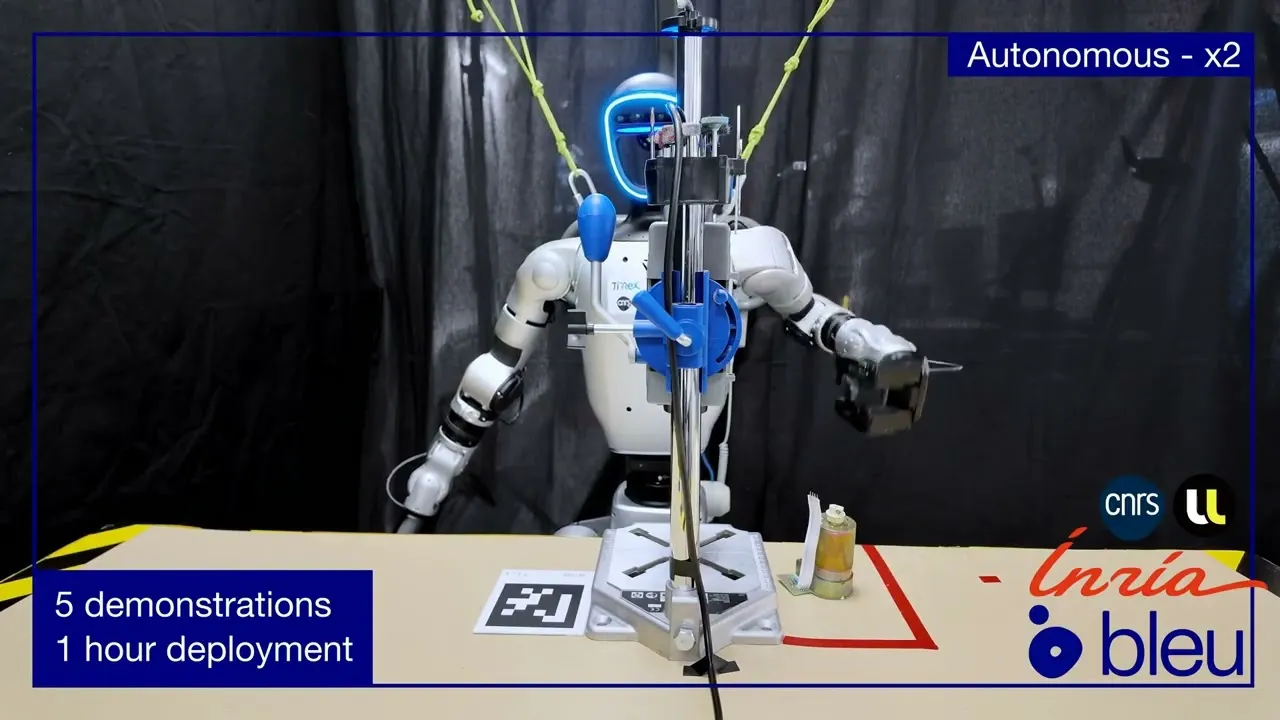
Humanoid robots are becoming easier to imagine on a factory floor. Getting one to do useful work there is another matter.
The internet is chock full of videos showing a machine walking and grasping in a demonstration. But in reality, they still need months of programming before they can take on a particular station. And even then, there's more training when the job or production line changes.


Bleu Robotics thinks it can shorten that gap. In doing so, it aims to speed up the practical deployment of robots.
The Paris startup, a spinout from INRIA, got a major boost to those efforts when it officially announced a €5 million Pre-seed Round, co-led by Contrarian Ventures and OVNI Capital, with participation from Kvanted, WEPA Ventures, Motier Ventures, and technology investor Charlie Songhurst.
Bleu Robotics at a glance
- What it does
- Builds the AI software layer for industrial humanoid robots. Its abductive learning model lets a robot learn a new factory task from about ten operator demonstrations, with the full deployment done in under an hour. The software runs on any ROS-connected robot; the company does not build hardware.
- Founded
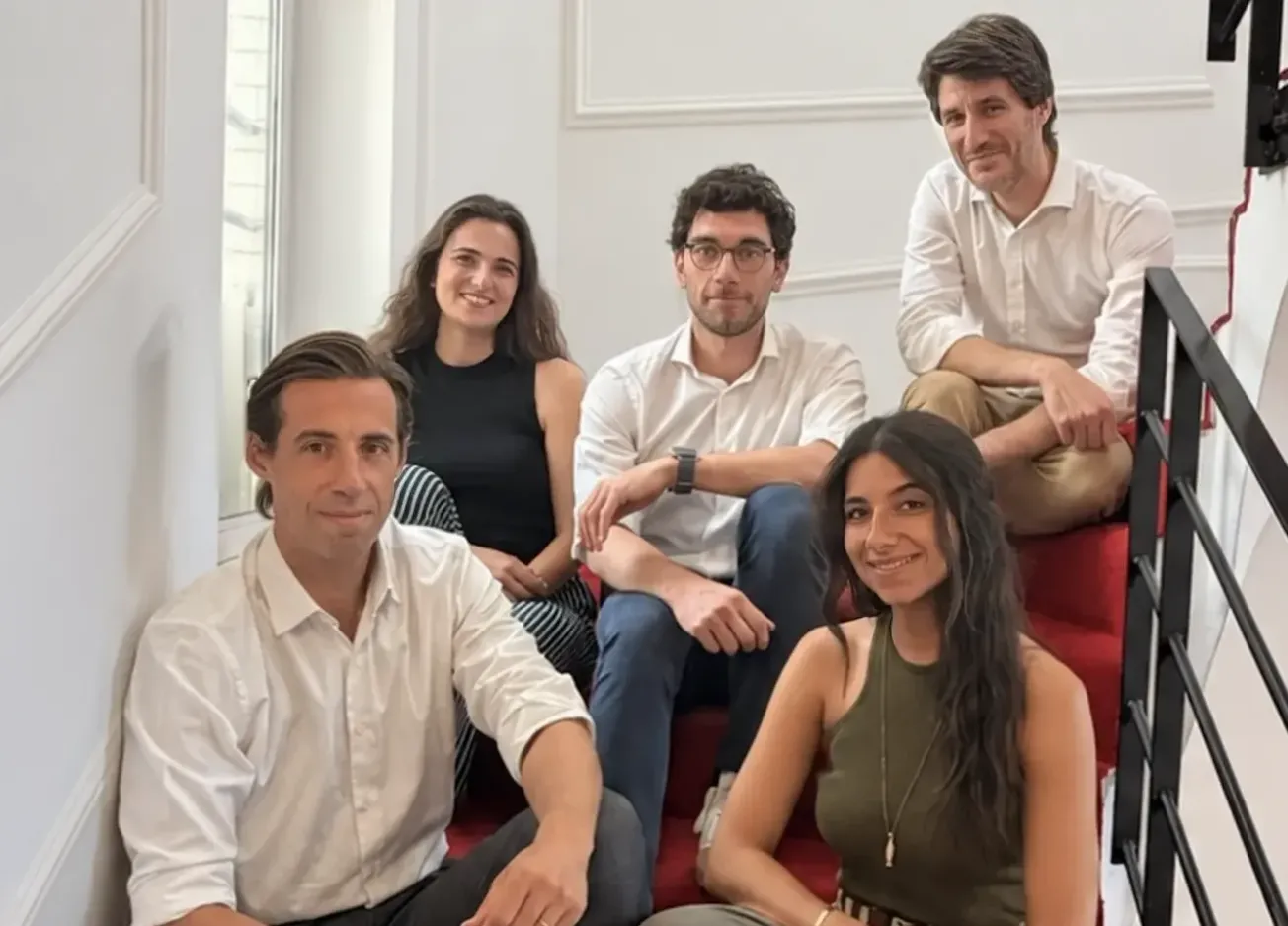
- December 2025 in Paris, as a spin-off of Inria's HuCeBot humanoid-robotics team in Nancy, by Benoît Berkoukchi (CEO, ex-Renault manufacturing manager) and Inria research directors Jean-Baptiste Mouret (directeur général) and Serena Ivaldi
- Headquarters
- Paris (20th arrondissement), with research roots in Nancy
- Employees
- Eight, with five open engineering and marketing roles in Paris (October 2026)
- First model
- Bleu_0.1, published March 2026; reported 98% success on the ManiSkill3 StackCube benchmark with fewer than ten demonstrations, trained in under two minutes on a laptop, tested on the Unitree G1 humanoid and the Franka Research 3 arm
- Customers
- Pre-commercial. First factory deployments under way with two unnamed major manufacturers in automotive and consumer goods; planned business model is a monthly subscription sold through robot makers and integrators
- Funding
- €5 million pre-seed, announced October 29, 2026; filings show the shares were subscribed in June–July 2026
- Investors
- Contrarian Ventures and OVNI Capital (co-leads), Kvanted, WEPA Ventures, Motier Ventures, and Meta board member Charlie Songhurst; filings also list Better Angle, Super Capital, Bear Flag Capital, and business angels
- Public programs
- France 2030 Pionniers de l'IA laureate (February 2026), 21st by CentraleSupélec accelerator (April 2026), Bpifrance i-Lab 2026 laureate; French patent application filed by Inria in November 2025
Sources: Bleu Robotics press release; The French Tech Journal interview with Benoît Berkoukchi; France AI Radar (INPI and BODACC filings)
The company is building software that teaches robots industrial tasks from about ten demonstrations, aiming to cut deployment from months to less than an hour. But that goal is still a work in progress. CEO and co-founder Benoît Berkoukchi describes the current goal as turning research into a product by testing it in factories, in a closed loop, before trying to scale.
"Humanoid robots will be useful in manufacturing facilities because they automate tasks that change over time," Berkoukchi said in an interview with The French Tech Journal, contrasting them with traditional industrial robots, which he describes as "blind and dumb" and built to "do exactly the same thing" forever. “Deploying a humanoid robot very quickly is the difference between a nice demo and deployment at scale."
A factory problem meets an Inria research team
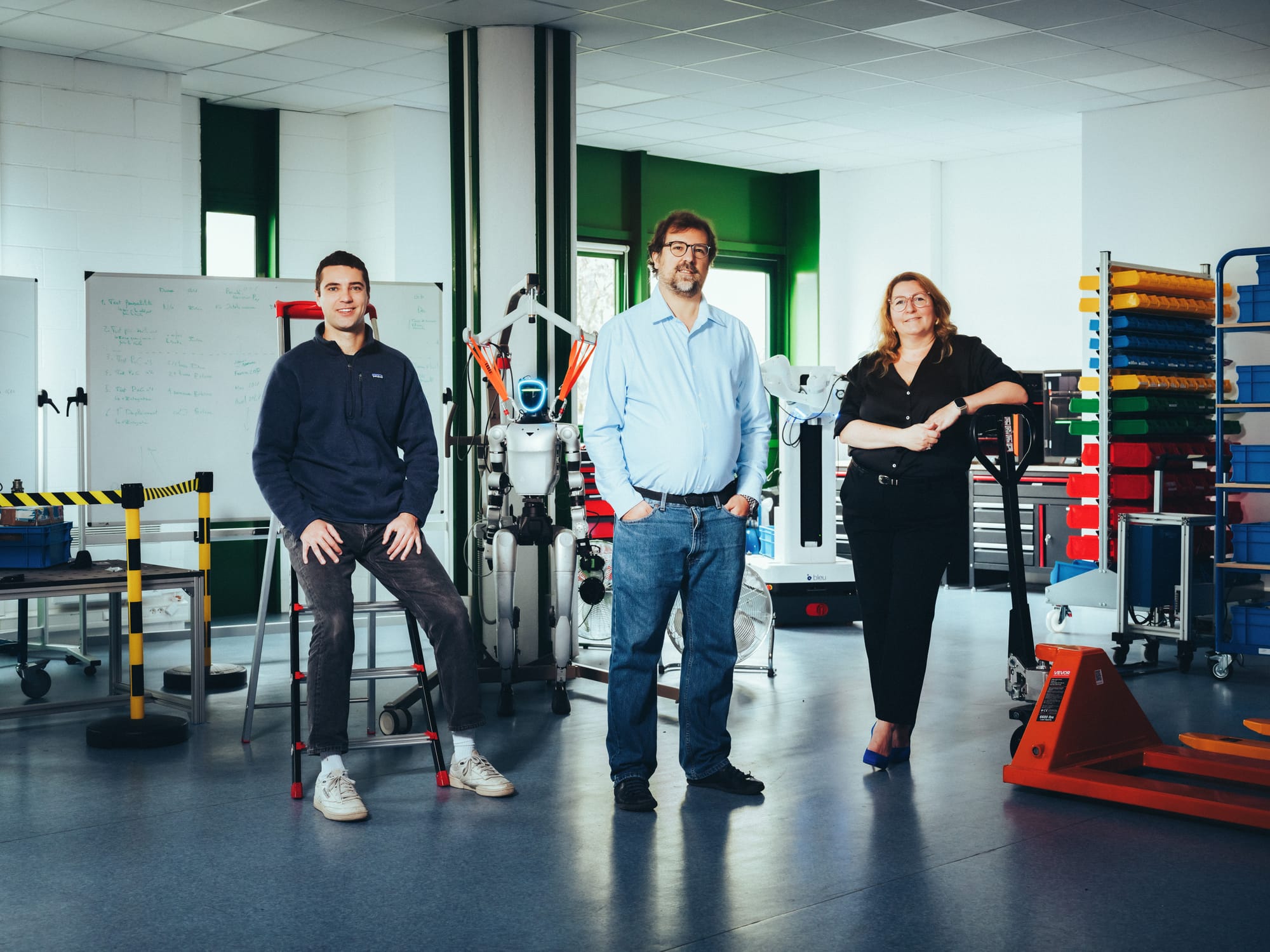
Berkoukchi's own route to robotics began on those production lines. He spent three years as a manufacturing manager at Renault, then worked in a Paris startup.
Bleu is a spin-off of Inria's HuCeBot humanoid-robotics team in Nancy. Co-founders Jean-Baptiste Mouret and Serena Ivaldi are research directors at Inria, where they have spent years working on humanoid robotics and AI. Mouret created the MAP-Elites algorithm, which appeared on the cover of Nature in 2015. Together, they have published hundreds of papers and organized some of the field's major humanoid conferences.
Inria filed a French patent application naming them as inventors in November 2025, and the company was registered in Paris the following month.
The decision to commercialize Bleu reflected several converging factors. As humanoid hardware gets cheaper, machine-learning and vision systems have become better at interpreting the world. That creates an opening for software companies, Berkoukchi said.
"Right now, you can buy Unitree robots for 30k," he said. "So the fact that the hardware is being commoditized is a strong incentive to build capable software."
Teach the task, not every movement
The company’s technical bet is that factory robots do not need to learn everything at once. Many current approaches use an end-to-end neural network: feed it large amounts of data and train it to produce actions.
That works when plentiful data is available. But robot demonstrations are scarce, and factory tasks are not as easy to collect as internet text and images. The data problem becomes especially acute when every new station or task demands another training cycle. That lack of training data is a broader challenge facing the emerging Physical AI sector.
"Imagine you were in the '80s," Berkoukchi said. "You want to build ChatGPT, and so you have to write the web yourself before training."
Bleu's answer is to stop trying to learn everything from scratch. A robot doesn't need demonstrations to learn how to move its joints or pick an object out of a camera feed. Existing controllers and pre-trained vision models solve those problems, more or less.
This deliberately narrow approach is called "abductive learning." It starts with capabilities the team believes robots already have or can use from existing tools. General vision models can help identify objects. The robot’s kinematics describe how it moves. A controller handles whole-body motion.
Instead, the company’s model focuses on the job itself, learning from object positions and demonstrations rather than trying to infer every movement from raw pixels.
Bleu works in factories rather than relying solely on simulation. Berkoukchi argues that simulated environments can help robots learn generic movements such as walking, but modeling each workstation in enough detail for task learning doesn't scale. His company wants operators to teach robots where the work happens and then learn from those deployments.
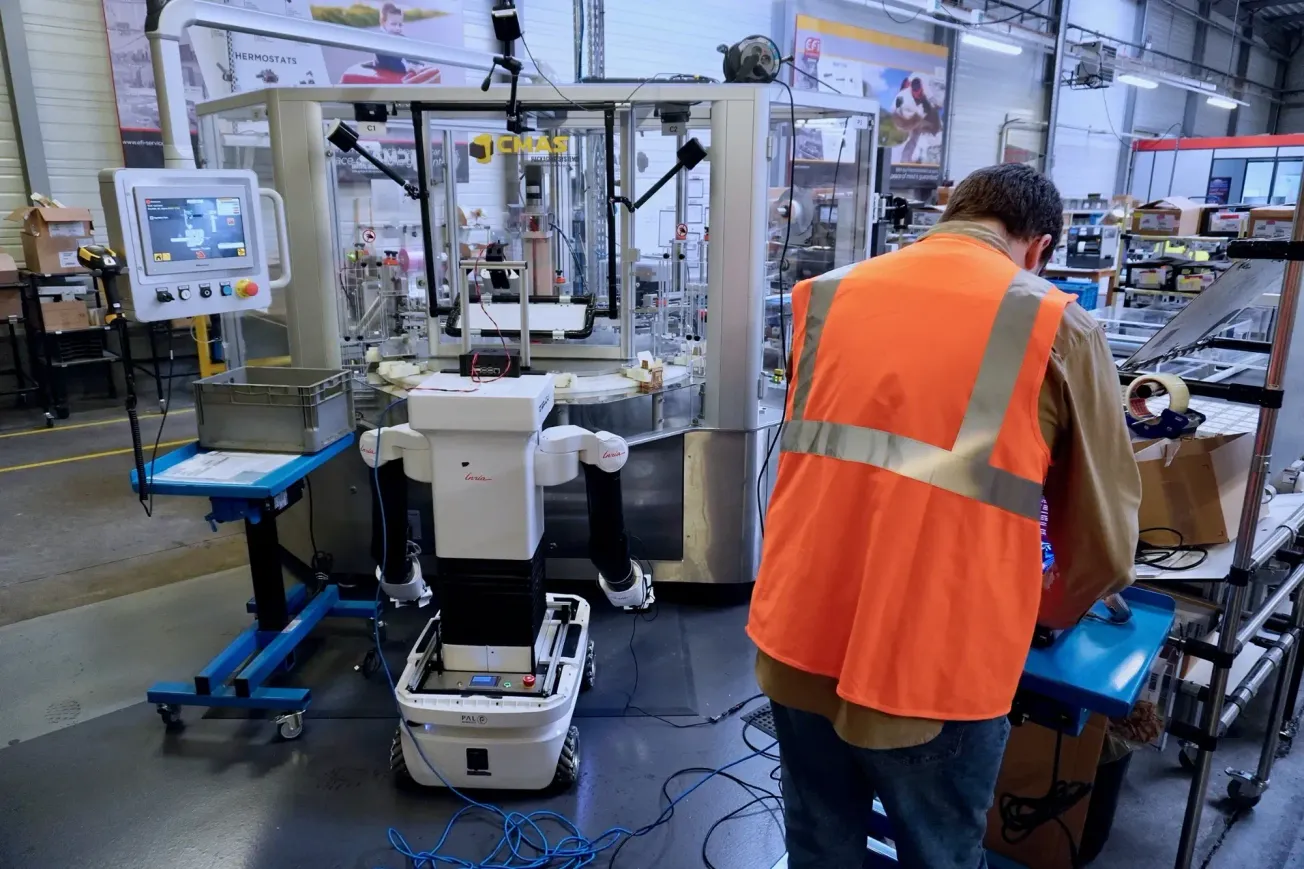
In practice, an operator demonstrates a task using handheld grippers, without writing code. Bleu’s algorithm looks for a simple process that explains the demonstrations and can be repeated when the objects or their positions vary within a familiar range. The company says training can take less than two minutes on a laptop and that a robot can be taught and deployed in under an hour.
"What we say at Bleu is we already know how to move a robot without this data. We already know how to segment objects through some general vision models," Berkoukchi said. "And for learning with few examples, we need to learn a few things. And the few things we want to learn are the task itself."
The model is built in layers. Perception comes from off-the-shelf trackers. Motion comes from a whole-body controller. In the middle sits the part that comes out of Mouret's research: an abductive learning layer that treats the ten demonstrations as descriptions of a single task and searches for the simplest geometric process that explains all of them.
The model can stop and ask for help when it encounters a trajectory outside its training distribution. That is a useful guardrail, but it also makes the limits visible: stopping safely is not the same as finishing the job autonomously. Bleu’s near-term roadmap includes improving precision manipulation, teaching interfaces, and movement between workstations.
Bleu’s first model, Bleu_0.1, was introduced in March. It has run on a Unitree G1 humanoid and a Franka Research 3 arm, and the company says its software can work with any robot connected through ROS. In benchmarks reported in the company’s technical material, Bleu_0.1 achieved 98% success on ManiSkill3 StackCube with fewer than ten demonstrations.
In practical terms, Berkoukchi said, the model needs "100 to 1,000 [times] less data for training than state-of-the-art models, and less data means less time spent gathering data, less compute, and this is how we shorten the deployment time."
Berkoukchi said the model doesn't simulate, for one. Simulation and reinforcement learning work fine for teaching a robot to walk, because walking doesn't involve touching anything. Factories are different. "If you have to do it in a factory, you have to simulate the factory, and you have to simulate each workstation very precisely, and this does not scale."
And it doesn't generalize far beyond what's been shown.
"We don't pretend we're going to do all tasks," he said. The robot repeats a demonstrated movement "with a certain level of generalization in the distribution. This applies very well to manufacturing operations because this is where people repeat the same job all day." Unloading a dishwasher, with its random assortment of glasses and plates, is out. So is anything soft. "We do not manipulate soft objects. So for example, it's not useful for folding cloth. But this is a limitation that does not matter in manufacturing facilities."
The real test begins on the factory floor
Bleu is not building a robot. Instead, its model is designed to work across hardware platforms, letting manufacturers and integrators teach machines new jobs without starting from scratch each time.
"You need to be able to deploy the robot very quickly on new tasks," he said. "Otherwise, if you take four months to deploy a robot on a new use case, then you're competing with traditional robotic solutions: the cell, the integrators, the conveyor. Because this also takes four months."
The €5 million round is intended to get the company through the next stage: a first model with limited capabilities that is nevertheless useful enough to deploy. Bleu also has received public and research backing. France 2030 selected it as one of the 23 Pionniers de l’IA projects under a €10 million pool shared across those projects; Bleu’s allocation has not been disclosed. It won the 2026 i-Lab innovation competition and joined CentraleSupélec's 21st support program.
“The amount of those grants is not much compared to the equity we raise now,” he said. What matters, he added, is “the recognition that what we do is deep research.”
The company is currently working with an automotive and consumer goods partner in a factory. "We need to test in closed loop in real factories what we do," Berkoukchi said. "This is how we learn fast, we fail fast, and we recover fast."
Rather than selling to factories specifically, the goal is for Bleu's model to be the software inside humanoid robots. The integrator buys a humanoid with Bleu loaded, installs it, and the manufacturer pays a monthly subscription "for using the software, training new tasks, and accessing the latest release of the model."
"When you buy a new computer, you already have Windows and Excel in it, and then you pay a subscription for using it. It will be the same thing with Bleu inside industrial humanoid robots," he said.
Further down the road, the company bets the data flywheel comes after deployment, not before. “You first should deploy a robot,” he said, arguing that the company should collect real-world experience and train larger models on top of it, rather than wait to build a massive robot dataset upfront. The idea resembles a broader software strategy: get the system into use, then improve it through what happens in the field.
"We think that we can be the first company to deploy those robots at scale and win this race," he said. "Because this is a race."