It’s not every day that a startup is born a unicorn. But when Turing Prize winner Yann LeCun is your co-founder and executive chairman, the rules of the game change considerably.
Advanced Machine Intelligence Labs (AMI) officially announced today that it has raised $1.03 billion (approximately €890 million) in a seed round, valuing the Paris-headquartered company at $3.5 billion pre-money.
That makes it the largest seed deal in European history and instantly vaults AMI into the rarefied air of AI unicorns before the company has shipped a single product.
The round was co-led by Cathay Innovation, Greycroft, Hiro Capital, HV Capital, and Bezos Expeditions, with participation from a globe-spanning roster of backers including Nvidia, Samsung, Toyota Ventures, Temasek, Bpifrance, Groupe Industriel Marcel Dassault, Association Familiale Mulliez, Publicis Groupe, and Aglæ Ventures (the LVMH-linked fund).
Individual investors include Jeff Bezos, former Google CEO Eric Schmidt, Mark Cuban, Xavier Niel, Tim and Rosemary Berners-Lee, and Jim Breyer. AMI had initially set out to raise €500 million but was overwhelmed by demand, ultimately doubling its target.
The company is the brainchild of LeCun, 65, who spent over 12 years at Meta, most recently as VP and Chief AI Scientist. He departed in November after growing disagreements with the direction of Meta’s AI strategy. His core argument: the large language models (LLMs) powering chatbots like ChatGPT and Gemini are fundamentally limited. They operate in the world of text. They don’t understand physical reality. They can’t plan ahead. In LeCun’s colorful formulation, they don’t even have the reasoning capacity of a house cat.
“I am very clearly in the camp that believes we need a paradigm shift” from the AI industry’s reliance on LLMs, LeCun told AFP. AMI’s work, he explained, continues directly from his research at Meta on a new architecture called JEPA: the Joint Embedding Predictive Architecture. “It’s a direct continuation of that project,” he said (AFP).
So what exactly is AMI building?
The answer is “world models.” These are AI systems designed to build abstract representations of the physical world, reason about cause and effect, and predict what happens next in real environments. Unlike LLMs, which generate text by predicting the next token in a sequence, world models aim to understand continuous, high-dimensional, noisy reality. That's the kind of data that flows from cameras, sensors, and the physical world around us.
As AMI’s website puts it, the company is “building a new breed of AI systems that understand the real world, have persistent memory, can reason and plan, and are controllable and safe.”
The practical applications, if the technology works, could be enormous: robotics, autonomous driving, healthcare diagnostics, industrial process control, augmented reality, and more.
AMI Assemble
CEO Alexandre LeBrun, a serial French entrepreneur who has been building AI products for over two decades, is candid about both the ambition and the timeline. “AMI Labs is a very ambitious project, because it starts with fundamental research. It’s not your typical applied AI startup that can release a product in three months,” he told TechCrunch. The company will spend its first year focused on R&D, with corporate partner discussions beginning in six to 12 months. Commercially viable products could be several years away.
LeBrun’s own track record is impressive. He founded VirtuOz in 2002 (a chatbot pioneer acquired by Nuance/Microsoft), then Wit.ai in 2013 (a natural language platform acquired by Meta after going through Y Combinator). At Meta, he worked closely with LeCun at FAIR, the company’s AI research lab. He went on to co-found Nabla, an AI-powered healthcare assistant now serving 85,000 physicians. Nabla will be AMI’s first strategic partner, with its customers getting early access to AMI’s world model research. LeBrun is transitioning from CEO of Nabla to Chief AI Scientist and Chairman there, while taking the CEO role at AMI.
"While the solutions we've shipped have (I hope) had a positive impact and helped people, they all relied on 'shortcuts,'" he wrote on LinkedIn. "Generative architecture trained by self-supervised learning 𝑚𝑖𝑚𝑖𝑐 intelligence; they don't genuinely understand the world. Predicting tokens, though powerful, works best for discrete and low-dimensional tasks like information retrieval, summarization, coding, and mathematics. However, factories, hospitals, and robots operating in open environments demand AI that grasps reality. And reality is not tokenized: it’s continuous, noisy and high-dimensional. Despite their immense power, I do not believe that generative architectures are the path to achieving this true understanding. It is time to move beyond shortcuts and work on a foundational solution. 𝐖𝐨𝐫𝐥𝐝 𝐦𝐨𝐝𝐞𝐥𝐬 learn abstract representations of real-world data, ignoring unpredictable details, and make predictions in representation space."

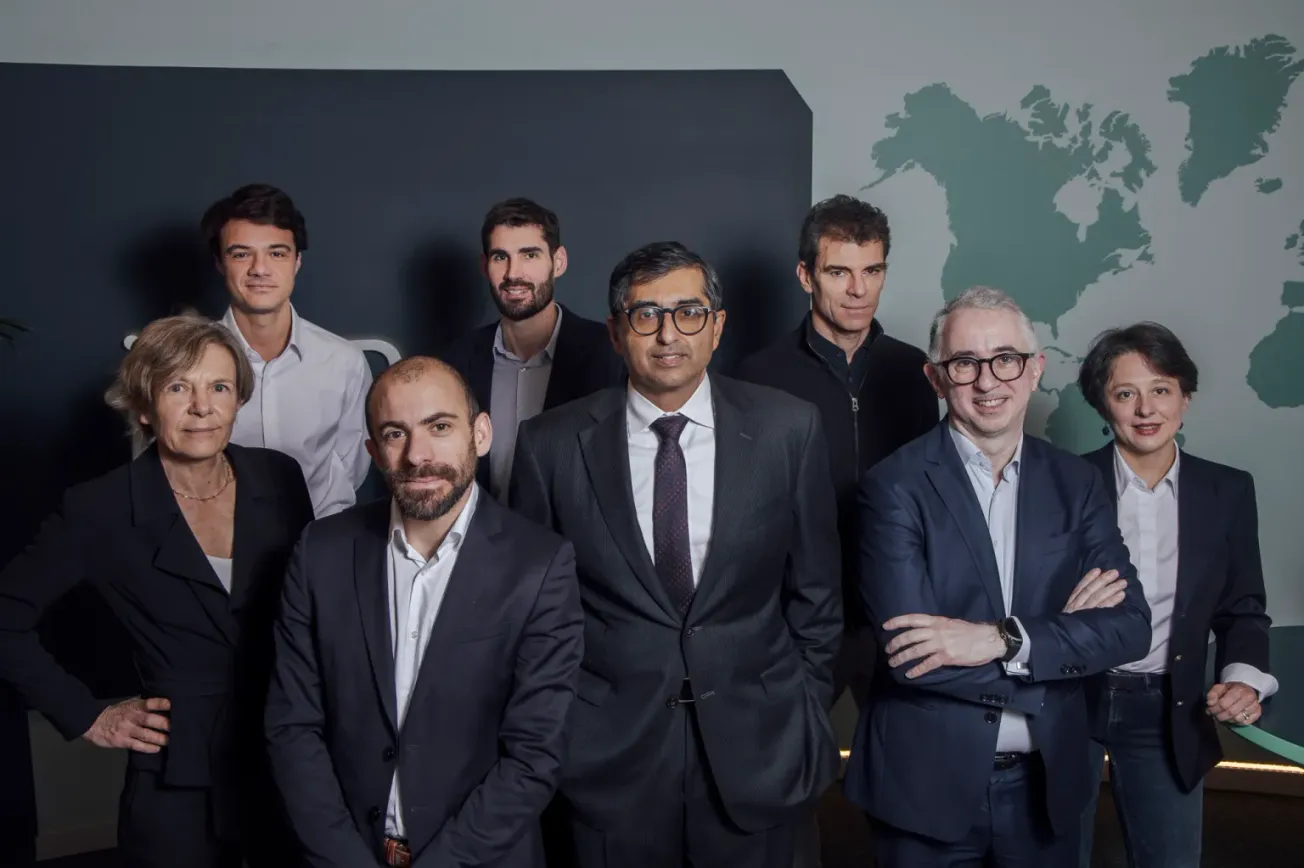
The founding team around LeCun and LeBrun is an all-star roster drawn almost entirely from Meta’s AI research apparatus:
- Saining Xie, the Chief Science Officer, is a specialist in visual representation learning who worked at both Google DeepMind and Meta.
- Pascale Fung, the Chief Research and Innovation Officer and the only woman on the founding team, is a Chair Professor at the Hong Kong University of Science and Technology, a fellow of the AAAI, IEEE, ACL, and ISCA, and formerly a Senior Director of AI Research at Meta-FAIR.
- Michael Rabbat, VP of World Models, was a director of research science at Meta-FAIR and an associate professor at McGill University. In his LinkedIn post announcing the launch, Rabbat wrote that world models are essential for enabling AI agents to “predict the consequences of their actions before they take them,” highlighting the massive research challenges ahead, from scalable representation learning to hierarchical planning.
Rounding out the co-founding team is Laurent Solly, the company’s COO and the sole non-technical founder. Solly spent nearly 13 years at Meta, most recently as VP for Europe, and before that served as General Manager of TF1, France’s leading TV broadcaster.
His earlier career took a notably different path. He was Chief of Staff to Nicolas Sarkozy at France’s Ministry of the Interior and during the 2007 presidential campaign.
In his LinkedIn announcement, Solly wrote that his experience alongside LeCun at Meta, where they helped grow FAIR Paris into the largest AI research lab outside the United States, convinced him that Europe possesses the talent to lead in AI. "Researchers from that lab went on to co-found some of Europe's most important AI companies," he wrote. "It confirmed something I have believed for a long time: Europe has the talent to lead in AI. What it has often lacked is the right structure to turn world-class research into world-class technology companies."
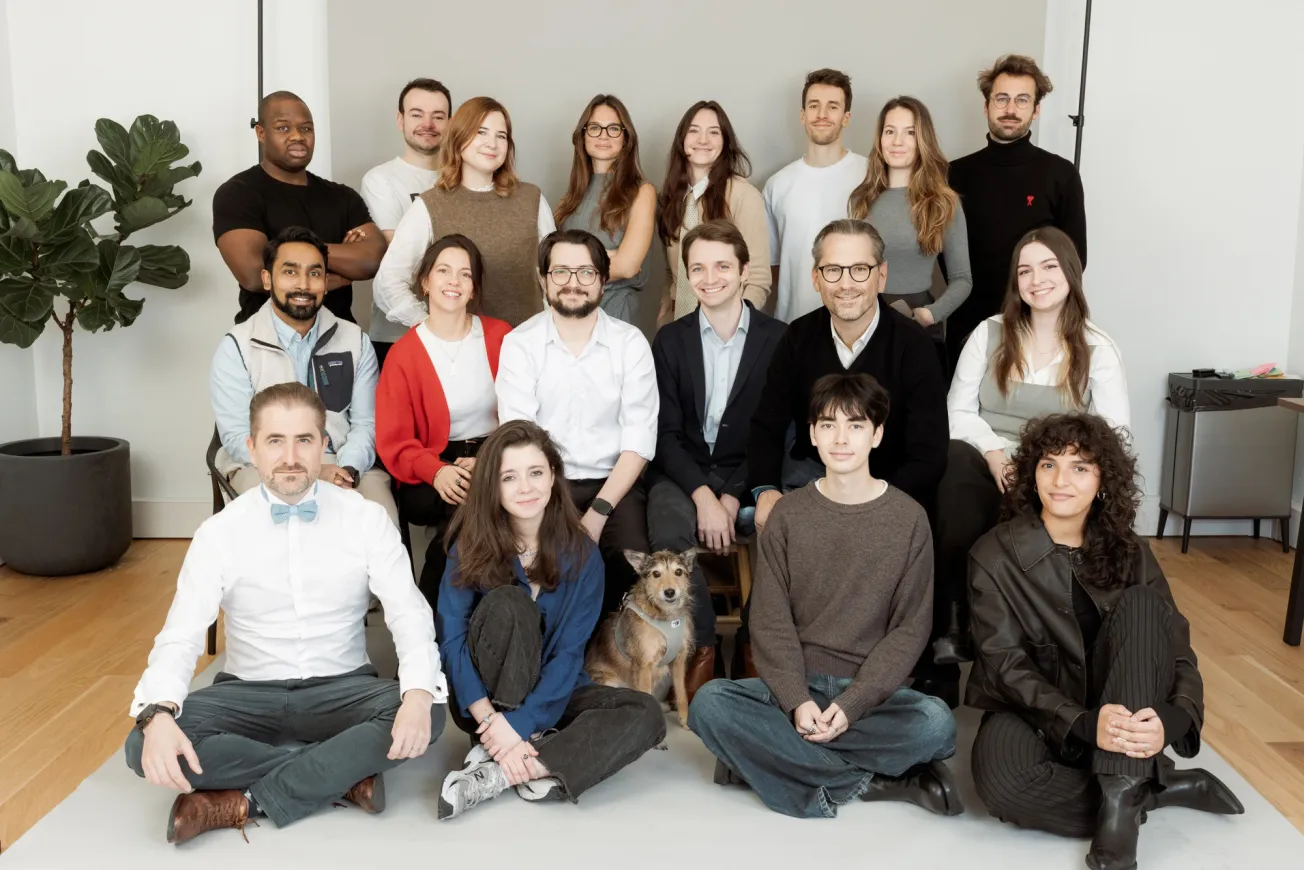
The company is incorporated as a French SAS (simplified joint-stock company) headquartered in Paris, with offices in New York, Montreal, and Singapore. Currently about a dozen people strong and almost entirely composed of researchers, AMI plans to grow to 30–50 employees within six months.
The geographic spread is deliberate. “We wanted to be very global from the start,” LeBrun told Les Echos. The investor base mirrors this ambition: roughly one-third American, one-third European, one-third Asian.
Big Seed Energy
The size of the Seed Round is certainly notable. But it is yet one more way that reflects the unusually close ties between AMI and Nabla. Most of Nabl's investors also invested in AMI:
- Cathay Innovation — co-led the AMI round
- HV Capital — co-led the AMI round
- Xavier Niel — individual investor in AMI
- ZEBOX Ventures — participated in the AMI round
- Artémis (Groupe Artemis) — participated in the AMI round
That's five investors appearing in both. Given that LeBrun co-founded Nabla and is now CEO of AMI, and that Nabla is AMI's first announced strategic partner, it makes sense that his existing investor relationships carried over. Cathay Innovation and HV Capital going from Nabla backers to AMI co-leads is particularly notable.
Of course, the sheer scale of the seed round speaks to both the prestige of LeCun’s name and the growing investor appetite for alternatives to the LLM paradigm.
As PitchBook noted, world model startups have attracted increasing attention: Fei-Fei Li’s World Labs raised $1 billion last month, and European startup SpAItial secured a $13 million seed round. But AMI’s billion-dollar debut, PitchBook reported, sets a new benchmark as Europe’s largest seed deal to date.
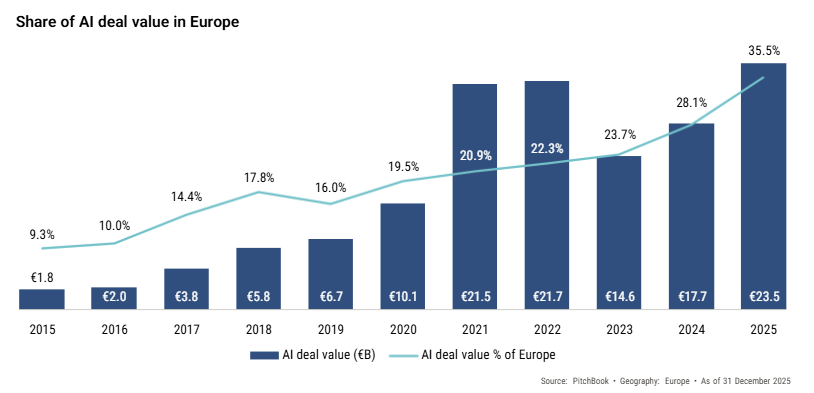
In 2025, 35.5% of European VC deal value was sunk into AI, according to PitchBook. That is predicted to top 50% in 2026. Certainly, the AMI will give that a boost.
“Advanced Machine Intelligence Labs’ $1.03 billion financing compounds a major couple of days for the European VC AI ecosystem," said PitchBook’s Nalin Patel, Director of EMEA Private Capital Research, in a short report about the funding news. "Earlier this week, Nscale's $2 billion round, which valued the UK-based AI startup at $14.6 billion, made headlines as one of the largest rounds on record, and in turn created one of the most valuable VC-backed companies in Europe. And only a few weeks ago, Ineffable Intelligence was in talks to raise $1 billion at a $4 billion valuation, potentially one of the largest rounds on record, not only at the seed stage, but across the entire European VC landscape."
The French AI Cock Crows
President Emmanuel Macron weighed in with a congratulatory post on X, calling LeCun’s move a testament to “the France of researchers, builders and the bold."
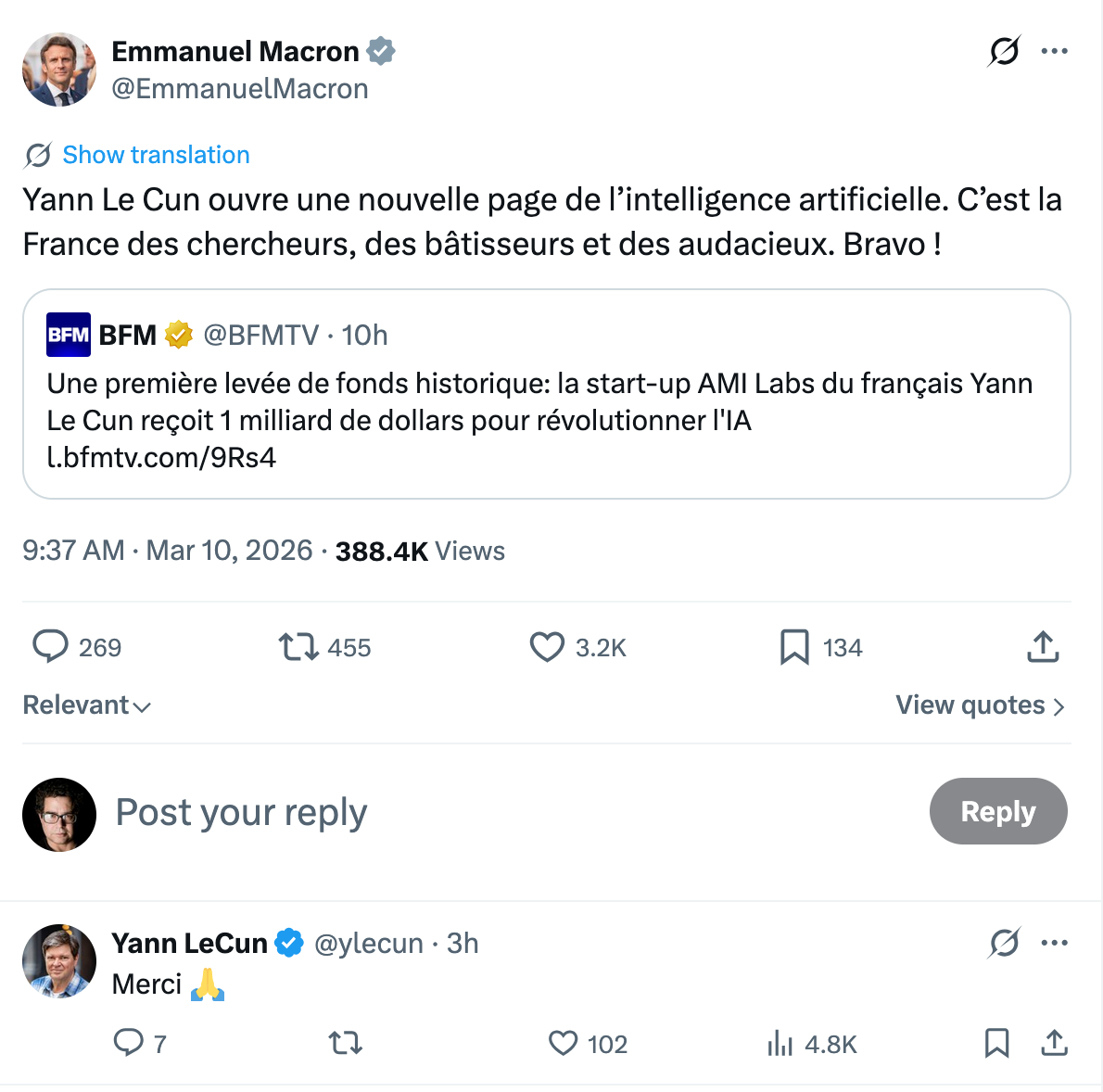
It’s the kind of endorsement that underscores a broader narrative: France and Europe are betting that they can compete in the global AI race, not by mimicking Silicon Valley, but by charting a different technological path.
LeBrun frames AMI as something like a third way in an increasingly bipolar AI world dominated by the U.S. and China.
AMI is also committed to open source and open research, a stance that aligns with LeCun’s long-held convictions and places the company in the same philosophical camp as Mistral AI, Hugging Face, and DeepSeek. The founders say they’ll publish their research papers and release most of their code openly. It’s a deliberate contrast with companies like OpenAI and Anthropic, which have moved toward more closed approaches.
LeBrun told Le Monde that AMI believes openness is the best way to manage AI risks, rather than concentrating powerful technology in the hands of a few companies.
None of this, of course, guarantees success.
The world model approach remains unproven at commercial scale. LeCun himself acknowledges the research is at an early stage, though he believes the work done on JEPA at Meta has reached an inflection point. The competitive landscape is fierce, with OpenAI, Google, and Anthropic all investing heavily in their own approaches to physical-world AI and robotics. And a $3.5 billion valuation for a month-old company with no product and a dozen employees is, by any measure, an extraordinary bet on the future.
But if AMI’s founding team has its way, the future of AI won’t be built on predicting the next word. It will be built on understanding the real world.
Real world. Real intelligence. And lots of real cash.
Now the hard part begins.