When I profiled quantum computing startup Pasqal three years ago, the company had just closed a €100 million Series B and employed about 100 people. Then CEO Georges-Olivier Reymond was full of praise for state bank Bpifrance, which had supported the company at virtually every stage of its journey, from a €60,000 emergence grant to hire its first employee to direct investment through its Large Venture Fund.
Now, Pasqal is making the biggest bet of its young life. The Paris-based company has announced that it has agreed to merge with Bleichroeder Acquisition Corp. II, a Nasdaq-listed SPAC, in a deal valued at $2 billion pre-money.
If all goes to plan, the transaction will close in the second half of 2026 and make Pasqal a publicly traded company on Nasdaq, with a dual listing on Euronext Paris to follow.
It is, by any measure, a landmark moment for the French deep tech ecosystem. And Bpifrance is right there in the middle of the deal, anchoring the convertible financing alongside new institutional investors.
The numbers
Let’s start with the financial architecture, which is layered and worth unpacking.
The deal assigns Pasqal a pre-money rollover equity value of $2 billion, with a pro forma market capitalization of approximately $2.6 billion and a pro forma enterprise value of roughly $2 billion.
The transaction is structured to deliver more than $600 million in gross proceeds to the company. That capital comes from three sources: approximately $289 million sitting in Bleichroeder’s trust account as of late February (assuming no shareholder redemptions), $200 million in committed convertible financing, and about $158 million already on Pasqal’s balance sheet.
The convertible financing was anchored by Inflection Point, an investor affiliated with the SPAC’s sponsors, alongside Bpifrance’s Large Venture fund and several other new institutional backers. Bleichroeder itself is led by Michel Combes and Andrew Gundlach. Lazard Frères advised Pasqal’s board, while Cantor Fitzgerald advised Bleichroeder.
Separately, Pasqal also completed a €170 million private funding round, bringing the total new capital secured to at least €340 million. The company plans to use the proceeds to scale production capacity, expand R&D, strengthen global deployment, and accelerate its push toward demonstrating practical quantum advantage.
Riding the quantum SPAC wave
Pasqal is hardly alone in choosing the SPAC route. Quantum computing companies are racing to public markets in 2026, and blank-check vehicles have become the on-ramp of choice.
Infleqtion, a U.S.-based neutral-atom competitor, completed its SPAC merger with Churchill Capital Corp X in February and began trading on the NYSE under the ticker INFQ at a $1.8 billion valuation. Canada’s Xanadu Quantum Technologies announced its own SPAC deal valued at $3.1 billion. Finland’s IQM followed suit last month.
And looming over all of them is Quantinuum, the Honeywell-backed trapped-ion giant that filed a confidential S-1 in January for what could be the sector’s largest IPO, with a valuation potentially reaching $10 billion.
The logic is straightforward. Quantum computing is enormously capital-intensive, profitability remains distant, and the SPAC mechanism offers a faster, cheaper path to public markets and fresh capital than a traditional IPO. For a company like Pasqal, which has deployed seven quantum processors across three continents but is still firmly in growth mode, that war chest matters.
The Bpifrance thread
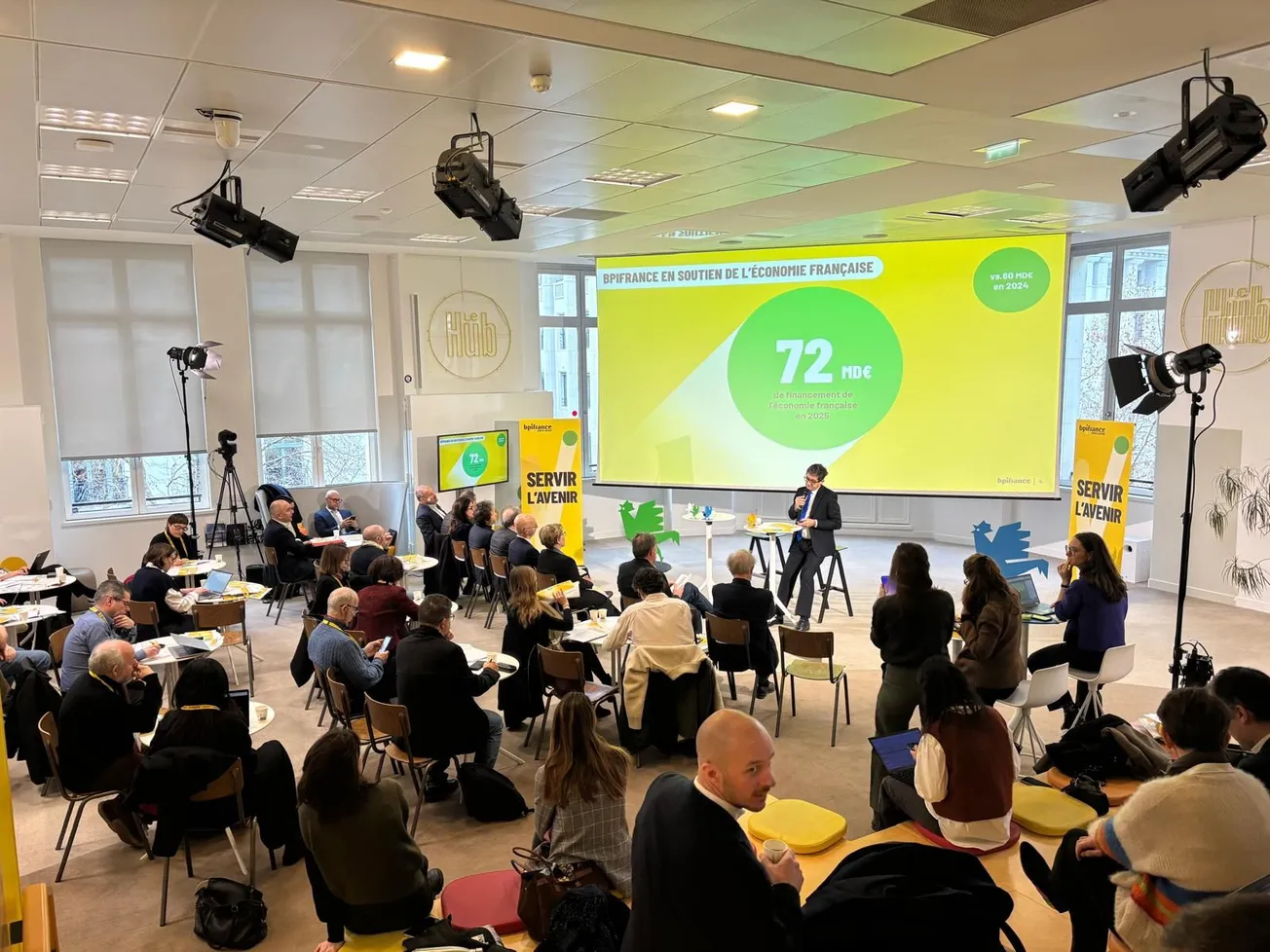
What makes Pasqal’s story distinctive is the degree to which the French state has nurtured this company from its earliest days, and the degree to which that support has now evolved into a co-investment position in a Nasdaq-bound deal.
Pasqal emerged from research at France’s Institut d’Optique, led by cofounder Alain Aspect, who won the 2022 Nobel Prize in Physics. Its birth coincided with the French government’s launch of a €2.5 billion (since expanded to €3.5 billion) deep-tech program run by Bpifrance, aimed at spinning up 500 deep-tech startups annually from breakthrough scientific research.
From there, the support was relentless. A €60,000 Bourse French Tech Emergence grant in 2019 let CEO Reymond hire his first employee. A €250,000 convertible investment through Bpifrance’s Digital Venture fund came with the seed round. Two loans totaling €2 million bridged the gap to the Series A. An i-Lab innovation competition win added another €400,000. That totaled €2.71 million in support before Pasqal had even raised a proper venture round.
When the $30.5 million Series A arrived in 2021, Bpifrance was again present, this time through Definvest, its defense innovation fund. The €100 million Series B in early 2023 featured direct investment from Bpifrance’s Large Venture Fund, the same vehicle that is now anchoring the convertible financing in this SPAC transaction.
Beyond capital, Bpifrance provided support for talent recruitment, international expansion boot camps, event sponsorships, and market study grants.
As Paul-François Fournier, Bpifrance’s senior executive vice president for Innovation, told me in 2023, the strategy was always about building an ecosystem: “Our financing tools permit us to accompany many, many startups. But the second pillar of this strategy is to develop the venture capital industry in France so that it can also attract international investors.”
Mission accomplished, one might say. Pasqal is now headed for the Nasdaq.
What Pasqal is saying
Pasqal’s current CEO, Wasiq Bokhari, struck a confident tone in a video the company released with the announcement materials: “Today marks a defining milestone for Pasqal...This investment reflects confidence in our technology, in our ability to scale it globally.”
CTO Loïc Henriet, in the same video, pointed to the company’s operational track record: “Over the past years, Pasqal has transformed neutral atom quantum computing into operational systems. We have produced and deployed quantum processors across three continents. Our customers are running real workloads today.”
In a LinkedIn post at the end of 2025, Pasqal execs highlighted that the company had attracted more than $145 million in combined public and private investments that year, including grants and contracts.
The company cited equity backing from Temasek, Bpifrance, the European Innovation Council Fund, Wa'ed Ventures, LG Electronics, and Dunamu & Partners, alongside institutional support from the French government's France 2030 investment plan, France's defense procurement agency (DGA), the EuroHPC Joint Undertaking, the Korean government, and the Illinois Finance Authority/Climate Bank.
On the commercial side, Pasqal pointed to customer momentum from CINECA, EDF, and Crédit Agricole CIB. "This level of support across public, private, and commercial sectors speaks volumes," Wasiq Bokhari, Pasqal's executive chairman, said in the post. "It shows deep trust in our vision, our offering and in our execution."
The SPAC’s co-sponsors, Combes and Gundlach, framed the deal as a bet on French scientific excellence. In a written statement, they called Pasqal “the strength of French scientific excellence translated into commercial leadership,” noting it was “supported by France’s deep national commitment to quantum innovation.”
Pasqal today employs over 275 people, including 70 PhDs. Its client list includes CMA CGM, OVHcloud, Thales, and Sumitomo, and it maintains partnerships with Nvidia and IBM. The company builds quantum processors using neutral atom technology — trapping rubidium atoms in 2D and 3D configurations — which researchers consider one of the most promising approaches for scaling toward fault-tolerant quantum computing.
The bigger picture
There are caveats, of course. The deal is subject to SEC review, Bleichroeder shareholder approval, Nasdaq listing approval, and the ever-present risk of investor redemptions that could significantly reduce the cash available from the trust account.
Quantum computing as a sector still has no clear path to near-term profitability, and the SEC filings acknowledge the company faces “significant technical challenges” and a “concentration of revenue in contracts with government or state-funded entities.”
Whether Pasqal can justify that valuation will depend on execution: scaling production, landing commercial customers, and eventually demonstrating quantum advantage in real-world applications.
The good news is that Pasqal now has a big fat check in the bank to pay for the next stage of its ambitions. But that comes with a price: The public markets will now be watching and scrutinizing that progress in a way the company has never faced.