It has been a busy couple of months for Mistral AI.
Barely three years old and already valued at north of $14 billion, France's great LLM hopeful has spent February and March 2026 on something resembling a full-court press: inking a landmark partnership with Nvidia, launching a voice AI product that potentially undercuts ElevenLabs, arming the French military with large language models, making its first acquisition, borrowing $830 million from seven banks to fill a data center with chips, and sending its increasingly visible CEO Arthur Mensch onto seemingly every stage that would have him.
Taken individually, any one of these moves would constitute a big quarter for a European tech company.
Taken together, they start to look like a company that has figured out its playbook, is laying the foundation for the long term, and is now running at full speed.
The Nvidia Embrace
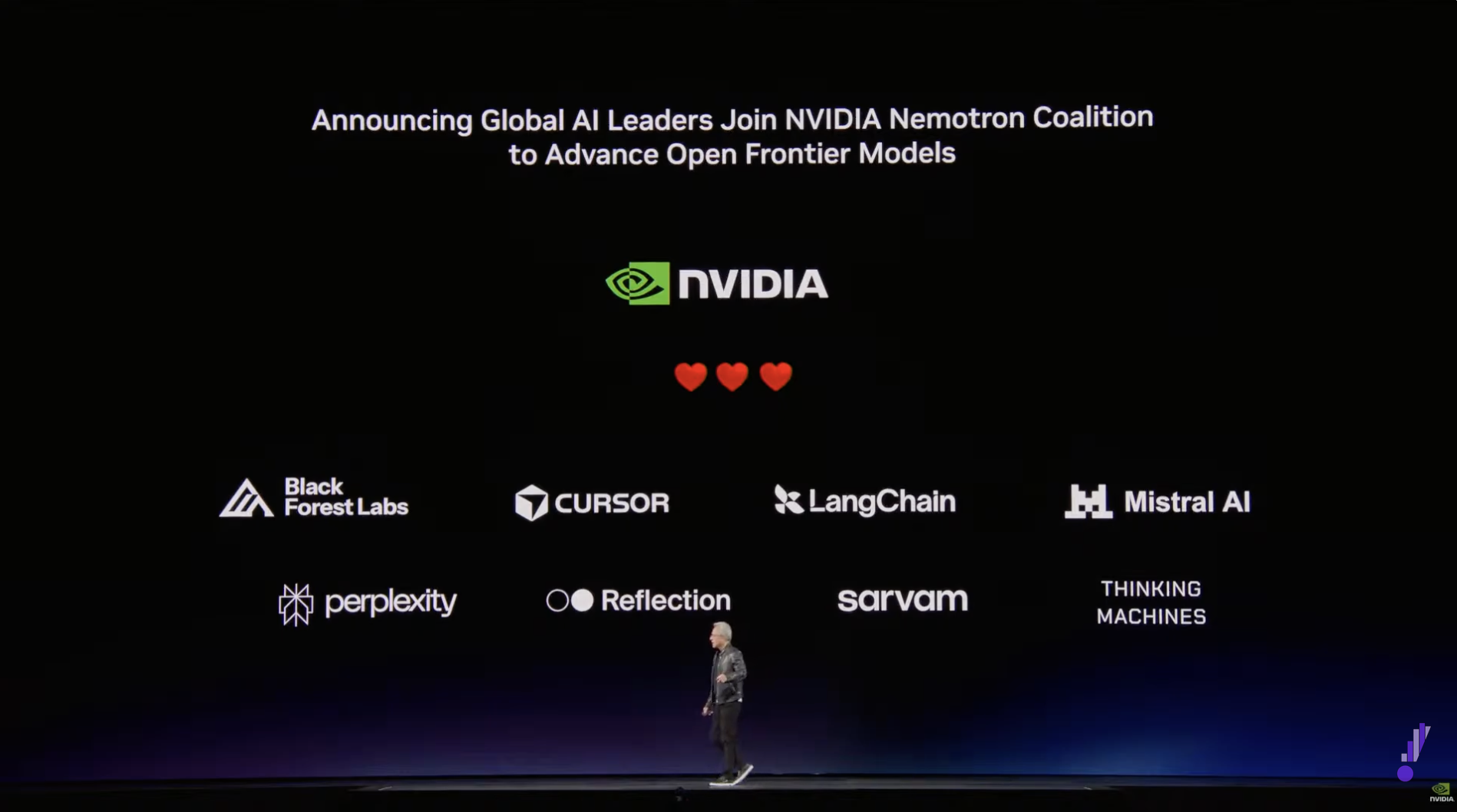
The marquee announcement came at Nvidia's GTC conference in mid-March, where Mistral was unveiled as a founding member of the Nemotron Coalition, a new initiative bringing together global AI labs to co-develop open frontier models. Nemotron models are NVIDIA’s open-source language models launched late last year and optimized for agentic workloads.
The coalition also includes Black Forest Labs, Cursor, Perplexity, and others. It pools expertise with Nvidia's compute muscle and synthetic-data pipelines.
While all coalition members will contribute data, evaluation frameworks, and domain expertise, the core base model that will underpin the upcoming Nemotron 4 family will be co-developed by just two partners: Mistral AI and NVIDIA.
Once released, it'll be open-sourced, meaning developers and organizations worldwide can take it, fine-tune it for their own industries and regions, and build on top of it however they see fit. For Mistral, this is a natural extension of its founding philosophy. By co-developing the model from the ground up alongside NVIDIA, Mistral gets to shape the capabilities of what could become one of the most widely used open foundation models in the world.
Mistral is bringing some serious assets to the table. As a founding coalition member, it's contributing its proprietary training techniques, multimodal capabilities, and enterprise-grade fine-tuning tools.
This builds on the two companies' prior collaboration, which produced the Mistral Nemo model. And Mistral timed the coalition announcement with another big reveal: Mistral Small 4, a new open model, plus Forge, a service that lets large enterprises and governments create fully custom AI models built on their own proprietary data.
Meanwhile, the other coalition members each contribute their own specialties. Black Forest Labs brings multimodal visual intelligence. Cursor offers real-world developer performance data. LangChain focuses on making AI agents more reliable. Perplexity contributes to frontier model development expertise. Sarvam is working on AI for sovereign languages for underserved communities. And Thinking Machines Lab, led by former OpenAI executive Mira Murati, is focused on making AI more broadly accessible.
Borrowing to Build
Of course, Mistral CEO Arthur Mensch has been courting Nvidia strongly, as one must in the current AI era. Nvidia has been an investor in Mistral since the company's $2 billion Series C round last September, and now those hardware ties are about to get even deeper.
The company announced this week that it is taking on debt for the first time to fund its own data centers as it races to scale.
Mistral will borrow $830 million to build and operate "a cutting-edge data center near Paris." The company had revealed plans last year to move into the infrastructure side of things, which aligns with the hybrid strategy of LLM players like OpenAI. Mistral has said it plans to pour up to €4 billion into sites in France and Sweden, even as it remains unprofitable.
That's pretty much true for all the LLMs. In this case, it's a critical move for Mistral because it wants to control more of the AI value chain, not just build models but also train, host, and run them for clients. That's core to its sovereignty positioning, which appears to be gaining momentum amid a geo-political environment where governments and non-U.S. companies are increasingly doubtful they can rely on the American government long term, or want to be overly dependent on U.S.-based companies.
Mistral's facility near Paris will be packed with Nvidia chips and is expected to go live in 2026. According to Mistral, it will be built with Grace Blackwell infrastructure with 13,800 NVIDIA GB300 GPUs, bringing the company's total capacity to 44MW. The debt funding comes from a banking syndicate that includes Bpifrance, BNP Paribas, Crédit Agricole CIB, HSBC, La Banque Postale, MUFG, and Natixis Corporate & Investment Banking.
"Europe needs an ambitious AI cloud infrastructure and an independent AI stack," the company wrote on LinkedIn. "We are building 200 MW of capacity across Europe by the end of 2027 to support the demand from governments and enterprises that seek to build and control their own AI."
Until now, Mistral has relied on cloud providers such as Microsoft Azure, Google Cloud, and CoreWeave to run its models. By owning its own compute, the company gains more control over costs, latency, and, crucially, the sovereignty narrative. That's key if it wants to credibly promise European data sovereignty.
It is also a bet that revenue will keep climbing.
Mistral's annual recurring revenue crossed $400 million in February, up from $20 million a year earlier, a 20x surge driven largely by enterprise clients including HSBC, Stellantis, the European Space Agency, and roughly 30% of the Fortune 500. Mensch has publicly set a target of $1 billion in ARR by year's end.
Mistral showed how serious it was about infrastructure back in February when it made its first acquisition Koyeb, a Paris-based serverless platform.
Koyeb gives Mistral control over the last mile of AI delivery, the layer where models actually turn into usable products. Koyeb allows Mistral to deploy, run, and scale its models in production without relying as heavily on third-party infrastructure. That means tighter optimization of inference workloads, better GPU utilization, and the ability to offer enterprises a seamless path from model access to real-world applications.
In short, it's another step that helps Mistral move from just being a model provider to an end-to-end platform.
To help more enterprises adopt that platform, Mistral has been signing partnerships with consulting firms such as Accenture and Reply to extend its reach.
Finding Its Voice
Two days before the debt deal dropped, Mistral released its latest product that had observers buzzing.
Voxtral TTS, announced on March 26, is a text-to-speech model that can clone a voice from just 3 seconds of audio, speaks in 9 languages, and runs with a latency of 70 milliseconds. At 4 billion parameters, it is small enough to operate on a laptop.
The numbers are impressive on their own: a 68.4% win rate against ElevenLabs Flash v2.5 in multilingual voice-cloning tests. But the real significance is architectural. Voxtral TTS is the final piece in an end-to-end voice pipeline Mistral has been methodically assembling: Voxtral Transcribe handles speech-to-text, the company's language models provide reasoning, and now Voxtral TTS closes the loop with speech output.
Combine that with Forge, the enterprise customization platform unveiled at GTC, and Mistral has a full-stack offering for companies that want to build voice agents for sales, customer support, and internal operations entirely on Mistral rails.
The Sovereignty Bet
Still, if there is a single thread running through everything Mistral has done in 2026, it is sovereignty.
The word comes up in nearly every public statement the company makes, and for good reason: it is simultaneously a political argument, a product differentiator, and a sales pitch.
The logic goes like this. European governments, banks, defense agencies, and industrial conglomerates are sitting on enormous volumes of sensitive data. They want to use AI. But they are increasingly uneasy about routing that data through American cloud infrastructure controlled by companies subject to U.S. law.
Mistral's answer: open-weight models you can download and run on your own servers, on your own sovereign soil, under your own jurisdiction.
Nowhere is this pitch more vivid than in the company's recent deal with France's Ministry of the Armed Forces.
Formalized this week under a three-year framework agreement announced in January, the contract gives the French military access to Mistral's foundation models, enterprise assistants, document-processing tools, and custom agents, all to be deployed on French-controlled infrastructure.
The immediate use cases are not autonomous weapons or battlefield robots. They are the unglamorous but critical work of compressing staff work, accelerating intelligence analysis, and supporting logistics planning. The deal extends to agencies under the ministry's authority, including the CEA and ONERA.
The vote of confidence has not gone unnoticed by other European governments watching from the sidelines. France and Germany have already announced plans for a public-private partnership involving Mistral and SAP, with binding agreements expected by mid-2026.
The CEO Steps Forward
As for Mensch, the 32-year-old former DeepMind researcher has become an increasingly prominent public figure over the past several months.
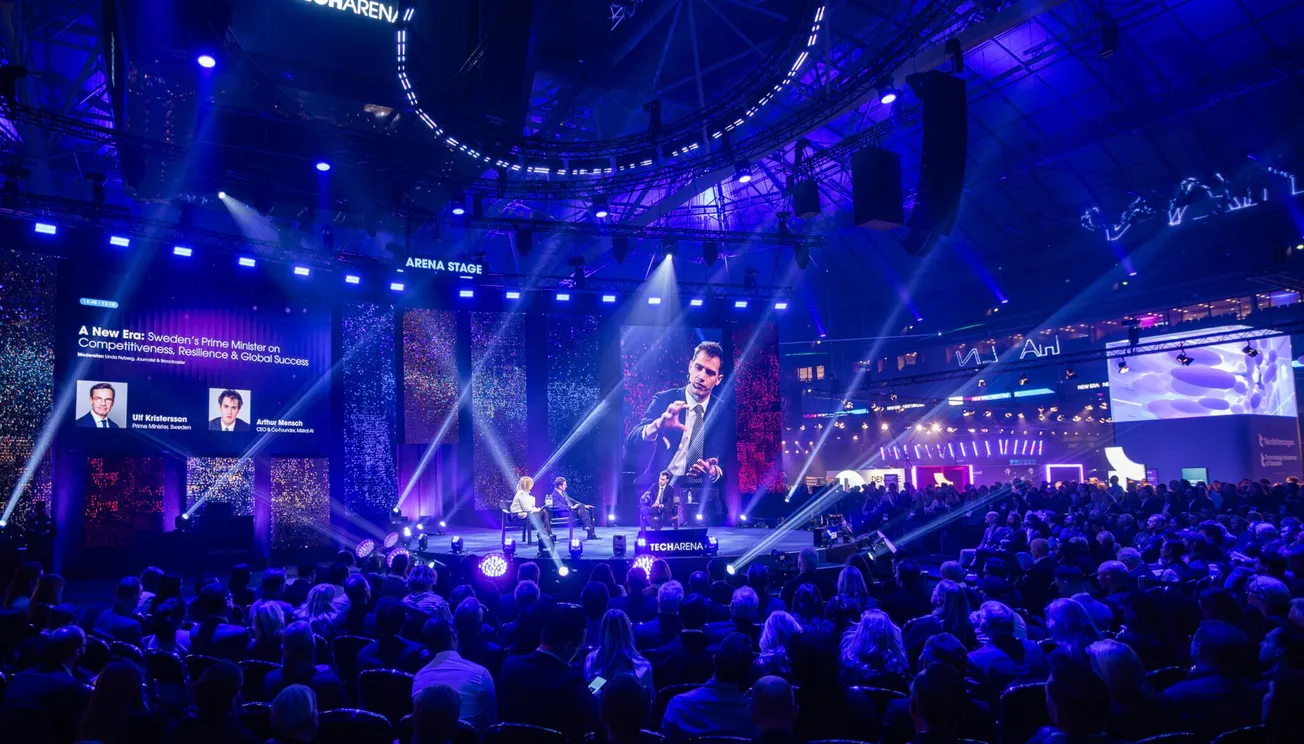
In January, he returned to his alma mater, École Polytechnique, to speak with students. In February, he sat for a CNBC interview at the India AI Impact Summit, pitching Mistral as an enabler of India's own AI sovereignty ambitions. At Davos, he declared the billion-dollar revenue target. At GTC, he unveiled Forge and the Nvidia partnership.
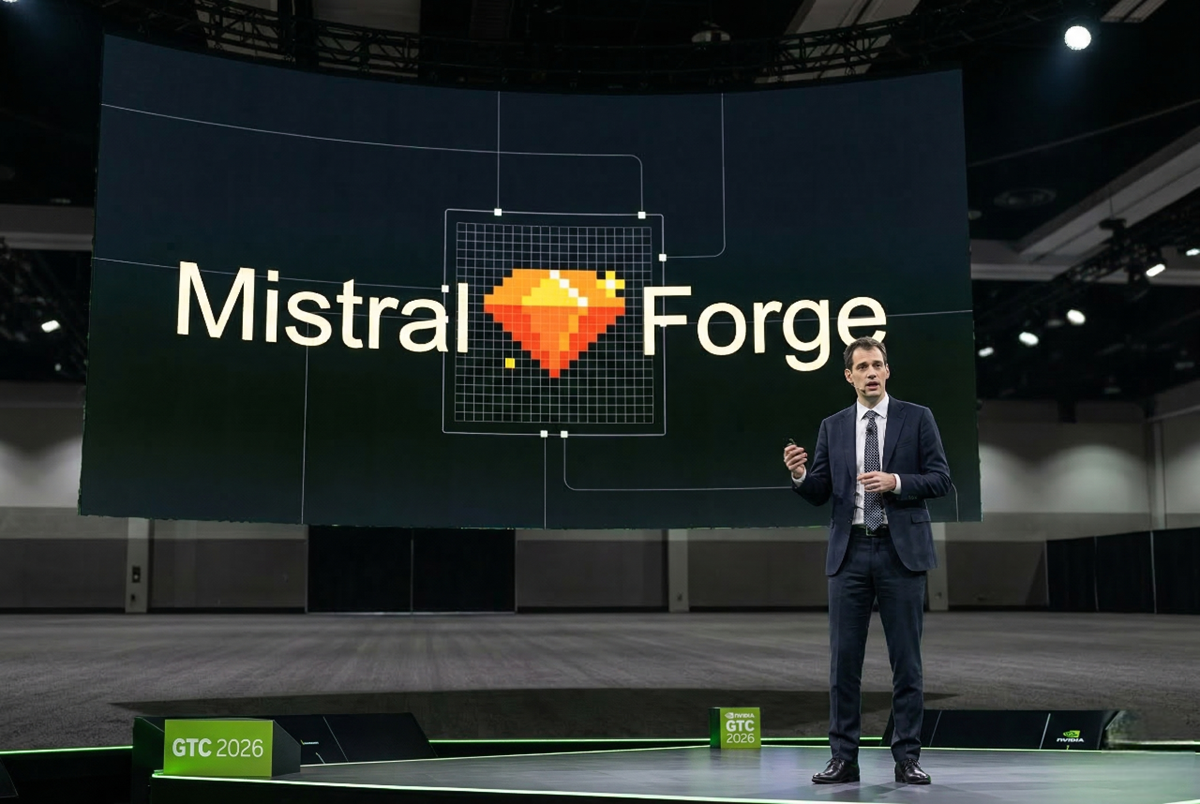
In between, he has testified before the French Senate, called for more generous research tax credits, and repeatedly hammered a message that has become his signature: "You cannot have AI sovereignty if all your compute runs on American cloud infrastructure."

What makes Mensch interesting is less his ambition and more his philosophical orientation.
He remains vocally skeptical of AGI hype, once dismissing the concept as tantamount to "creating God." While competitors race to claim they are approaching artificial general intelligence, Mensch talks about practical productivity tools, workforce retraining timelines, and the messy complexity of enterprise systems.
And, of course, Mensch wasn't afraid to cut against the grain of many of his AI peers when he called on Europe to rethink AI copyright.
The Mistral AI boss called for a mandatory contribution from AI model providers to compensate content creators, arguing that voluntary schemes won’t cut it.
"As AI reshapes the global economy, Europe risks becoming a passive consumer of technologies designed elsewhere, trained on our knowledge, our languages, and our culture, yet reflecting neither our values nor our diversity," Mensch wrote. "While the danger is eventually to lose our influence in the world, the debate around AI and copyright is too often framed as a confrontation between creators and AI developers. This framing is not only unhelpful, it is wrong. Far from being adversaries, we are perhaps the most natural of allies."
The proposal added fuel to an already heated debate over how to fairly share value in the generative AI economy. This proposal sparked immediate backlash, positioning Mistral at the center of the fierce European debate over compensating intellectual property owners in the generative AI landscape.
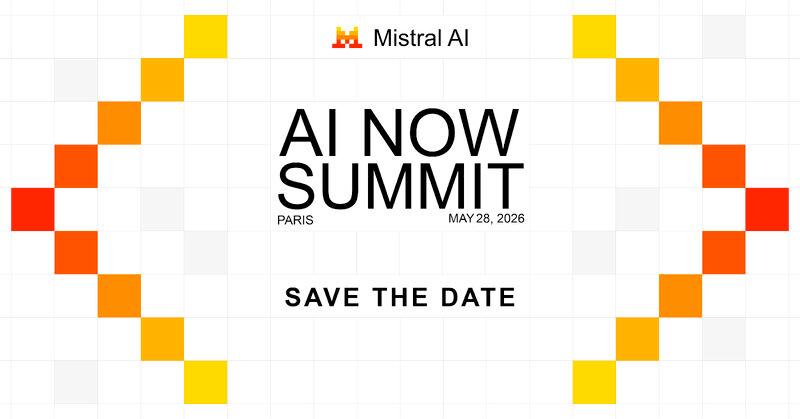
Still, that growing confidence should be evident when Mistral AI hosts its first flagship event: the AI Now Summit.
The one-day gathering on May 28 in Paris promises to bring together CEOs, founders, engineers, and practitioners to share real-world strategies for deploying AI at scale.
So...
...where does this leave Mistral?
The company has raised over $3 billion in total, commands a valuation that makes it comfortably one of the most valuable AI startups in Europe, and is building the kind of integrated stack, including models, voice, customization, and compute, that starts to look less like a plucky challenger and more like a platform.
The open-source strategy is its big distinction. By releasing models under permissive licenses, Mistral builds a developer ecosystem (200,000 registered developers and counting), establishes trust with regulated industries, and creates a flywheel in which broad adoption drives enterprise demand for premium services, including Forge, Le Chat Enterprise, and managed compute.
That's potential where the real money lives.
Still, the risks are massive. Mistral's total funding, while enormous by European standards, remains modest compared to the war chests at OpenAI, Google, and Anthropic. The open-source model is vulnerable to misuse and commoditization. And the sovereignty narrative, however compelling politically, has to be backed by models that can compete on performance.
But sitting here in early April 2026, for anyone tempted to write off Mistral in the face of those Silicon Valley giants and their massive financial backing, at the very least, the race appears far from settled.
Mistral appears to have found a strategic clarity, speed of execution, and product-market fit that has persuaded some fairly serious players in the industry.
The question now: How far can this playbook take the European decacorn?