
For more than two decades, online shopping followed a familiar script: search, click, compare, buy. But the rise of large language models is quietly rewriting that playbook.
Today, millions of consumers are increasingly turning to conversational AI platforms like ChatGPT, Claude, or Perplexity to research products, compare options, and even make purchasing decisions.
The shift is happening faster than many retailers expected. Some e-commerce websites are already reporting traffic drops of up to 30% as discovery moves upstream into AI interfaces.
For brands, the implications are significant. If the purchase journey now begins inside a conversational agent, how do retailers ensure their products are visible, recommended, and ultimately purchased?
Paris-based startup Lemrock believes it has the answer. Investors are taking notice.
Barely a year after launching, the French startup raised $7 million and signed more than 60 brands, positioning itself as one of the first companies building infrastructure for what it calls “agentic commerce.”
When AI becomes the new shopping gateway
Conversational AI is rapidly becoming a new front door to commerce.
Instead of typing keywords into a search engine, consumers can now explain their needs directly to an AI assistant:
“I’m moving into a new apartment...what furniture should I buy?”
...or...
“What’s the best travel camera under €800?”
The AI understands context, preferences, and constraints, then recommends relevant products. In other words, discovery is shifting from search results to conversation-driven recommendations.
According to Lemrock, as much as 60% of purchase journeys now include an AI discovery phase, while conversational platforms collectively reach hundreds of millions – and in some cases billions – of users. Yet most retailers remain technically unprepared for this shift.
Connecting product catalogues, displaying real-time availability, enabling transactions, and measuring performance inside AI platforms requires a new layer of infrastructure, one that simply didn’t exist until recently.
“Brands spent twenty years building relationships with customers through their own channels,” says Lemrock CEO Roxane Laigle. “But AI agents capture purchase intent before a consumer even visits a website. If retailers don’t adapt, they risk becoming invisible.”
From retail strategy to AI startup
Laigle understands the problem from the inside.
Before launching Lemrock, she worked at Fnac Darty, one of Europe’s largest retail groups, where she served as Director of Strategy and Innovation. Her role involved transforming commerce across digital, marketing, and omnichannel operations, while leading initiatives in customer intelligence, data strategy, and product innovation.
Over the years, she advised brands on more than 25 transformation projects, ranging from restructuring to growth strategies and brand development.
It was during a stint as an Entrepreneur in Residence at Entrepreneur First in early 2025 that the idea behind Lemrock began to crystallise.
There she met her two future co-founders: Sasha Collin (CPO) and Clément Nguyen (CTO), both engineers and alumni of the Silicon Valley accelerator Y Combinator.
Together, they began discussing the future of online commerce.
“We realized that the next generation of shopping wouldn’t start on e-commerce websites,” Laigle says. “It would start inside conversational AI.”
After several months immersed in the tech ecosystem in San Francisco, the trio began building the technology that would eventually become Lemrock.
Under the hood: building the stack for agentic commerce
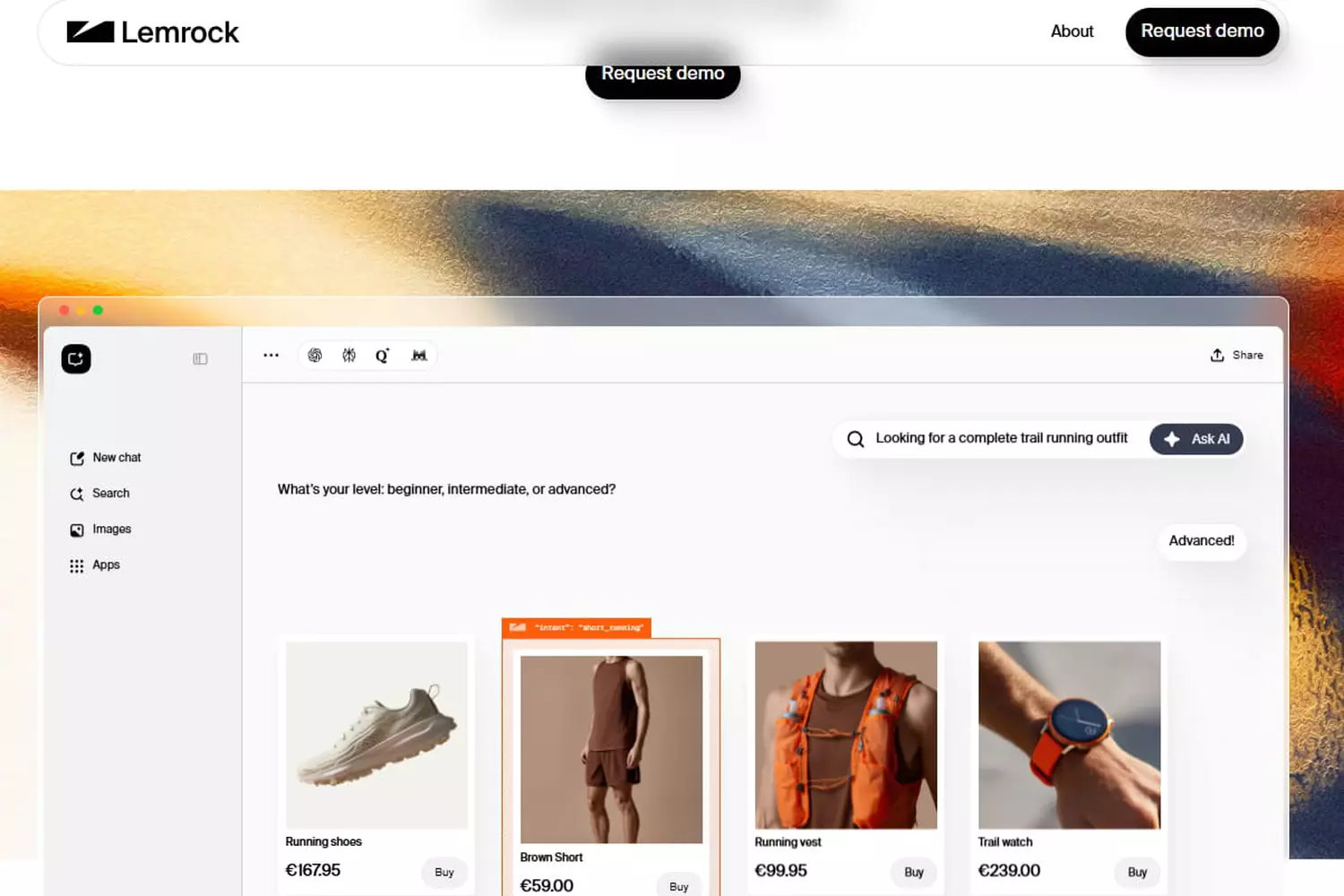
Lemrock is essentially a middleware platform connecting retailers to AI agents.
The system ingests a brand’s product catalogue, content, and availability data, then structures that information so it can be accessed by conversational platforms.
From there, the platform orchestrates how products appear within AI interactions.
For example, a user asking an AI assistant about cameras before a holiday might see a carousel of products with images, prices, and availability, or even a small “micro-store” embedded directly within the conversation.
Behind the scenes, Lemrock’s proprietary models analyze the context of the discussion, including preferences, previous queries, and constraints. It uses that information to deliver hyper-personalized recommendations.
The company says its architecture is trained on one of the largest independent datasets in agentic commerce, processing more than 100 million interactions every month.
Unlike many AI tools, Lemrock is LLM-agnostic, meaning it can integrate across multiple conversational platforms rather than relying on a single ecosystem.
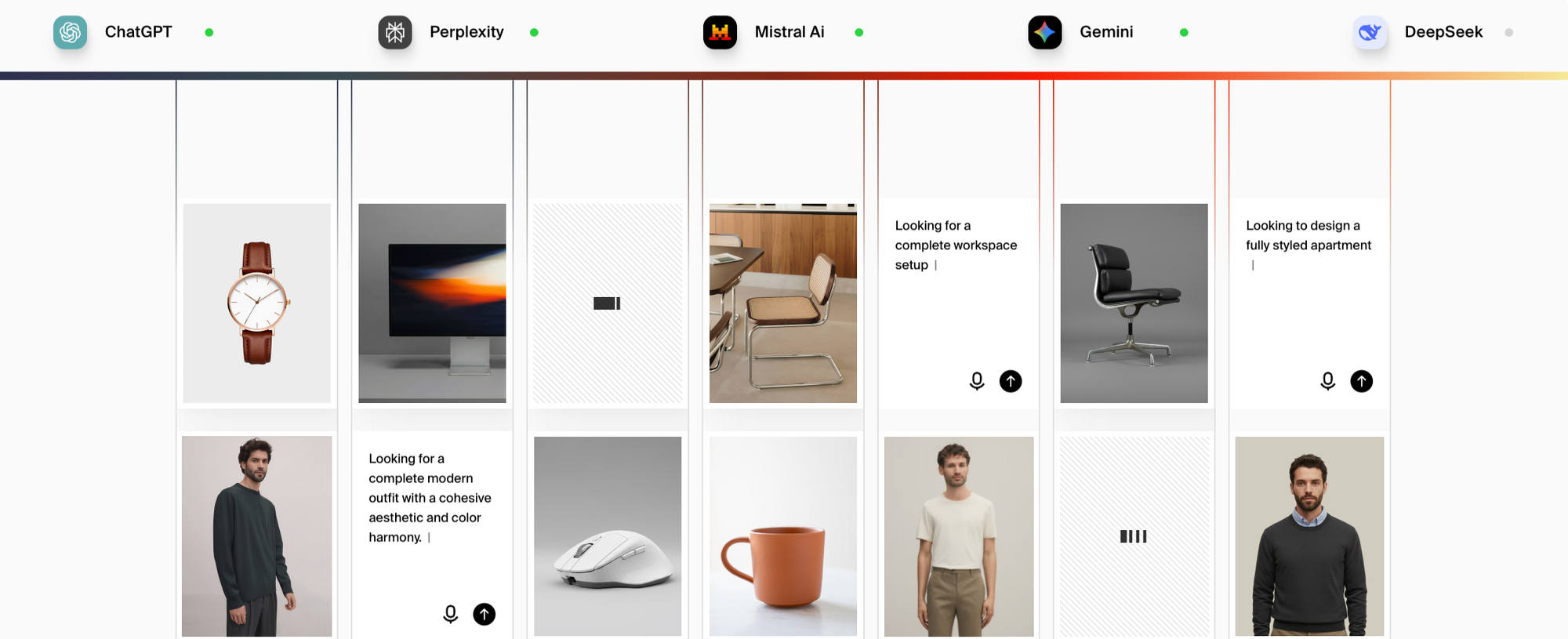
The goal is simple: make it possible for brands to manage their presence across AI agents through one single integration point.
A performance-driven business model
Lemrock’s model mirrors the economics of digital advertising. But it's adapted for AI-native commerce.
The startup positions LLMs as new distribution channels, while providing brands with the tools to optimize their presence within those channels.
Revenue is tied to performance metrics negotiated with clients.
These may include sales commissions, visibility metrics such as impressions or discovery views, or conversion-based performance indicators deeper in the purchase funnel.
The proposition has resonated quickly with retailers eager to avoid missing the next shift in digital commerce.
Since July, Lemrock has onboarded more than 60 clients, including brands such as Maisons du Monde, Cdiscount, Darty, DIM, Engie, and Lebara. The company also counts US customers, including legal software platform Rocket Lawyer.
Much of that early traction, Laigle says, has been driven by a simple dynamic: FOMO. “Brands understand that if conversational AI becomes the new entry point to commerce, they need to be there from the beginning,” she said.
Investors bet on a new infrastructure layer
Lemrock’s early momentum recently culminated in a $7 million seed round led by venture firm Galion.exe.
The round also attracted a number of high-profile investors from the tech and retail ecosystem, including Michaël Benabou (Veepee), Gary Anssens (Alltricks/Decathlon), and Frédéric Halley, among others.
Perhaps most notably, Criteo founder Jean-Baptiste Rudelle has joined the company’s board. For Rudelle, the parallels with earlier shifts in digital advertising are clear.
“When technology and the business model reinforce each other, you can build extremely powerful infrastructure companies,” he said in a statement supporting the investment.
Momentum is building elsewhere.
Lemrock has also just joined STATION F's newly launched F/AI program at STATION F, touted to be one of the most selective AI startup cohorts in Europe. Backed by venture firms including Sequoia Capital and 20VC, the program brings together founders working on frontier AI technologies alongside partners such as OpenAI, Anthropic, and Google, and gives founders access to AI savants such as Yann Lecun.
Building the standard for AI-native commerce
Lemrock currently operates with a team of around 10 employees across Paris and New York, with plans to grow to 15 in the coming months as it expands engineering and AI research.
Its priority markets include the United States, France, and the United Kingdom, reflecting both the scale of those retail markets and the rapid adoption of AI tools.
But the company’s ambition is far larger.
Laigle ultimately wants Lemrock to become the standard infrastructure layer connecting brands to AI agents worldwide.
If that vision plays out, the future of online shopping may look very different. Instead of browsing endless product pages, consumers will simply describe what they need, and the right products will appear instantly, tailored to their preferences.
“We want people to look back in five years and say: they saw it coming before everyone else!” Laigle says. “And what once sounded crazy has now become the new normal.”