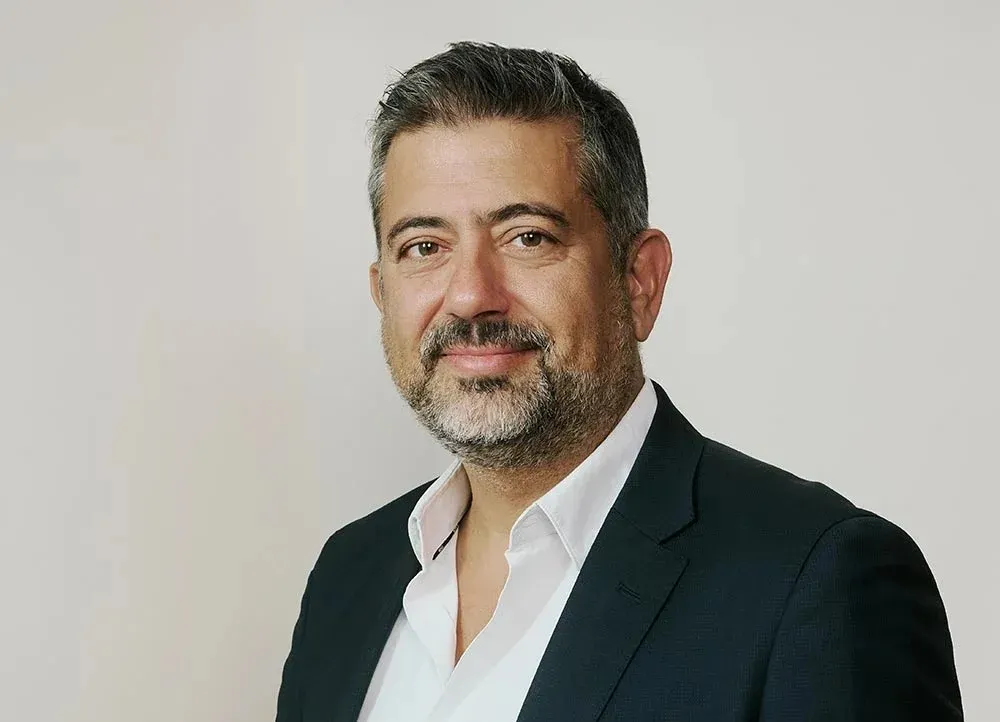
🧠 AI is transforming prenatal ultrasound. BrightHeart helps clinicians catch over 90% of deadly fetal heart defects before birth, turning one of medicine’s hardest screenings into a routine, life-saving exam. CEO Cécile Dupont explains the journey from lab to commercial product, and why scaling had to start in the U.S.
Chris O'Brien + Helen O'Reilly-Durand

ISO 27001 is the gold standard for information security—but getting certified can feel like navigating a maze. That’s why Vanta has created a straightforward ISO 27001 Compliance Checklist to help you cut through the complexity and take action with confidence. Whether you're starting from scratch or refining your existing program, this resource lays out exactly what you need to do—step by step.
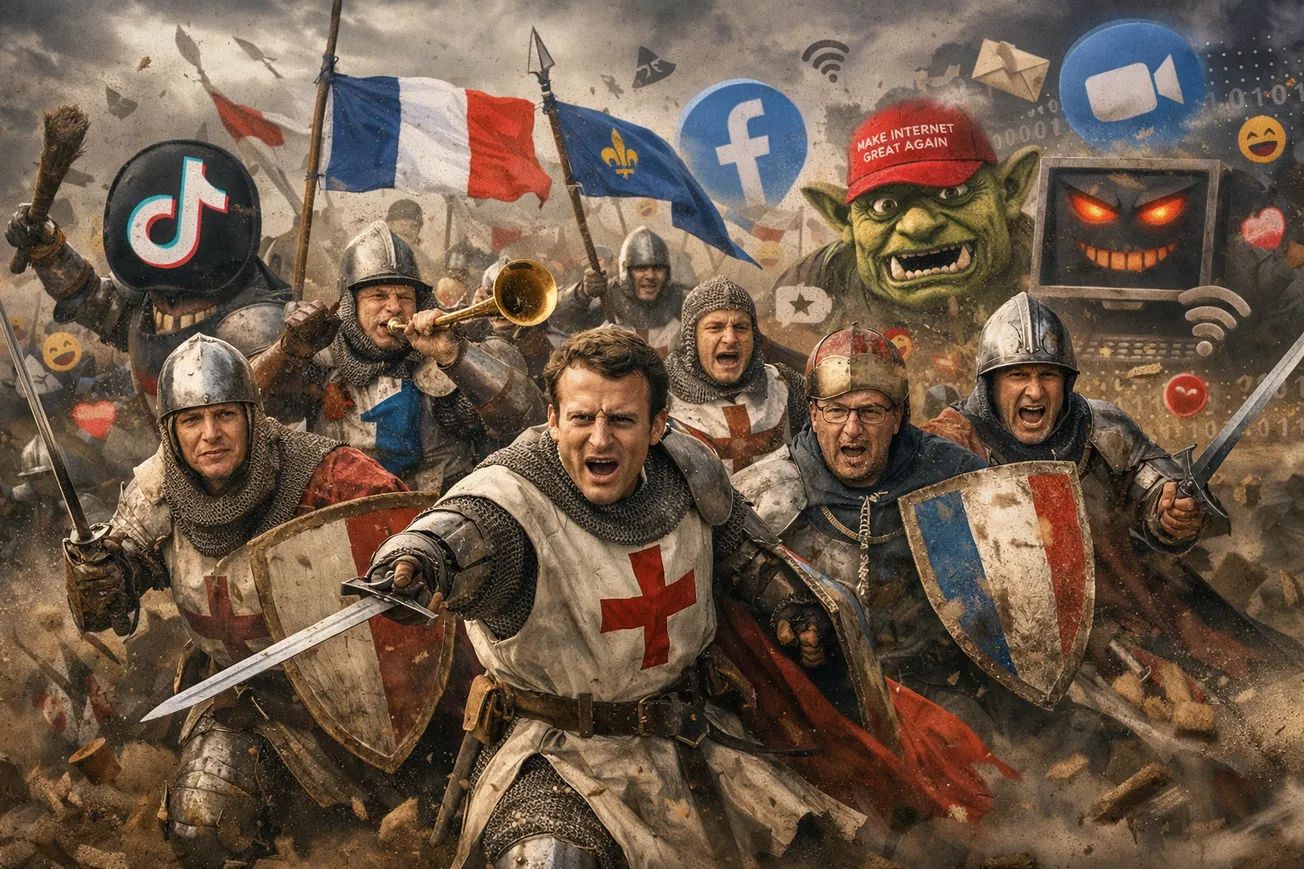
France Vs The Internet ⚔️
Sharpen the swords, cue the trumpets, and call out the banners. This week, the French government mounted a full-blown crusade against Big Tech, the barbarians of Silicon Valley, and the Evil Troll who occupies the White House.
Legions of bureaucrats and politicians charged into battle against Zoom, TikTok, and mysterious algorithms to liberate France, especially its teenagers. They came seeking the Holy Grail of Digital Sovereignty. Whether they are simply tilting at digital windmills remains to be seen.
🗞️ France is finally getting serious about kicking Zoom and Teams out of government offices. David Amiel, the minister in charge of the civil service, announced that all state agencies must switch to "Visio" by 2027. That's the government's homegrown video conferencing tool. The reason: Digital sovereignty, baby. No more letting Uncle Sam's tech giants peek at sensitive French government conversations.
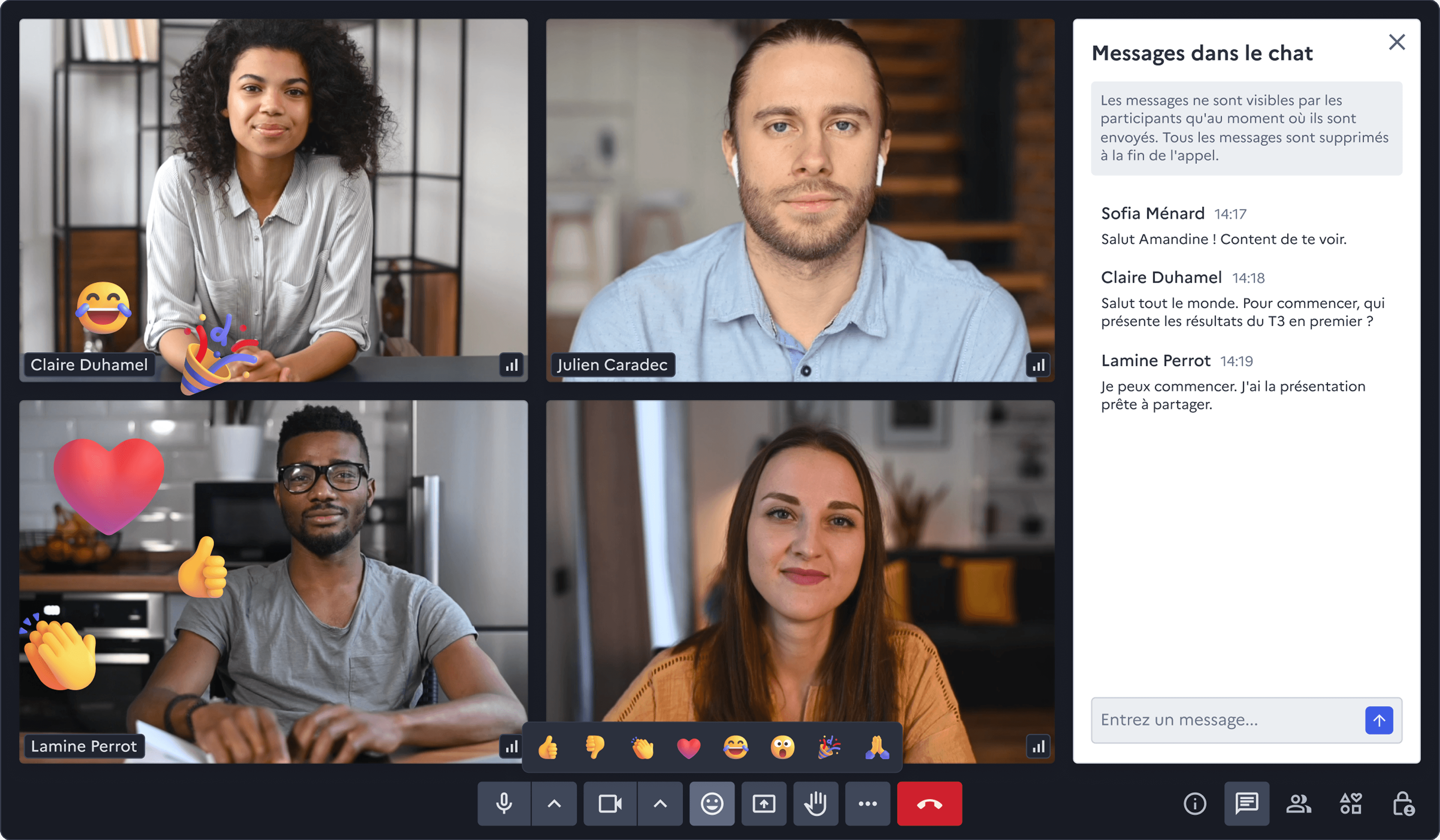
Visio is built on an open source platform and has been in beta for a year with 40,000 users, and it's about to scale up fast. It's the latest tool in a growing range of open-source alternatives the government is building under its La Suite umbrella. The CNRS research agency is ditching Zoom for its 34,000 employees and 120,000 affiliated researchers starting this spring. The Defense Ministry and tax authorities are also making the switch.
Here's where French AI startups enter the chat. PyannoteAI, which raised $9 million last year, is providing the speaker "diarization" technology. That's basically the AI that figures out who's talking when during meeting transcriptions. Kyutai, the open-source AI lab backed by Xavier Niel and other French tech heavyweights, is powering real-time subtitles coming this summer. The data gets hosted by Outscale, a Dassault Systèmes subsidiary with France's strict SecNumCloud security certification. Translation: your strategy meetings won't be subject to American extraterritorial laws.
The economics are potentially compelling. The government estimates it'll save €1 million annually for every 100,000 users who dump paid American licenses. When you're talking about millions of civil servants, that adds up. | Maddyness
But wait, there's more...
🗞️ France is pushing ahead with one of its most aggressive tech-policy bets yet: banning social networks for under-15s, fast-tracked and personally championed by El Presidente Emmanuel Macron. The bill, debated and approved in first reading at the Assembly, would make it illegal for minors under 15 to access social platforms, with only narrow carve-outs for educational sites and private messaging apps. To make that stick, the government is leaning toward mandatory age verification, likely borrowing the same ID checks and algorithmic age estimation already used for porn sites (yes, that debate again).
Officials insist anonymity can be preserved via third-party verification and “double anonymat,” though critics note the tech still struggles precisely where teens actually sit: the blurry 11–18 zone. The law also tackles phones in high schools, stopping short of a full ban but pushing usage out of classrooms and hallways.
Politically, the text is broadly supported but legally fragile, walking a tightrope with EU law and the Digital Services Act to avoid becoming another unenforced French tech law. Indeed, yesterday, there was confusion as to whether EU officials had said it was kosher or not. (It appears, "No.")
If it survives the Senate and Brussels, France would join Australia as one of the few countries willing to tell Big Tech: teenagers are officially off-limits. | France Info
But wait, there's more...
🗞️ The government took a very on-brand step toward “doing something” about algorithms this week by launching new institutions and a public awareness campaign. At a government-hosted event in Bercy, Digital and AI Minister Anne Le Hénanff unveiled two concrete tools: an Observatory of Digital Sovereignty to map France’s tech dependencies, and a Digital Resilience Index to measure how exposed public and private actors really are. In parallel, the foreign ministry kicked off a public campaign warning citizens about how recommendation algorithms shape opinions, fuel polarization, and can be exploited by foreign interference. The government also used the moment to remind everyone that, yes, the EU’s Digital Services Act exists and that France plans to enforce it with ARCOM and the Commission. | France Diplomacy, Maddyness, Digiwatch, Euractiv
Headlines
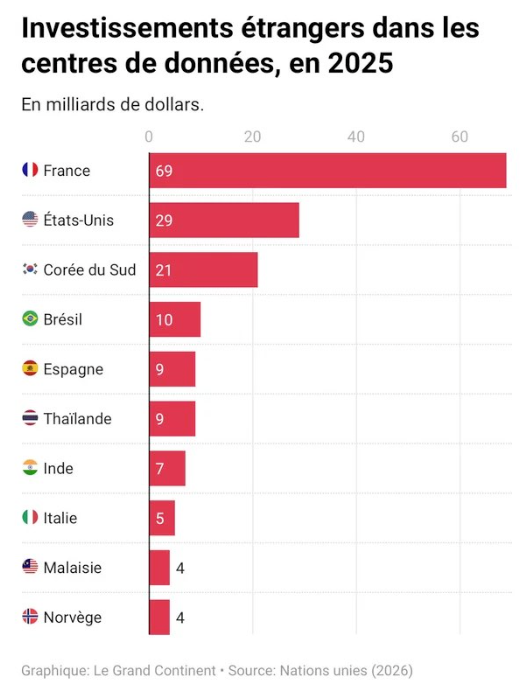
🗞️ France quietly pulled off an AI infrastructure flex in 2025, attracting a whopping $69 billion in foreign investment for data centers. That's more than double the U.S. and triple that of South Korea, according to the UN. The appeal is a rare combo of nuclear-powered clean electricity, dense undersea cable connections, and a government that actually rolls out the red carpet instead of red tape. Much of the cash is flowing into mega-projects like an AI campus backed by Mistral, Nvidia, MGX, and Bpifrance, plus a massive bet from Brookfield. | Le Grand Continent
🗞️ After years of political drama and regulatory brinkmanship, ByteDance finally closed the TikTok U.S. chapter by spinning it into a new joint venture called TikTok USDS. The entity will run the sensitive stuff Stateside: U.S. user data, the recommendation algorithm, source code security, and content moderation, while ByteDance keeps a carefully capped 19.9% stake. The quiet plot twist for French readers: NJJ, Xavier Niel’s family office, is among the investors, alongside Oracle, Silver Lake, MGX, and a small club of heavyweight backers. Niel’s presence isn’t entirely random. He’s already been sitting on ByteDance’s board since 2024. But seeing a French telecom billionaire on TikTok’s U.S. cap table still raised eyebrows. The valuation is around $14 billion. | Le Figaro
🗞️ Thales Leads Defense-AI Innovation with 200+ Patents. The French defense and aerospace giant has been named among the world's 100 most innovative organizations for the 13th consecutive year, with over 200 AI patents filed specifically for critical systems. This highlights how French industrial champions are weaponizing AI in defense and critical infrastructure, a quieter but important part of France's AI story that often gets overshadowed by hype around startups. | PR
🗞️ L'Oréal Invests €383 Million in AI Technology Center in India. While headquartered in France, L'Oréal is building a massive AI research hub in India, signaling that even French luxury tech innovators are looking to emerging markets for computational talent and infrastructure. | Modaes
🗞️ Joëlle Pineau Joins Cohere as Chief AI Officer. Following in the footsteps of fellow French AI pioneer Yann LeCun, Joëlle Pineau has left Meta to lead AI efforts at Canadian startup Cohere. The former vice president of Facebook AI Research is bringing her world-class credentials to focus the company on practical AI applications for businesses rather than the hype-driven race for artificial general intelligence. | Le Monde
🗞️ As ChatGPT gears up to allow explicit conversations at a massive scale, a new Ifop survey for Gleeden suggests the real action is already well underway, especially in France. While sexual or romantic chats with AI are still a minority practice overall, they’re gaining real traction among young people, particularly men under 35, and not just for porn: think flirting advice, emotional support, and relationship management. The catch is that more than half of users of “AI companions” say they’ve felt genuinely addicted, and nearly half admit it’s sometimes replaced real intimacy with a partner. In short, AI is quietly moving from novelty to emotional infrastructure, with all the dependency, tension, and awkward questions that come with it. | IFOP
ICYMI
🗞️ Europe's AI Reckoning: Caught Between Regulation, Rivalry, and Risk | As 2026 begins, France and the European Union find themselves at the center of a perfect storm, facing diplomatic confrontation with Washington, urgent safety crises, and mounting questions about whether their regulatory approach can survive first contact with geopolitical reality. | The French Tech Journal
🗞️ From Tesla to Paris: UMA's Audacious Bet on European Robotics | A new French startup believes Europe—not Silicon Valley—is the best place to build the robots of tomorrow. | The French Tech Journal
🗞️ Gradium Wants To Make Voice The New Operating System for AI | The Paris startup, spun out of research lab Kyutai, just emerged from stealth with a $60M seed round to become the global foundation layer for real-time voice interactions. | The French Tech Journal
🗞️ How HyprView Is Using Photonics And AI To Bring Cancer Diagnostics Into the Light | Thanks to developments in AI, photonics is stepping out of the lab and into the clinic. HyprView uses light to uncover the invisible biology inside tumors - information microscopes miss entirely - opening the door to faster, smarter, and far more predictive cancer diagnostics. | The French Tech Journal
🧠 Prenatal Ultrasound, Reinvented: How BrightHeart AI Catches 90% of Deadly Fetal Heart Defects Before Birth
For decades, prenatal ultrasound has been one of medicine’s most reassuring rituals. A grainy image. A heartbeat. A moment of relief.
But beneath that reassurance hides a brutal truth: most fetal heart defects are never detected before birth.
Congenital heart defects affect roughly 3% of all pregnancies—making them more common than many conditions that are routinely screened for. Yet historically, only about one in three are caught during pregnancy. Not because clinicians don’t care or aren’t skilled—but because the task itself borders on impossible.
At just three months, a fetal heart is barely a centimeter wide. It moves constantly. The anatomy is complex. And most obstetricians are not pediatric cardiologists.
This is where AI is quietly changing the rules.
Over the last few years, medical imaging has become one of AI’s most commercially successful frontiers, growing into a multi-billion-dollar market driven by early detection and clinical decision support. But nowhere are the stakes higher than in prenatal medicine, where minutes and millimeters can change a life.
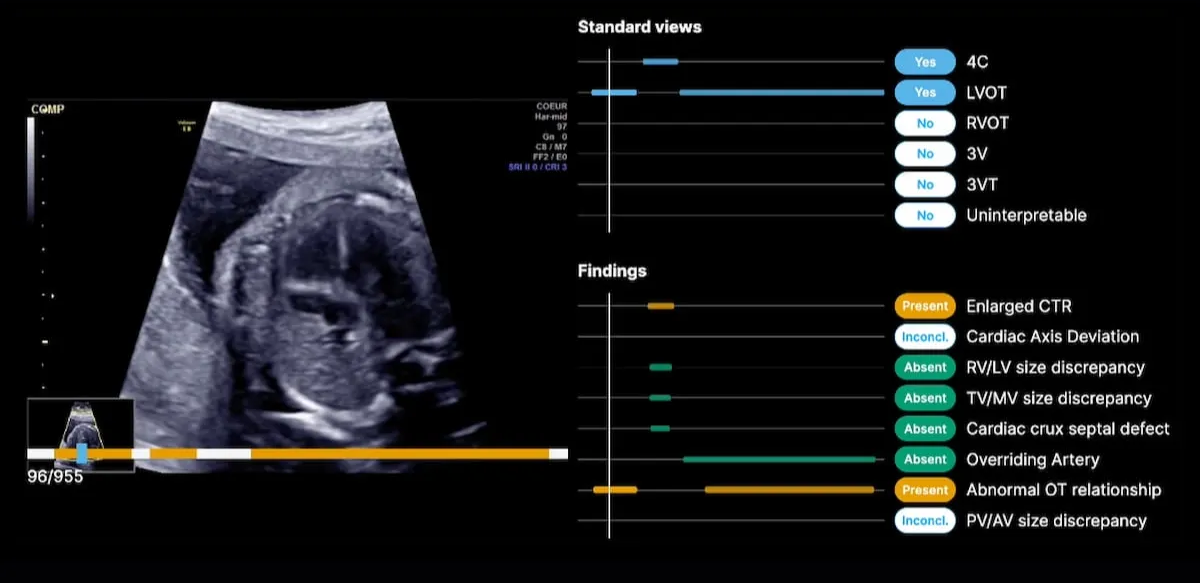
Enter BrightHeart, a Paris-born startup that set out to solve one of the hardest problems in screening: making expert-level fetal heart exams routine, not exceptional. Instead of trying to replace clinicians, BrightHeart’s AI guides them—step by step—through the ultrasound exam, ensuring completeness, flagging subtle anomalies, and dramatically reducing missed diagnoses.
The results are startling. Detection rates jump from ~30% to over 90%. Exam times shrink. Recalls drop. And for the first time, severe heart disease can be identified before birth—when care pathways, delivery plans, and outcomes can still be changed.
But building AI for medicine isn’t just a technical challenge. It’s a regulatory, clinical, and cultural one. BrightHeart’s journey—from a pediatric hospital in Paris to U.S. deployment and an €11M Series A—reveals what it really takes to turn AI into standard of care, not just another tool.
👉 In the full story, we dive into the clinical insight behind BrightHeart, how its technology actually works, why screening (not diagnosis) is the real AI wedge in healthcare, and what this case tells us about the future of medical AI at scale.
Want to reach an audience of more than 30,000 readers each month? The French Tech Journal is the leading English-language media platform covering France's dynamic tech ecosystem. With 31,000 + engaged readers across key global markets and consistently high engagement rates, our sponsorships provide unparalleled access to decision-makers in French tech.
🗣️ Announcements 🗣️
🚀 €1M AI Challenge for Space Data Innovation | Apply by March 9 | The Île-de-France Region and CNES officially launch a €1 million AI Challenge to accelerate innovation at the intersection of artificial intelligence and space data. Continuing the Region’s AI Challenge series started in 2019, this initiative aims to foster future national champions and strengthen France’s technological and economic sovereignty. Two tracks are open: (1) AI-powered applications leveraging satellite data for use cases such as security, energy, environment, and risk management; and (2) advanced vision-language models for automatic interpretation of high- and very-high-resolution satellite imagery. CNES will provide data, technical expertise, and project oversight. | Apply via the Île-de-France Region platform: Challenge AI for Space
📆 Events 📆
📆 Ray Meetup at Criteo Paris: Building Scalable AI & Data Platforms | February 5 | Join us at the Criteo office in Paris to learn how Ray simplifies building and scaling modern AI and ML workloads. We will walk through how teams use Ray to move from a single machine to distributed compute, run training and inference at scale, and power production AI platforms. Hear from experts at Anyscale, Criteo, and H Company on distributed training architectures, scaling reinforcement learning agents, and real-world lessons from migrating production systems to Kubernetes. | Request to join
📆 Neurons and Peppers #3 | datacraft AI Research Meetup | February 5 | Attend this Paris-based AI research meetup to dive into cutting-edge discussions on domain-specific modeling (quantitative finance) and retrieval-augmented generation benchmarking, alongside presentations like the LLM Pro Finance Suite and ViDoRe V3, finished with food & drinks. | Request to join
📆 AI Day 2026 | France Digitale | February 10 | At Station F in Paris, this flagship AI event gathers ~2,000 founders, C-level leaders, investors, researchers, and operators from across Europe. Explore AI & Research, AI & Business, and AI & Operations tracks through high-level talks, hands-on workshops, demos, exhibitions, and structured matchmaking between startups and investors — all under the high patronage of the French President. | Get tickets
📆 World AI Cannes Festival (WAICF) | February 12 and 13 | Palais des Festivals et des Congrès de Cannes | With more than 10,000 expected participants, 320 international speakers, and 180 exhibitors, the WAICF is the European event dedicated to the innovations and strategic challenges of artificial intelligence. | Buy tickets
📆 Paris Hardware Meetup | The New Defense Stack | February 17 | Join Paris-area hardware builders — founders, engineers, designers, and investors — for talks and community networking focused on defense hardware and physical product innovation at Hexa (eFounders) in Paris. Speakers include leaders from Harmattan AI, Helsing, Landroval, and more, with structured talks followed by open mic and networking. | Request to join
📆 OpenText Summit Paris 2026 | April 15 | Palais Brongniart | AI is everywhere and full of promise — but without contextualized data, governance, and security, AI fails. Join OpenText Summit Paris 2026 to discover how to unlock the intelligence of your enterprise data and activate AI with confidence. Expect visionary keynotes, French customer success stories, real-world use cases, in-depth small-group sessions, live demos, expert meetings, and peer networking. Explore the latest innovations in content management, cybersecurity, service management, business networks, and more — and learn how to deploy responsible, compliant AI with full control and freedom of choice. | Register
📆 RAISE Summit 2026 | July 8–9, 2026 | Carrousel du Louvre, Paris | Join one of Europe’s most influential AI gatherings bringing together thousands of builders, investors, executives, and innovators to shape the future of artificial intelligence. Learn from global leaders through keynotes, panels, workshops, a hackathon, startup competitions, and high-impact networking — all curated to accelerate AI strategy, investment, and real-world deployment across industries. | Tickets
👋🏻 If you’re enjoying The French Tech Journal, support the project by forwarding it to friends and sharing it on your social networks. You can also comment on this post. And if you have ideas for stories, tips, or just want to harass us, shoot us an email: [email protected] / [email protected] 👋🏻