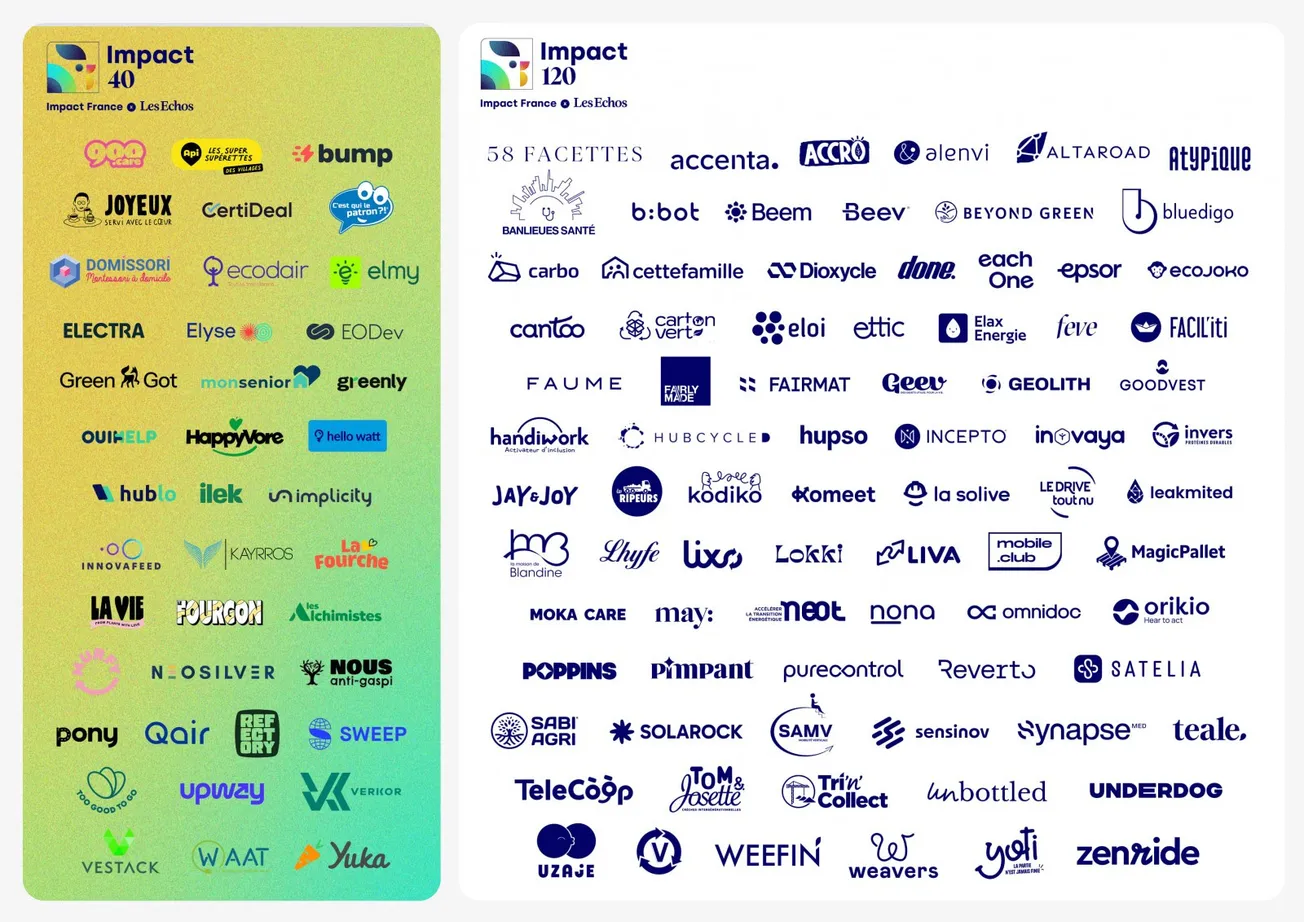

Impact France unveiled its 3rd annual Impact 40/120 index this week, a ranking of the 120 French startups most likely to become the next generation of "impact unicorns."
The organization, which brings together business leaders committed to building a sustainable economy, published the index this year in partnership with Les Echos. The two-tiered list mirrors the government's Next 40/120 initiatives designed to identify the most promising startups across sectors.
According to the organizers, the laureates in the latest batch have collectively raised €7.4 billion since inception, up 17.5% from the 2024 cohort. More than half (53%) now operate internationally.
A full 51% have at least one woman on the founding team. And 36% are already profitable, a figure the sponsors hope will quietly demolish the old cliché that purpose-driven companies can't make money.
As France is squeezed by budget austerity and social tension, it may be essential for this sector's continued expansion in the years ahead if future governments are less supportive.
The Circular Economy Is King
The largest sector in the 2026 cohort was "Circular Economy and Sustainable Consumption," with 28 companies.
That included names like Too Good To Go (the anti-food-waste giant), Murfy (which repairs rather than replaces home appliances), 900.care (refillable personal care), and CertiDeal (refurbished electronics). Le Fourgon, based in northern France, revives the old-fashioned returnable bottle and has grown into a 200-plus-person operation. Within the Impact 40, the companies considered most likely to reach unicorn status, eight are in the circular economy.
Energy is the second sector in the Impact 40, with seven companies. Verkor, the Auvergne-Rhône-Alpes-based battery manufacturer with 500+ employees, is France's answer to Europe's dependence on Asian battery supply chains. Electra is rolling out ultra-fast EV charging stations. Elyse Energy is developing low-carbon molecules. Qair, another company with 500+ employees, is a renewable energy producer. Hello Watt helps households slash their energy bills.
AI, With a Twist
For the first time, AI emerged as a major standalone category, with 12 companies across the full cohort. But the sponsors emphasized that these AI companies existed not to disrupt for disruption's sake, but to solve specific, measurable problems in health and climate.
For instance, Implicity uses AI to remotely monitor cardiac implants. Kayrros deploys satellite imagery and machine learning to track methane emissions globally.
There are also 13 companies in health and vulnerability, and 12 more in social inclusion.
Groupe Ouihelp, Alenvi, CetteFamille, Groupe MonSenior, and NEOSILVER are all building infrastructure to support the care of older adults at home or in community settings. Hublo tackles healthcare staffing shortages. May supports new parents' mental health.
Paris Dominates, But Not Entirely
The majority of laureates are based in Île-de-France. No surprise there. Still, Auvergne-Rhône-Alpes claims nine laureates, including the industrial heavyweights Verkor and Elyse Energy. Pays de la Loire, Occitanie, and Nouvelle-Aquitaine each contribute six.
Even France's overseas territories are represented, with Domissori, an education startup, based in Outre-mer.
What the Numbers Reveal
For the latest index, the methodology for selecting companies was developed by BCG, Impact France, and ESSEC. It values companies not just by financial returns but by "costs avoided" for society, such as reduced CO2 emissions, lower healthcare spending, and fewer people in poverty.
By those calculations, the impact startups generate social and environmental value equivalent to 130% of their revenue. That is the larger message here: organizers want to shift how the world measures corporate success.
It's also noteworthy that the circular economy and energy companies are well represented. Both reflect Europe's regulatory environment. The EU's Corporate Sustainability Reporting Directive (CSRD) is forcing every large company to account for its social and environmental footprint. French impact startups have turned this into a market opportunity by building the tools and infrastructure that enable compliance.
Finally, the fact that 36% of these startups are already in the black is also significant.
For years, impact investing was treated as a charitable exercise. The 2026 Impact 40/120 cohort suggests that solving society's hardest problems might actually be good business.
As France is squeezed by budget austerity and social tension, that may be essential to this sectors continued expansion in the years ahead should future governments be less supportive.
Impact 40/120 2026
Comments
Related
Latest