
👋 Inside this week's edition:
👀 Partech's €300M Impact Fund reveals a structural shift: Europe's impact startups are maturing faster than its capital stack, creating a “missing middle” opportunity where PE-style discipline meets mission-driven tech at scale. Partech partner Rémi Said explains the gap and the plan to fill it.
👀 Seven years after France launched its Deeptech Plan, startups are raising record funding and driving industrial innovation. But behind the €4.1B headline, early-stage investment is tightening, and the ecosystem faces a growing private capital gap.
👀 New filings reveal how Advanced Machine Intelligence closed a near full raise with at least 67 investors, giving them classic protections while retaining full control in just 2.5 weeks. Read our special report.
Chris O'Brien + Helen O'Reilly-Durand
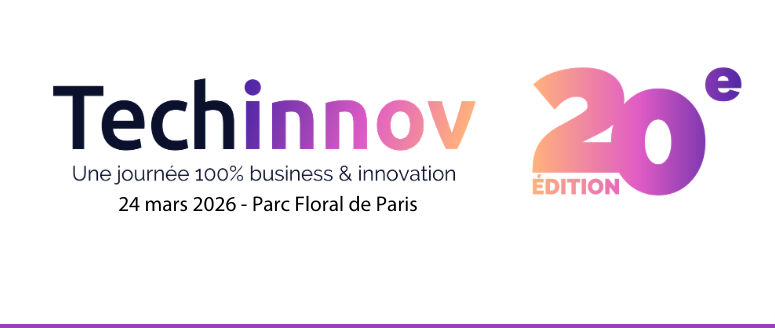
Meet hundreds of startups, corporations, and investors at the Techinnov event, the business convention organized by the CCI Essonne and Paris Île-de-France, on March 24, 2026, at the Parc Floral in Paris.
Tech Talk
👓🎮 French mixed reality startup Lynx has been placed into judicial liquidation. The news comes just weeks after CEO Stan Larroque was hyping the upcoming Lynx-R2 headset in January, a more powerful, open, enterprise-focused device pitched as a sovereign alternative to Big Tech. Despite raising several million euros and anchoring the €8M EU-backed XR2Industry project, the company was running on fumes, with near-zero cash and a heavy debt load, according to its most recent annual reports. The failure also leaves a gap at the heart of XR2Industry, a project built around Lynx’s technology that now faces an uncertain future. | BODACC
🏃👋 Fluidstack has apparently decided that France’s AI ambitions are nice in theory, but the real money is still across the Atlantic. The London-based “neocloud” darling has walked away from not one but two headline-grabbing French data center projects, including a €10 billion flagship El Presidente Macron once proudly touted, according to Bloomberg. Instead, it’s chasing massive U.S. deals, where power, customers, and contracts seem to materialize with far less friction. The move is a not-so-polite way of saying Europe’s AI buildout still struggles to turn big announcements into actual infrastructure. | Bloomberg
🇪🇺 🚀 Meanwhile, Brussels finally dropped its long-awaited “EU Inc” framework. The unified startup status is meant to make scaling across Europe less of a legal nightmare. The ecosystem says “finally”… but also “not enough” as the gap with the US remains stubbornly wide. The new regime would let founders launch a company in 48 hours, fully online, for under €100, sidestepping the usual 27-country legal maze. The pitch is less paperwork, more scaling, and maybe – just maybe – some European tech champions to rival the US and China. Not everyone’s cheering. Critics warn of lighter oversight, fuzzy legal enforcement (“27 flavors” of interpretation, anyone?), and potential pressure on workers’ rights. Of course, others worry that it doesn't go far enough to actually address the underlying issues. What, you thought everyone would suddenly be dancing a jig? Please. | France 24, Les Echos
💸 🌱 Speaking of Europe, the EU’s flagship greentech funding vehicle is looking…slightly wilted. Launched in 2020 with a headline-grabbing €40B budget, the European Union’s Innovation Fund has so far deployed less than 1% of its budget. According to the party people known as the European Court of Auditors, just €332M has been spent over five years, with only 5 of 208 projects reporting emissions reductions. Blame volatile carbon markets, slow processes, and a strategy that seems to pivot faster than it plans. Europe wants to lead the climate race, but at this pace, it might still be tying its shoelaces. | Les Echos
⚡ 💶 Greentech Electra is speeding along in the EV charging market. Despite being one of France’s best-funded EV startups, Electra has kept a low profile on its finances – until now. The Next40 startup, led by Aurélien de Meaux, reported €136.4M in revenue for 2024, up 74% from 2023, with a net profit of €22M. About a third of its sales come from international markets. Looking ahead, the company expects €130–150M in revenue for 2026. Last year, Electra helped launch ChargeLeague, a new pan-European startup alliance that includes Fastned, Ionity, and Atlante. The alliance offers drivers a single app to charge their electric vehicles anywhere in Europe. | Les Echos
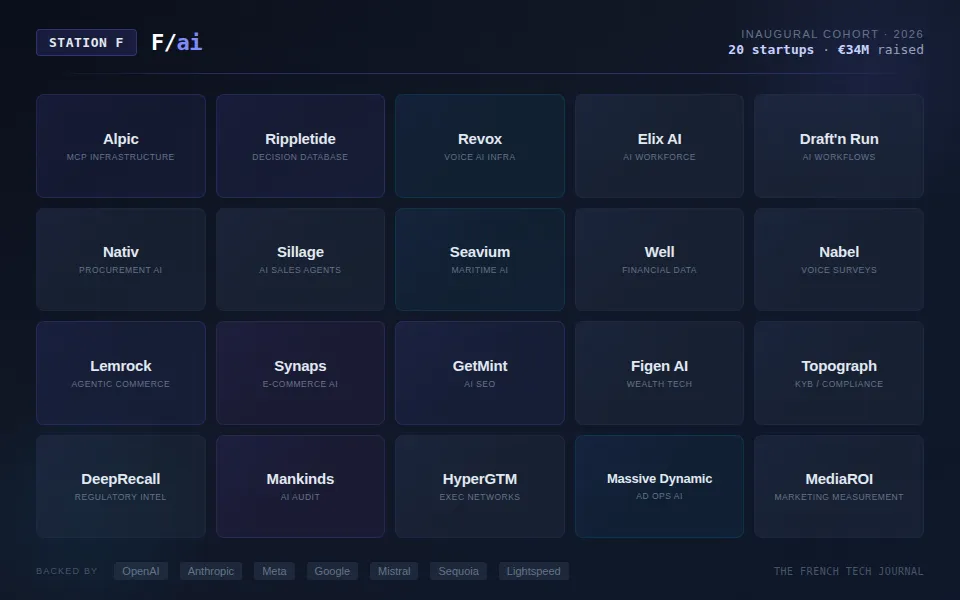
👩💻 🏆 The Margaret Awards are back, and this year’s finalists are serving a strong dose of AI-powered ambition. Backed by Nobel laureate Philippe Aghion, the 2026 cohort spotlights six women building everything from clinical AI assistants (shoutout Nabla) to next-gen “agentic commerce” via Lemrock. Winners will be crowned April 9 in Paris, with a €1M acceleration package on the line plus mentorship, access to funding, and serious visibility. | Maddyness
🧑⚕️🤖 Speaking of tech power au féminin, French healthtech startup Nabla has a new leader in France, and she’s anything but your typical startup operator.” Former civil servant and ENA graduate Laurie Soffiati is stepping in to lead Nabla’s French expansion, replacing cofounder Alexandre Lebrun (now off building with Yann LeCun). Her mission is to crack the notoriously complex French healthcare system and bring Nabla’s AI-powered consultation assistant to more hospitals. With 97% of its 100,000 users currently in the US, Nabla is essentially sending in a policy-savvy insider to unlock France. Less “move fast and break things,” more “navigate bureaucracy and actually get adopted.” | Les Echos
🎮 📰 Alexandre Yazdi is levelling up from mobile gaming to media mogul. The boss of Voodoo is in exclusive talks to take a majority stake in DC Company, the group behind youth media darling Konbini and satire king Le Gorafi. After snapping up BeReal for €500M, Yazdi is clearly building a Gen Z attention empire that embraces gaming, social, and now content. With 8 billion views already under DC Company’s belt, the play would mix Voodoo’s product chops with media firepower and see what happens. | AFP
🏝️ 💼 Meanwhile, another well-known entrepreneur, Anthony Bourbon, is packing up his holdings and heading to Greece. He's trading France for sunnier skies, lighter taxes, and more security amid rising concerns in the crypto/investor scene. It's a slightly unusual move (Luxembourg is usually the go-to), but one that quietly reflects a broader itch among founders to look beyond France. Not quite an exodus…but definitely a signal. This comes shortly after his foodtech startup Feed was forced to pay a fine and rebrand to O.K.R following a trademark dispute with American company TheFeed. A French court ruled against Bourbon’s company for counterfeiting. Extra motivation? Maybe, but, on ne va pas en faire tout un feta. | Les Echos
☁️ 🇪🇺 OVHcloud joins the e-euro project. The French cloud giant has been tapped to provide EU-based infrastructure for the European Central Bank’s digital euro, or e-euro. The move is aimed at keeping payments both digital and sovereign. As cash use declines and private solutions dominate, the e-euro is designed to safeguard Europe’s financial independence. OVHcloud will handle part of the backbone, while other providers, such as Senacor Technologies, manage secure payment exchanges. The rollout is gradual: tests start in 2027, with a potential launch in 2029. The price tag is about €1.3B to build, plus €320M per year to run. It hinges on Europe agreeing on the legal framework for the e-euro. | Usine Digitale
France’s Deeptech Startups Raise €4.1B As Sovereign Tech Rises But Seed Funding Stalls
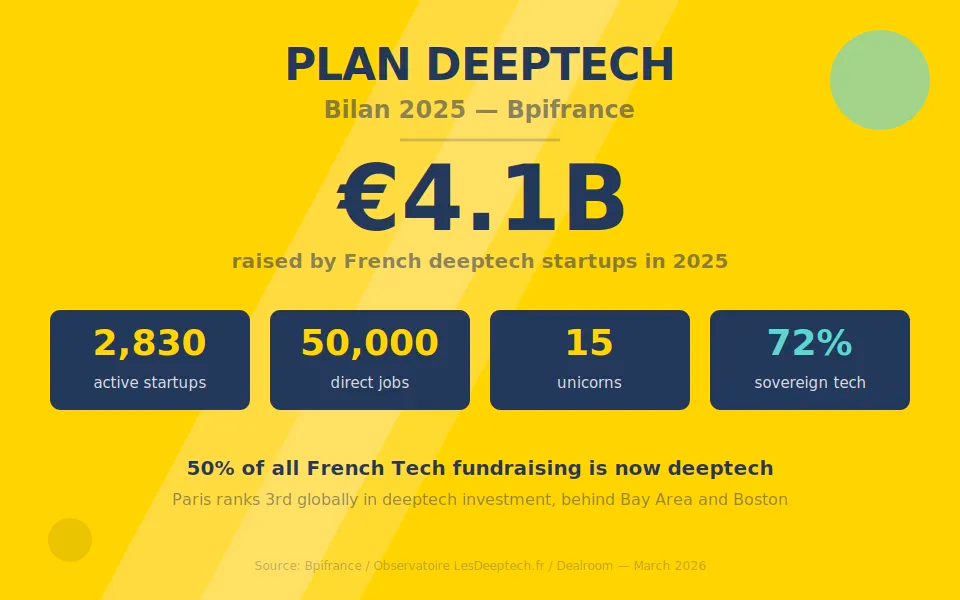
Seven years into France's Plan Deeptech, the numbers tell a story of steady, almost stubborn, growth.
In 2025, France's deeptech startups raised a record €4.1 billion. That's four times what they pulled in when the plan launched in 2019, and now represents about half of all French Tech fundraising.
Some 410 new deeptech startups were created during the year, more than double the 178 created in 2018. The ecosystem now counts 2,830 active startups generating €5.4 billion in annual revenue and employing 50,000 people directly, according to Bpifrance.
"Seven years — that's starting to be the age of reason," Paul-François Fournier, Bpifrance's executive director for innovation, told journalists at a press conference launching the report. "This is no longer anecdotal. It's a real ecosystem."
Partech's €300M Impact Fund Signals a New Phase for European Growth Investing
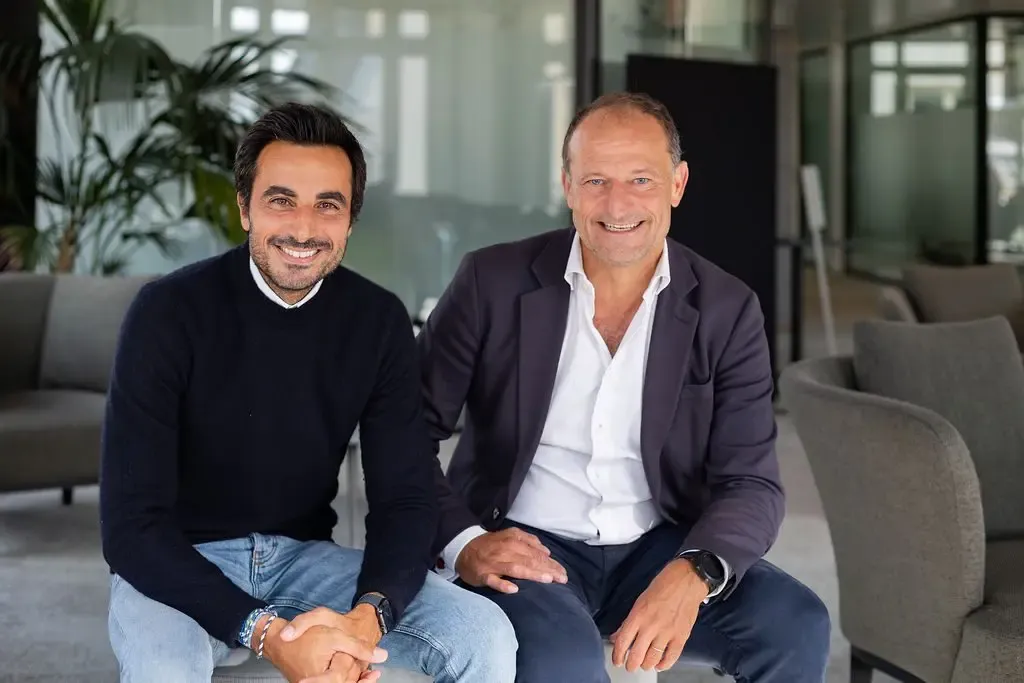
When Partech announced the final close of its inaugural Impact Fund at €300 million this week, the headline number was impressive enough.
But what makes this story worth paying attention to isn't just the size of the check. It's what it reveals about a structural shift happening beneath the surface of European tech investing.
For years, impact investing in Europe has been overwhelmingly an early-stage game. By Partech's own count, there are more than 200 early-stage impact funds operating across the continent, most of them either focused on a single theme across multiple countries or spread across multiple themes within a single market. At the other end, a handful of large US buyout funds occasionally dip into the category.
In between? Not much.
That's the gap Partech is targeting. It's a gap that says something important about where European tech is right now.
"We are at the same level as digital was 10 to 15 years ago, and we are at the beginning of the curve," said Rémi Said, General Partner at Partech.
According to Said, the fund's pipeline includes more than 6,000 companies, from which the team needs to select just 15 investments. The ratio suggests that the supply of commercially mature impact-tech companies in Europe is far larger than the available pool of growth capital designed to serve them.
AMI: Breaking Down Europe’s Record Seed Round

The $1.03 billion Seed Round raised last week by Yann LeCun’s Paris-based Advanced Machine Intelligence (AMI) was a European record. But a series of recent administrative filings by the company reveal additional details about this extraordinary round.
💸 Top Funding Deals 💸
📇 Company: Parallel
🏷️ Sectors: HealthTech, AI
🔍 Description: Parallel develops AI agents that automate administrative workflows in hospitals, starting with medical coding and expanding to billing and admissions, integrating directly into hospital software systems.
📍 HQ City: Paris
🧗 Round: Series A
💰 Amount Raised: $20M
🏦 Investors: Index Ventures (lead), Frst, Y Combinator, Hexa, Arthur Mensch (Mistral AI), Félix Blossier (Pennylane), Quentin de Metz (Pennylane), other business angels
👨💼👩💼 Founders: Paul Lafforgue, Thomas Sohet
🗞️ News: Parallel has raised $20M in Series A funding to scale its AI agents designed to automate administrative tasks in healthcare institutions. The round was led by Index Ventures, with participation from existing investor Frst, Y Combinator, Hexa, and several prominent angel investors, including Arthur Mensch (Mistral AI). Originally launched in 2023 as Kiosk, the company pivoted to healthcare in 2024 and now focuses first on medical coding—a critical, time-intensive process tied to 60–80% of hospital revenues. Its AI agents can be deployed within weeks, significantly faster than traditional software integrations. Already live in around 40 hospitals, Parallel plans to expand into billing and admissions workflows, grow its team by ~30 hires in 2026, and scale across Europe and the US. | Maddyness, Sifted, FrenchWeb, Tech EU
📇 Company: Lupin & Holmes
🏷️ Sectors: Cybersecurity, AI
🔍 Description: Lupin & Holmes develops Depi, a platform that maps real-world attack paths across software systems by analyzing how multiple vulnerabilities can be combined, shifting security from static detection to dynamic exploitation modeling.
📍 HQ City: Paris
🧗 Round: Pre-Seed
💰 Amount Raised: €5.4M
🏦 Investors: 20VC (lead), Seedcamp, Kima Ventures, Purple Ventures, various business angels
👨💼👩💼 Founders: Roni Carta
🗞️ News: Lupin & Holmes has raised €5.4M in pre-seed funding to build a new approach to cybersecurity focused on mapping attack paths rather than listing isolated vulnerabilities. Founded in 2023 by Roni Carta—a 23-year-old former top bug bounty hunter who earned ~$800K discovering vulnerabilities for companies like Google, Amazon, and Netflix—the startup brings a hacker-first perspective to security. Its platform, Depi, analyzes how vulnerabilities interact across complex systems (including dependencies, build chains, and configurations) to identify exploitable pathways. Already working with Fortune 500 companies and clients like Ledger, Lupin & Holmes plans to expand its team and invest heavily in R&D to further develop its attack-path intelligence platform. | FrenchWeb, Tech EU
📇 Company: Topograph
🏷️ Sectors: FinTech, RegTech, AI
🔍 Description: Topograph builds a real-time data infrastructure layer that connects directly to official company registries and transforms unstructured legal documents into standardized, traceable data for compliance workflows (KYB, AML, onboarding).
📍 HQ City: Paris
🧗 Round: Seed
💰 Amount Raised: €2M
🏦 Investors: Seedcamp, Kima Ventures, Motier Ventures, Better Angle, Drysdale Ventures
👨💼👩💼 Founders: Pierre-Henri Janssens, Emmanuel Scharff, Hugo Dellinger
🗞️ News: Topograph has raised €2M in seed funding to build a real-time infrastructure layer for accessing and structuring company registry data. Rather than relying on aggregated databases, the startup connects directly to official registers across jurisdictions and converts raw documents into standardized, API-accessible data. This approach enables financial institutions and fintechs to move from periodic compliance checks to continuous monitoring, improving data freshness, traceability, and reliability in KYB and AML processes. Positioned as an infrastructure provider rather than a front-end tool, Topograph integrates into existing compliance stacks to support use cases such as merchant onboarding, beneficial ownership verification, and regulatory monitoring. The company aims to progressively connect company registries globally. | FinTech Global
👋🏻 If you’re enjoying The French Tech Journal, support the project by forwarding it to friends and sharing it on your social networks. You can also comment on this post. And if you have ideas for stories, tips, or just want to harass us, shoot us an email: [email protected] / [email protected] 👋🏻