
Throughout August, we’re revisiting eight long-form FTJ articles from the past year whose themes continue to resonate. From AI and deeptech to sovereignty, cybersecurity and global scale, they explore the ideas, companies and debates shaping French Tech. We hope you enjoy revisiting them with us.
We first published this Digital Diplomats article in March 2025.
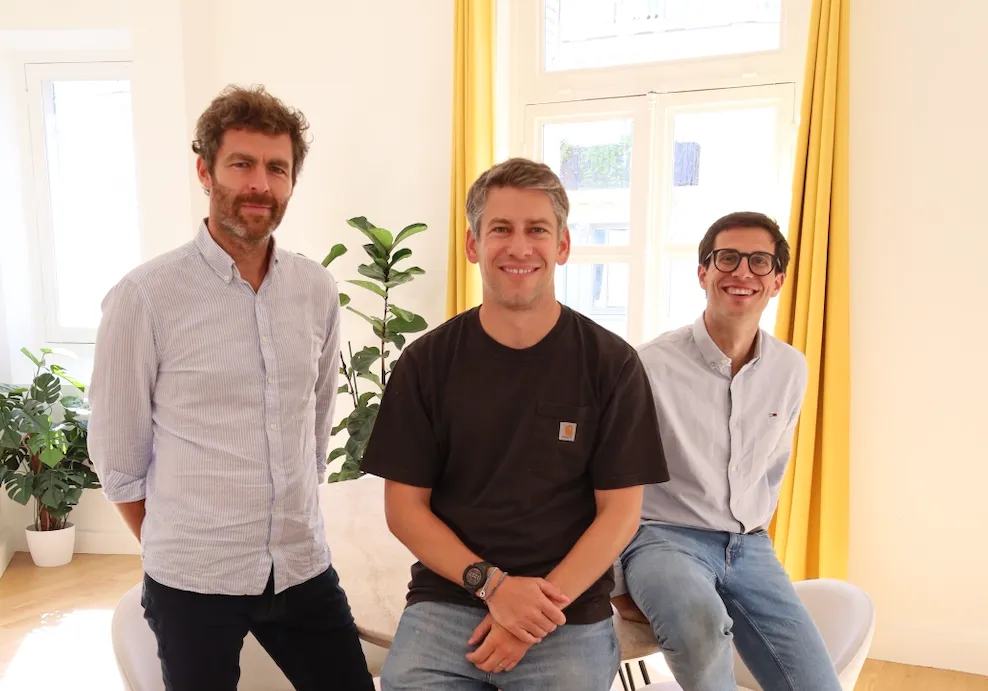
Co- authored by Marjolaine Catil, Newfund Investment Director and head of its "Road to the USA" initiative, and French Tech Journal Editor, Chris O'Brien, the article explores how AI productivity gains are enabling younger startups (founded after 2022) to reach 100$ million in revenue far faster than their older counterparts, with far fewer employees - and examines the impact this shift in Silicon Valley is having on French startups.
AI is Making Silicon Valley Startups Leaner and Meaner. Can French Founders Keep Up?
Chris O’Brien: Marjolaine, there’s something extraordinary happening right now in Silicon Valley with the conversation around the impact of AI on startups. We’ve seen a wave of ultra-lean AI startups in Silicon Valley hitting massive revenue milestones with minimal headcount. It’s become such a thing that even a mainstream publication like The New York Times is talking about it.
Marjolaine Catil: You’re right. Ultra-lean startup success is now a meme, with techies excitedly sharing lists that show how companies like Anysphere, a start-up that makes the coding software Cursor, hit $100 million in annual recurring revenue in less than two years with just 20 employees, and ElevenLabs, an A.I. voice start-up, did the same with around 50 workers.
When we look at the evolution of employees needed to reach $100M ARR, productivity gains have dramatically increased across distinct technological eras:
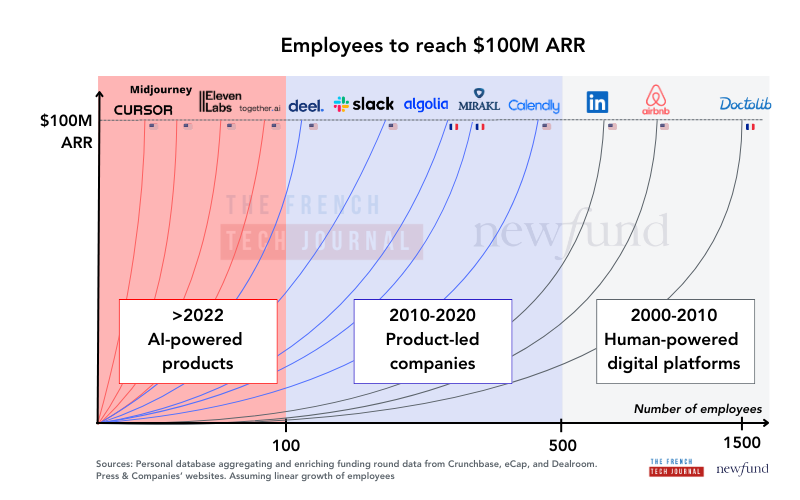
In the early 2000s, what we can call “human-powered platforms” like LinkedIn needed 900 employees and Shopify required over 600 to reach $100M ARR. These companies operated with traditional license/subscription models requiring large sales teams, extensive customer support, and substantial internal IT departments. Scaling meant linear headcount growth.
The 2010s with “product-led companies” brought some improvements - Slack and Algolia needed around 250 employees. The automations around the product reduced reliance on sales teams while cloud-based delivery decreased infrastructure headcount. However, scaling still required substantial personnel for more complex customer interactions.
What we're witnessing with “AI-powered startups” since 2022 completely rewrites the playbook. Today's leanest AI startups have 0.2 employees per million in ARR, versus 3-7 employees just a decade ago - that's a 15-25x efficiency improvement that fundamentally transforms venture economics...
👋🏻 If you’re enjoying The French Tech Journal, support the project by forwarding it to friends and sharing it on your social networks. You can also comment on this post. And if you have ideas for stories, tips, or just want to harass us, shoot us an email: chris@frenchtechjournal.com / helen@frenchtechjournal.com 👋🏻