Skip to content

Brevo’s €500M Deal Delivers Historic Liquidity Event for French Tech

Brevo’s €1bn valuation was driven by a PE-led growth buyout: General Atlantic and Oakley take 50%, Partech exits, and the cap table resets. It’s a landmark French-tech liquidity moment that gives Brevo powerful partners for U.S. expansion, bigger M&A, and AI-powered growth.

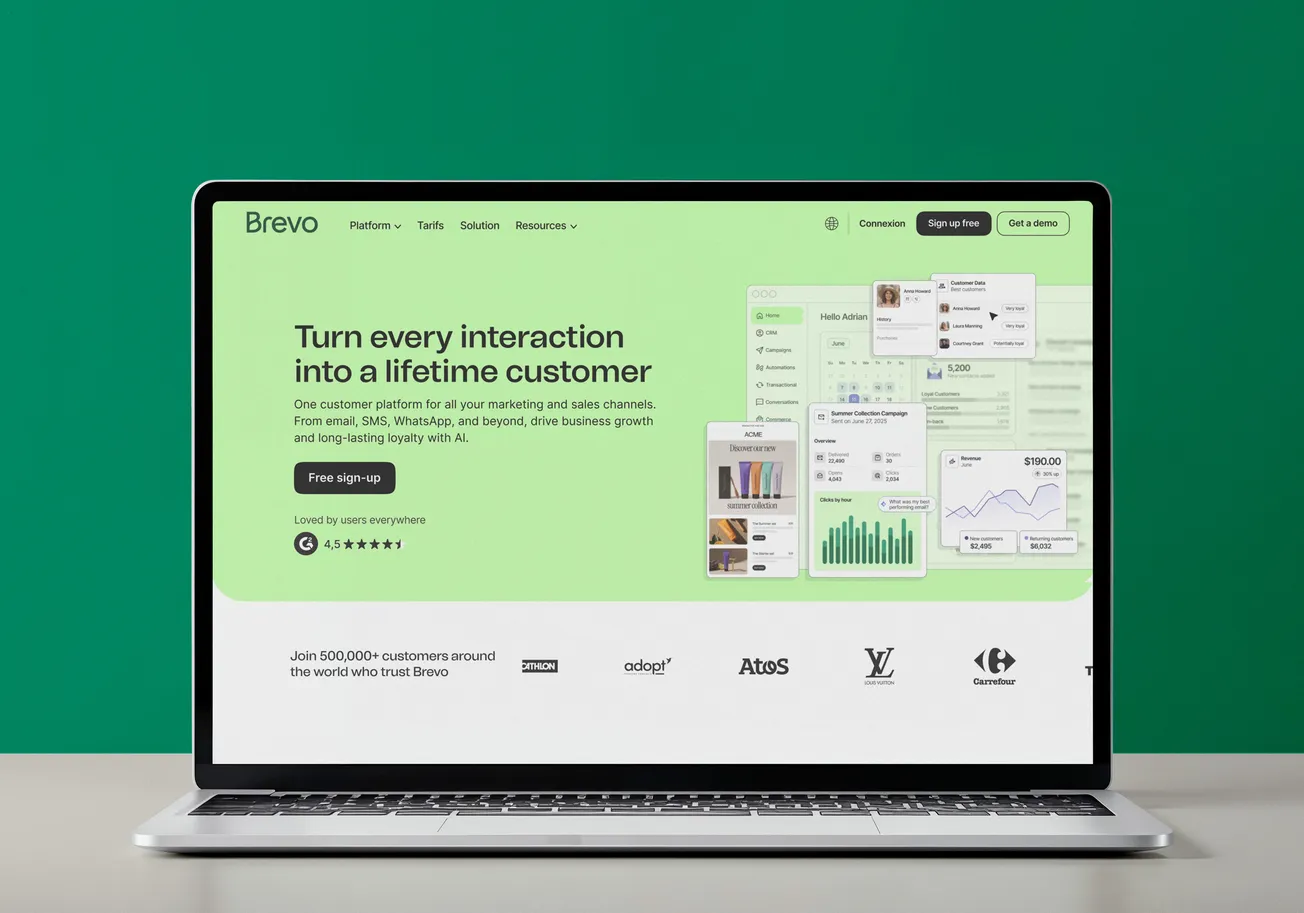
When Armand Thiberge founded Sendinblue in 2007, he was entering a crowded market for email marketing software dominated by American players like MailChimp.

Thirteen years later, the company—now rebranded as Brevo—has just completed a €500 million financing round that makes it France's newest unicorn while simultaneously reshuffling its shareholder base.

The transaction had French Tech boosters doing cartwheels and high fives across LinkedIn after it was announced on Thursday because nothing gets the juices flowing like another unicorn and a nine-figure funding round on a chilly December morning. Indeed, the news is certainly a remarkable achievement, but for reasons different from the ones being celebrated.

In this case, the actual transaction was closer to a Private Equity buyout than it was a fundraising, though its overall complexity and a fairly opaque press release did not help matters. The main goal seemed to be to highlight that the valuation of the deal pushed Brevo above €1 billion, which means it's officially a unicorn, for whatever that may be worth these days.

In reality, it's a Private Equity-led growth buyout structured as a primary + secondary cap-table reset.

Alas, a bit less meme-worthy.

Here's an attempt to explain that:

Two private firms, General Atlantic and Oakley Capital, each coughed up about €250 million, and each acquired 25% of Brevo. Which means they collectively own half of the company (in case you're too tired to do the math). In the press release and interviews, the company emphasized that management and employees remain the largest shareholders at 26%, but they are not the majority shareholders.

So where did that money go?

Some chunk of it went to buy the shares of Partech, one of the original investors, though it's unclear how much. (We'll come back to Partech later). Another chunk of it went to buy shares from two other historic shareholders: Bridgepoint and Bpifrances, who now both own less than they did before. In the case of Bridgepoint, the firm sold all the shares it had previously invested via an older fund (BDC III) in 2020 and then reinvested in Brevo through a new fund (Bridgepoint Development Capital V).

And then some amount (presumably) went to Brevo itself to do stuff like invest in product development, expansion, etc. a reference to debt likely confused

Just to add to the confusion: the deal came with access to a line of credit to facilitate potential M&A at some point. But the €500 million does not include debt. But a reference to debt likely confused at least one media outlet that referred to the deal as a "leveraged buyout," which it most definitely was not.

So, what is this?

In the Private Equity world, the answer to that question is pretty straightforward, and the PE-financial press has been reporting rumors of this potential deal for months:

Whatever one wants to call this, let's be clear about something: There is nothing wrong with any of this. It's all perfectly normal.

In fact, if one were to put this in the "exit" bucket rather than the "funding" bucket (which is probably where it really belongs), this is a historic moment. Based on a €1 billion valuation, it would be one of the largest liquidity events in French startup history.

As for VCs cycling through investments, also normal. See this story I wrote a few years ago about iBanFirst doing the same.

And the company is getting serious resources to fight on a global scale. So, no need to poop on anyone's parade here. But also, no need to pretend it's something it's not. It's a great outcome after almost 20 years.

Let's take a closer look at what it all means for Brevo.

From Sendinblue to Brevo

Brevo CEO and Founder Armand Thiberge

Brevo's journey reflects both the opportunities and challenges of building a tech company in Europe.

The company started as Sendinblue, competing in email marketing against entrenched American players. It has since evolved into what Thiberge describes as a "customer platform" offering customer relationship management, customer data platforms, and multi-channel communication capabilities.

The 2023 rebrand from Sendinblue to Brevo signaled the company's evolution beyond its email marketing origins. Today, the platform integrates marketing automation, CRM capabilities, SMS, WhatsApp, push notifications, and social CRM, positioning it as an alternative to both specialized point solutions and broader platforms like Salesforce.

The company serves businesses of all sizes but has historically been strongest among small and medium enterprises. Notably, 30% of its 600,000 customers are paying subscribers, with the remainder using free-tier services. Brevo crossed €200 million ARR in October, is profitable, and has more than 1,000 employees with offices in India, Paris, and Austin, Thiberge said.

So why now?

According to Thiberge, the timing of the deal was partly driven by shareholder agreement provisions.

"Our last fundraiser was in 2020, so we had that agreement with the shareholders to do another fundraising in 2025," he explained. "Some primary motivation was just a shareholder agreement to exit. Partech came in 2017, so they had to exit."

Beyond contractual obligations, the company sees strategic value in its new investor base. General Atlantic brings deep American market expertise, while Oakley Capital offers European expansion capabilities.

The geographic distribution of Brevo's revenue reveals why American expansion is such a priority. Thiberge said that 30% of its revenues is from France, 20% from Germany, and 15% from the US.

"So, the US is important, but not as important as it should be," he said. "We are growing there faster than any other country. For us, a priority is to be more international. General Atlantic is very well known, so they will help us to go bigger in the US. And Oakley Capital, they are German, but also headquartered in the UK. So we have a European and US shareholder pool."

To accelerate American growth, the company has hired a new Chief Revenue Officer based in Boston, with plans to invest more than €100 million in the US market through 2030.

As noted above, the finance includes access to debt, which will also fuel an aggressive acquisition strategy. Brevo has completed 11 acquisitions since its founding, but Thiberge signaled ambitions for larger deals ahead.

By the way, this is also a classic PE playbook. Such global firms have vast networks tracking larger numbers of potential acquisition targets, and because they have ready access to financing can help portfolio companies such as Brevo move quickly on strategic deals.

"Historically, we have done a lot of M&A, but now we want to accelerate and do more and bigger M&A," Thiberge said. "We have this goal to reach one billion in revenue in 2030. That will mostly be organic, but a part of it will also be inorganic. So the idea would be to buy some competitors."

Simultaneously, the company is investing heavily in artificial intelligence integration. Brevo announced a €50 million AI investment initiative earlier in 2025 and has already deployed AI-powered features, including sales agents and a connector that links its platform to AI assistants like Claude, ChatGPT, and Mistral's Le Chat.

He cited practical applications: automated follow-up emails after sales calls, contact enrichment using AI to better understand prospect profiles, and enhanced lead scoring capabilities that give sales teams more time for direct customer engagement.

"AI is changing the game and how we build a product," Thiberge said. "It's a mix between regular UI and also prompting. I don't believe that prompting will completely replace [traditional interfaces]. It's very slow to prompt everything. So UI is still important."

Au Revoir, Partech

In resetting the cap table, the most significant departure is Partech, which had been Brevo's lead investor since 2017 and is now completely exiting its stake.

André François-Poncet, a partner at Partech who led the original investment, described the exit as part of a deliberate strategy. He characterized the transaction as emblematic of a healthy market functioning.

"This is something that typically takes place as part of long-term value creation and natural rotation of capital that needs to happen for long-term company building," he explained.

François-Poncet declined to disclose Partech's return on its investment. But coming in at the Series A stage eight years ago and exiting at a unicorn valuation, it's safe to assume that Partech's returns on the investment were...better than ok.

But still, given that the liquidity portion of this deal was (inevitably) going to get less attention, I asked François-Poncet if there were any larger lessons for European startups to take from this outcome. With IPO markets choppy and mega-acquisitions by American tech giants facing increased regulatory scrutiny, structured PE buyouts like Brevo's may offer a template for others.

In this case, François-Poncet said the particular details were driven by the specific circumstances of the companies and the mix of shareholders.

That said, other entrepreneurs need to understand that the benefits go beyond just shuffling some money around. There were important benefits for maturing companies such as Brevo, he said.

"We believe that enabling rotation of the cap table is paramount because it enables the entrepreneurs, the managers at the helm of the company, to reset the clock and have all shareholders aligned on a new horizon that is beneficial for the company," he said.

That includes signaling value for employees holding equity. Because it had been several years since Brevo last raised funding, valuing options for new employees could be theoretical. Now, as it chases top talent in markets such as the U.S., it can point to a valuation set by A-list investors.

"It enables the company to show that the stock is a really valuable security," he said.

Building Global Champions From Europe

The transaction comes at a moment of anxiety about European tech competitiveness. Debates rage about whether the continent can produce global technology champions, or whether its best companies will inevitably be acquired by American giants or see their talent drain to Silicon Valley.

François-Poncet sees Brevo's trajectory as a counterpoint to such pessimism. The two PE firms are placing big bets that Brevo can be the foundation of a much larger company with Thiberge still at the helm.

"It has grown into a global category leader from Europe, built in Europe," he said. "They have an immense runway to continue building. I think it's a positive message to deliver at this point in the current context that we have in Europe with so much pessimism."

For Brevo, the message is simpler. With fresh capital, new strategic partners, and a consolidated ownership structure, the company is positioning itself for what Thiberge hopes will be a decade of continued expansion, proving that European software companies can compete on the global stage.

"Our ambition remains unchanged: to build a global European CRM leader capable of competing with US players through product excellence," Thiberge said.

Comments

Latest

French Tech Funding Wire December 1: 400 RetailTech Startups; Pennylane Funding Rumors; €131M Raised In 15 Rounds

French Tech Funding Wire December 1: 400 RetailTech Startups; Pennylane Funding Rumors; €131M Raised In 15 Rounds

Between Nov 24 and Nov 28, French Tech startups raising VC included Zadient Technologies, AFYREN, Lexip (formerly Pixminds), Water Horizon, Damae Medical, VESTO, Alkion BioInnovations, Ventuno Biotech, Sim&Cure, AURA AERO, Komia, AberActives, Drive Innov, VoilaChef, AlgenScribe, and IvySpec.

Members Public